
General Instructions :
Read the following instructions very carefully and strictly follow them:
| (i) | This question paper contains 38 questions. All questions are compulsory. |
| (ii) | This question paper is divided into five Sections – A, B, C, D and E. |
| (iii) | In Section A, Questions no. 1 to 18 are Multiple Choice Questions (MCQs) and questions number 19 and 20 are Assertion-Reason based questions of 1 mark each. |
| (iv) | In Section B, Questions no. 21 to 25 are Very Short Answer (VSA) type questions, carrying 2 marks each. |
| (v) | In Section C, Questions no. 26 to 31 are Short Answer (SA) type questions, carrying 3 marks each. |
| (vi) | In Section D, Questions no. 32 to 35 are Long Answer (LA) type questions carrying 5 marks each. |
| (vii) | In Section E, Questions no. 36 to 38 are case study based questions carrying 4 marks each. Internal choice is provided in 2 marks questions in each case study. |
| (viii) | There is no overall choice. However, an internal choice has been provided in 2 questions in Section B, 2 questions in Section C, 2 questions in Section D and 3 questions in Section E. |
| (ix) | Draw neat diagrams wherever required. Take $pi = frac{22}{7}$ wherever required, if not stated. |
| (x) | Use of calculator is not allowed. |
SECTION A
This section has 20 Multiple Choice Questions (MCQs) carrying 1 mark each.
(20x1 = 20)
The exponent of 3 in the prime factorization of 2025 is :
If $2024x + 2025y = 1$ and $2025x + 2024y = -1$, then the value of $(x - y)$ is :
The number of polynomials having $-2$ and $5$ as their zeroes is :
Which of the following is not a quadratic equation?
The value of $x$ for which $2x$, $(x + 10)$ and $(3x + 2)$ are the three consecutive terms of an A.P. is :
If $1 + 2 + 3 + 4 + \dots + 50 = 25k$, then $k =$ :
The distance between the points $(\cos 30^\circ, \sin 30^\circ)$ and $(\cos 60^\circ, -\sin 60^\circ)$ is :
The coordinates of the point which is the reflection (mirror image) of the point $(-3, 5)$ across the x-axis are :
If in $\Delta ABC$ and $\Delta DEF$, $\frac{AB}{DE} = \frac{BC}{FD}$, then they will be similar when :
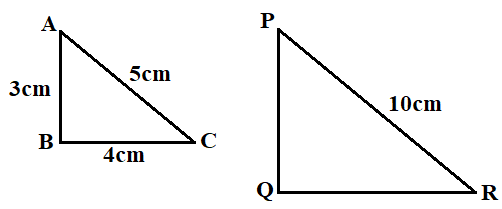
If $\Delta ABC \sim \Delta PQR$ with $AB = 6\text{ cm}, BC = 4\text{ cm}, AC = 8\text{ cm}$ and $PQ = 9\text{ cm}$, as shown in the figures below, then the perimeter of $\Delta PQR$ is :
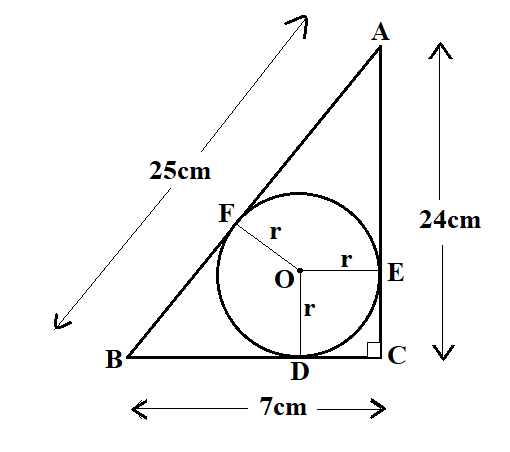
In the figure given below, radius $r$ of the incircle touching the sides of right-angled triangle $ABC$ (right-angled at $B$ with $AB = 6\text{ cm}$ and $BC = 8\text{ cm}$) is :
Which one of the following expressions is not equal to Unity (1)?
For the frequency distribution with classes $0-10, 10-20, 20-30, 30-40, 40-50$ having frequencies $5, 8, 12, 10, 5$, the median class is :
The empirical relationship connecting the three measures of central tendency is :
From an external point $Q$, the length of the tangent to a circle is $24\text{ cm}$ and the distance of $Q$ from the centre is $25\text{ cm}$. The radius of the circle is :
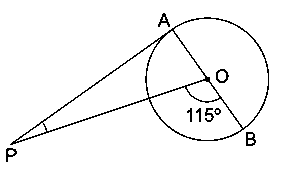
In the given figure, $PA$ and $PB$ are tangents from an external point $P$ to a circle with centre $O$. If $\angle APB = 80^\circ$, then $\angle AOB$ is equal to :
The circumferences of two circles are in the ratio $3 : 4$. The ratio of their areas is :
An event is most unlikely to happen. Its probability is closest to :
Assertion (A): The line segment joining the midpoints of any two sides of a triangle is parallel to the third side and is half of it.
Reason (R): In a triangle, a line drawn parallel to one side dividing the other two sides in the same ratio is the Basic Proportionality Theorem.
Assertion (A): Two coins are tossed simultaneously. The possible outcomes are two heads, two tails, or one of each. Therefore, the probability of each outcome is $\frac{1}{3}$.
Reason (R): The probability of an event $E$ is given by $P(E) = \frac{\text{Number of favourable outcomes}}{\text{Total number of possible outcomes}}$, provided all outcomes are equally likely.
SECTION B
This section has 5 Very Short Answer (VSA) type questions carrying 2 marks each.
(5x2 = 10)
(A) Show that the number $2 \times 5 \times 7 \times 11 + 11 \times 13$ is a composite number.
OR
(B) Find the HCF and LCM of 72 and 120 using prime factorisation method.
[2 marks]
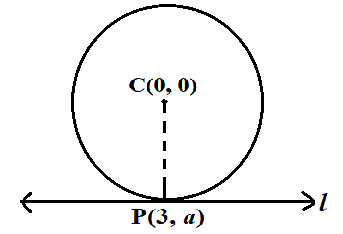
Find the value of $a$ if the point $P(3, a)$ lies on the line given by $x + y = 5$, and hence find the distance of point $P$ from the origin.
[2 marks]
If $\sin\theta = \frac{1}{2}$, find the value of $(3\cos\theta - 4\cos^3\theta)$.
[2 marks]
Find the discriminant and determine the nature of the roots of the quadratic equation $x^2 + 4x - 3\sqrt{2} = 0$.
[2 marks]
(A) Evaluate: $2\sin 30^\circ\tan 60^\circ - 3\cos^2 60^\circ\sec^2 30^\circ$.
OR
(B) Prove that: $\frac{\sin\theta}{1 + \cos\theta} + \frac{1 + \cos\theta}{\sin\theta} = 2\csc\theta$.
[2 marks]
SECTION C
This section has 6 Short Answer (SA) type questions carrying 3 marks each.
(6x3 = 18)
Show that $(\sqrt{2} - \sqrt{5})$ is an irrational number.
[3 marks]
Find the mean of the following frequency distribution of agricultural land holdings of families in a village :
| Area of land (in hectares) | 1–3 | 3–5 | 5–7 | 7–9 | 9–11 |
|---|---|---|---|---|---|
| Number of families | 20 | 45 | 80 | 55 | 40 |
[3 marks]
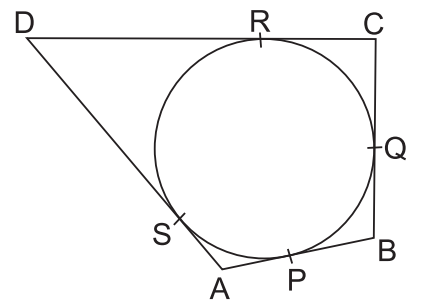
A quadrilateral $ABCD$ is drawn to circumscribe a circle, as shown in the figure below. Prove that $AB + CD = AD + BC$.
[3 marks]
A card is drawn at random from a well-shuffled pack of 52 playing cards. Find the probability of getting :
(i) a black face card
(ii) a red jack
(iii) a spade or an ace.
[3 marks]
Find the coordinates of the points of trisection of the line segment joining the points $A(2, -2)$ and $B(-7, 4)$.
[3 marks]
If the sum of the first $n$ terms of an A.P. is given by $S_n = 5n^2 - n$, find the $n^{\text{th}}$ term and hence find its $20^{\text{th}}$ term.
[3 marks]
SECTION D
This section has 4 Long Answer (LA) type questions carrying 5 marks each.
(4x5 = 20)
State and prove Basic Proportionality Theorem.
[5 marks]
(A) The numerator of a fraction is 3 less than its denominator. If 2 is added to both the numerator and the denominator, the new fraction becomes $\frac{2}{3}$. Find the original fraction.
OR
(B) The sum of the digits of a two-digit number is 9. Also, nine times this number is twice the number obtained by reversing the order of the digits. Find the number.
[5 marks]
(A) The angle of elevation of the top of a chimney from the foot of a tower is $60^\circ$ and the angle of elevation of the top of the tower from the foot of the chimney is $30^\circ$, as illustrated in the figure below. If the tower is $40\text{ m}$ high, find the height of the chimney. $(\text{Take } \sqrt{3} = 1.732)$
OR
(B) Two poles of equal heights are standing opposite each other on either side of a road, which is $80\text{ m}$ wide. From a point between them on the road, the angles of elevation of the top of the poles are $60^\circ$ and $30^\circ$ respectively. Find the height of the poles and the distances of the point from the poles.
[5 marks]
A solid toy is in the form of a hemisphere surmounted by a right circular cone of the same radius, as shown in the figure below. The height of the cone is $2\text{ cm}$ and the diameter of the base is $4\text{ cm}$. Determine the volume of the toy. If a right circular cylinder circumscribes the toy, find the difference of the volumes of the cylinder and the toy. $(\text{Take } \pi = 3.14)$

[5 marks]
SECTION E
This section has 3 Case Study Based questions carrying 4 marks each.
(3x4 = 12)
CASE STUDY 1
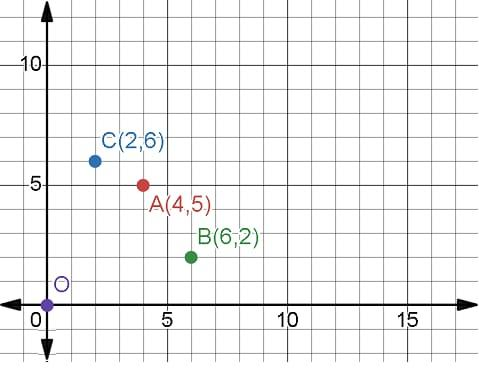
Carpooling is the sharing of car journeys so that more than one person travels in a car, reducing air pollution and travel costs. Three friends Amar, Bhavin and Chetanya live in housing societies located at points $A(1, 2)$, $B(4, 6)$ and $C(k, 2)$ on a coordinate map where each grid unit represents $1\text{ km}$, as shown in the grid below :
Based on the above information, answer the following questions :
(i) Find the distance between Amar's society $A$ and Bhavin's society $B$. [1 mark]
(ii) If the point $M$ is the midpoint of $AB$, find the coordinates of $M$. [1 mark]
(iii) (a) If the distance between Amar's society $A(1, 2)$ and Chetanya's society $C(k, 2)$ is $6\text{ km}$ ($k > 1$), find the value of $k$ and calculate the area of $\Delta ABC$. [2 marks]
OR
(iii) (b) Check whether points $A, B$ and $C$ can lie on the same straight line when $k = 7$. [2 marks]
CASE STUDY 2
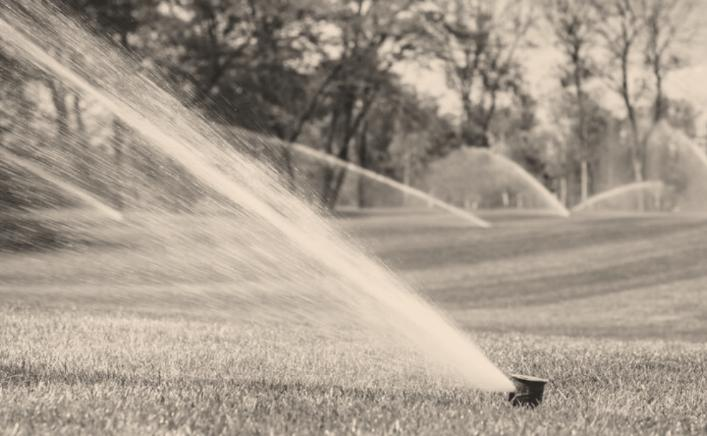
A water sprinkler is a device used to irrigate agricultural crops and lawns. A sprinkler rotates through an angle of $120^\circ$ and shoots a stream of water up to a distance of $21\text{ metres}$, as shown in the diagram below :
Based on the above information, answer the following questions :
(i) Name the geometrical shape formed by the area covered by the water spray. [1 mark]
(ii) Find the length of the outer circular boundary irrigated by the sprinkler stream. [1 mark]
(iii) (a) Calculate the total surface area of the field that is watered by the sprinkler in one rotation sweep. $\left[\text{Take } \pi = \frac{22}{7}\right]$ [2 marks]
OR
(iii) (b) If the spray radius is increased to $28\text{ metres}$ while keeping the rotation angle same, find the additional area irrigated. [2 marks]
CASE STUDY 3
In a blood donation camp organized at a general hospital, 100 voluntary donors were tested for their blood groups. The percentage distribution of donors across the four major blood types $A, B, O$ and $AB$ is given in the chart and table below :

| Blood Group | A | B | O | AB |
|---|---|---|---|---|
| Number of Donors | 30 | 32 | x | 4 |
Based on the above information, answer the following questions :
(i) Find the value of $x$ (donors with blood group O). [1 mark]
(ii) If a donor is selected at random, find the probability that the donor has blood group AB. [1 mark]
(iii) (a) Find the probability that a randomly chosen donor does not have blood group A. [2 marks]
OR
(iii) (b) Find the probability that a randomly chosen donor is a universal donor (Blood Group O) or universal recipient (Blood Group AB). [2 marks]