
General Instructions : Read the following instructions very carefully and strictly follow them :
(i) This question paper comprises 39 questions. All questions are compulsory.
(ii) This question paper is divided into five sections – A, B, C, D and E.
(iii) Section A – Questions No. 1 to 20 are Multiple Choice Questions. Each question carries 1 mark.
(iv) Section B – Questions No. 21 to 26 are Very Short Answer type questions. Each question carries 2 marks. Answer to these questions should be in the range of 30 to 50 words.
(v) Section C – Questions No. 27 to 33 are Short Answer type questions. Each question carries 3 marks. Answer to these questions should be in the range of 50 to 80 words.
(vi) Section D – Questions No. 34 to 36 are Long Answer type questions. Each question carries 5 marks. Answer to these questions should be in the range of 80 to 120 words.
(vii) Section E – Questions No. 37 to 39 are 3 source-based/case-based units of assessment carrying 4 marks each with sub-parts.
(viii) There is no overall choice. However, an internal choice has been provided in some sections. Only one of the alternatives has to be attempted in such questions.
SECTION A
Select and write the most appropriate option out of the four options given for each of the questions no. 1 to 16. There is no negative marking for incorrect response.
Which structure in a leaf is mainly responsible for gaseous exchange during photosynthesis and respiration?
Identify the mode of asexual reproduction where a single parent organism divides into two approximately equal-sized daughter cells:
Organisms that undergo asexual reproduction produce offspring with very little genetic variation because :
Human brain has various specialized regions. Identify the part responsible for maintaining posture, equilibrium, and precision of voluntary actions :
Pancreas secretes pancreatic juice which contains digestive enzymes. Choose the correct statement regarding their respective functions :
Which of the following biological processes require cellular energy in the form of ATP?
(i) Gaseous diffusion in alveoli
(ii) Active uptake of mineral ions by root hair cells
(iii) Translocation of sucrose in phloem sieve tubes
Which of the following groups contains only non-biodegradable waste materials?
Consider the two reactions :
(i) $BaCl_2(aq) + Na_2SO_4(aq) \rightarrow BaSO_4(s) + 2NaCl(aq)$
(ii) $Pb(NO_3)_2(aq) + 2KI(aq) \rightarrow PbI_2(s) + 2KNO_3(aq)$
Both reactions can be classified as :
Which of the following substances can function as an olfactory indicator to detect acidic and basic solutions?
When dry lead nitrate crystals are heated strongly in a dry test tube, the gases evolved are :
The characteristic functional group present in the homologous series of aldehydes is :
Which of the following metals does not react with either cold water or hot water, but reacts only with steam to liberate hydrogen gas?
Identify the correct matching of natural organic acids with their natural sources :
A piece of metal X reacts with water less violently than sodium, and the bubbles of hydrogen gas produced stick to the surface of the metal causing it to float. Metal X is :
An object is placed in front of a thin convex lens of focal length $15\text{ cm}$ such that a real, inverted image of the same size as the object is formed on the other side. The positions of the object and the image from the optical centre of the lens are :
When you are looking at a nearby object like a book held in your hand, what changes occur in your eye lens and ciliary muscles?
For Questions number 17 to 20, two statements are given — one labelled as Assertion (A) and the other labelled as Reason (R). Select the correct answer to these questions from the codes (A), (B), (C) and (D) as given below.
Assertion (A): The muscular walls of ventricles are significantly thicker than those of the atria.
Reason (R): Ventricles have to pump blood with higher pressure into distant organs across systemic and pulmonary circuits.
Assertion (A): In human beings, the biological sex of the child is genetically determined by the father.
Reason (R): Human males are heterogametic and possess an XY sex chromosome pair, while human females possess XX chromosomes.
Assertion (A): Covalent compounds are generally poor conductors of electricity.
Reason (R): Covalent molecules are formed by mutual sharing of electrons and do not contain free ions or charged particles.
Assertion (A): The emergent ray from a rectangular glass slab is parallel to the incident ray but displaced laterally.
Reason (R): The extent of bending of the ray of light at the opposite parallel surfaces of the rectangular glass slab is equal and opposite.
SECTION B
Questions no. 21 to 26 are Very Short Answer Type questions carrying 2 marks each.
State the primary mechanical function of the diaphragm in the human respiratory system and describe its anatomical position.
[2 marks]
(a) Differentiate between chewing of food and salivation on the basis of conscious control.
(b) Name the parts of the human brain that control involuntary actions like blood pressure and salivation.
[2 marks]
(a) What are amphoteric oxides? Give one balanced chemical reaction to demonstrate amphoteric behavior.
(b) Classify $Na_2O$, $ZnO$, and $CO_2$ into basic, amphoteric, and acidic oxides.
[2 marks]
(a) In the reaction $ZnO + C \rightarrow Zn + CO$, identify the substance oxidised and the substance reduced.
(b) Write a balanced chemical equation for the precipitation reaction between lead nitrate and potassium iodide solutions.
[2 marks]
A real and inverted image of an illuminated needle is formed by a convex lens at a distance of $30\text{ cm}$ from the lens. If the image formed is twice the size of the needle, determine the focal length of the lens and the position of the object.
[2 marks]
(A) A cylindrical metal wire of length $1\text{ cm}$ and circular radius $0.01\text{ cm}$ has a resistance of $7\,\Omega$. Calculate the resistivity of the material of the wire.
OR
(B) An electric heater draws a current of $11\text{ A}$ from a $220\text{ V}$ power source. Calculate its electrical resistance and power rating.
[2 marks]
SECTION C
Questions no. 27 to 33 are Short Answer Type questions carrying 3 marks each.
Observe the diagram of the female reproductive part of a flower (carpels/pistil) shown below and answer the following questions :
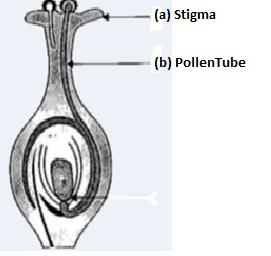
(a) Identify parts A and B.
(b) Describe the role of part B during pollination and fertilization.
[3 marks]
Explain Mendel's law of independent assortment with the help of a standard dihybrid cross involving round yellow ($RRYY$) and wrinkled green ($rryy$) pea seeds. State the phenotypic ratio observed in the $F_2$ generation.
[3 marks]
Differentiate between consumers and decomposers in an ecological trophic web. Give two points of difference and state the ecological consequences if all decomposers were eliminated from a forest ecosystem.
[3 marks]
(a) Name the industrial process used for the manufacturing of sodium hydroxide from brine solution.
(b) Name the gases liberated at the anode and the cathode during this process.
(c) Write the chemical equation for the reaction of chlorine gas with dry slaked lime to manufacture bleaching powder.
[3 marks]
Differentiate between Roasting and Calcination in metallurgy with balanced chemical equations for zinc blende ($ZnS$) and calamine ($ZnCO_3$). Why are sulphide and carbonate ores converted into oxides before reduction?
[3 marks]
(a) A person can see distant objects clearly but cannot read a textbook comfortably without holding it far away. Name the visual defect and state two causes.
(b) Illustrate with a neat ray diagram the defect and its optical correction using a suitable lens.
[3 marks]
Describe an experiment to show that a current-carrying aluminium rod placed in a magnetic field experiences a mechanical force. State Fleming's Left-Hand Rule used to predict the direction of this force.
[3 marks]
SECTION D
Questions no. 34 to 36 are Long Answer Type questions carrying 5 marks each.
(a) In a monohybrid cross between homozygous tall ($TT$) and dwarf ($tt$) pea plants, describe the phenotypic and genotypic ratios obtained in the $F_2$ generation with a Punnett square.
(b) Explain the mechanism of vegetative propagation in Bryophyllum and fragmentation in Spirogyra.
[5 marks]
(a) An organic compound X ($C_2H_6O$) on oxidation with alkaline $KMnO_4$ forms compound Y. Compound X reacts with Y in the presence of conc. $H_2SO_4$ to form a sweet-smelling compound Z. Identify X, Y, and Z. Write the chemical equations.
(b) Explain the cleansing action of soaps. Why are soaps ineffective in hard water?
[5 marks]
(a) Two thin lenses of focal lengths $+20\text{ cm}$ and $-50\text{ cm}$ are placed in co-axial contact. Calculate the power and focal length of the combination.
(b) Two incandescent lamps rated $100\text{ W}, 220\text{ V}$ and $60\text{ W}, 220\text{ V}$ are connected in parallel to an electric mains supply of $220\text{ V}$. Find the total current drawn from the line.
[5 marks]
SECTION E
The following questions (No. 37 to 39) are Source-based/Case-based units of assessment carrying 4 marks each. Read the case carefully and answer the questions that follow.
CASE STUDY 1
Plants respond directionally to environmental stimuli such as light, gravity, touch, and chemical substances through growth movements known as tropisms. Growth of shoot tips towards sunlight is governed by unequal distribution of the plant hormone auxin.
Based on the above information, answer the following questions :
(i) Name the plant hormone synthesized at the shoot tip that promotes cell elongation. [1 mark]
(ii) Why do shoots bend towards light (phototropism)? [1 mark]
(iii) (a) Differentiate between phototropism and hydrotropism with one example each. [2 marks]
OR
(iii) (b) How does thigmotropism enable tendril-bearing climbing plants to coil around a support? [2 marks]
CASE STUDY 2
Metals low in the activity series are very unreactive and their oxides can be reduced to metals by heating alone. Metals in the middle of the activity series are moderately reactive and exist as sulphides or carbonates. Highly reactive metals are extracted by electrolytic reduction.
Based on the above information, answer the following questions :
(i) Name the ore of mercury and write the equation for its extraction by thermal reduction. [1 mark]
(ii) Why can sodium not be obtained by heating sodium oxide with carbon? [1 mark]
(iii) (a) Describe the electrolytic refining of blister copper with reactions occurring at anode and cathode. [2 marks]
OR
(iii) (b) Explain Thermite reaction with balanced chemical equation and state its industrial application. [2 marks]
CASE STUDY 3
Study the following circuit diagram showing resistors and electrical heating elements connected across an electric source :
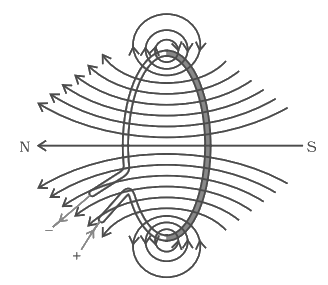
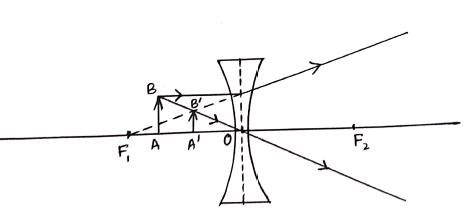
An electric heating device has two resistance coils that can be used separately, in series, or in parallel.
(i) Calculate the total equivalent resistance when the resistors are connected in parallel. [1 mark]
(ii) Find the current drawn when connected to a $220\text{ V}$ power supply. [1 mark]
(iii) (a) Calculate the heat energy produced per minute in parallel combination compared to series combination. [2 marks]
OR
(iii) (b) Explain why alloy coils are preferred over pure metals for the heating elements in domestic appliances. [2 marks]