
General Instructions : Read the following instructions carefully and follow them :
(i) This question paper contains 37 questions. All questions are compulsory.
(ii) The question paper is divided into four disciplinary sections: Section A (History), Section B (Geography), Section C (Political Science), and Section D (Economics).
(iii) Questions comprise Multiple Choice Questions (1 mark), Very Short Answer type (2 marks), Short Answer type (3 marks), Long Answer type (5 marks), Source/Case-based units of assessment (4 marks), and Map skill-based items.
(iv) There is no overall choice. Internal choices have been provided in select questions within each section.
SECTION A
(History - 20 Marks)
Questions 1 to 9
Most conservative regimes set up in 1815 introduced strict censorship laws. What was the primary purpose of these laws?
(a) To regulate information written about the rulers and their policies.
(b) To control the growing demand for modernising the army.
(c) To restrict the spread of ideas of liberty and freedom expressed through newspapers and other publications.
(d) To prevent the circulation of views suggesting that modernisation could strengthen traditional institutions.
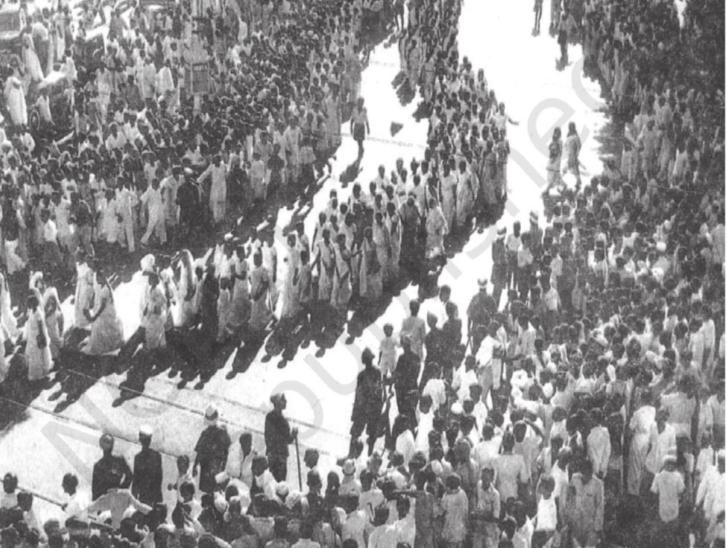
Look at the given historical photograph and identify the mass movement during India's freedom struggle characterised by the popular slogan 'Do or Die' (Karo ya Maro) given by Mahatma Gandhi in August 1942 :
Read the statements given below regarding the Simon Commission and choose the correct option :
Statement (I): The Simon Commission was constituted under Sir John Simon to review the functioning of the constitutional system in India and suggest changes.
Statement (II): The commission was greeted with the slogan 'Go Back Simon' because it did not have a single Indian member.
Arrange the following historical events of the global economy and India in chronological order :
I. The Great Depression begins in the United States.
II. First World War begins in Europe.
III. Bretton Woods Conference establishes IMF and World Bank.
IV. Outbreak of Rinderpest (Cattle Plague) in Africa.
"The Spanish conquerors' most powerful weapon was not a conventional military weapon." Explain this statement with two suitable arguments.
[2 marks]
(A) How did female figures become an allegory of the nation in nineteenth-century Europe? Explain with examples.
OR
(B) Describe the role of poets, artists, and nationalist leaders in the Greek War of Independence.
[3 marks]
(A) "The effects of the Non-Cooperation Movement on the economic front were dramatic." Support this statement with five arguments.
OR
(B) Explain the role and participation of Indian merchants and industrialists in the Civil Disobedience Movement.
[5 marks]
SOURCE-BASED ASSESSMENT (CASE STUDY)
Read the given extract and answer the questions that follow :
"From 1780, James Augustus Hickey began to edit the Bengal Gazette, a weekly magazine that described itself as 'a commercial paper open to all, but influenced by none'. So it was private English enterprise, proud of its independence from colonial influence, that began English printing in India. Hickey published a lot of advertisements, including those that related to the import and sale of slaves. But he also published lots of gossip about the Company's senior officials in India. Enraged by this, Governor-General Warren Hastings persecuted Hickey, and encouraged the sanction of officially sanctioned newspapers that could counter the flow of information that damaged the image of the colonial government. By the close of the eighteenth century, a number of newspapers and journals appeared in print."
(8.1) Name the weekly magazine edited by James Augustus Hickey and state the year it started. [1 mark]
(8.2) Why did Governor-General Warren Hastings persecute James Augustus Hickey? [1 mark]
(8.3) Analyze how print culture began to act as a medium of critique against the British East India Company. [2 marks]
MAP SKILL-BASED QUESTION (HISTORY)
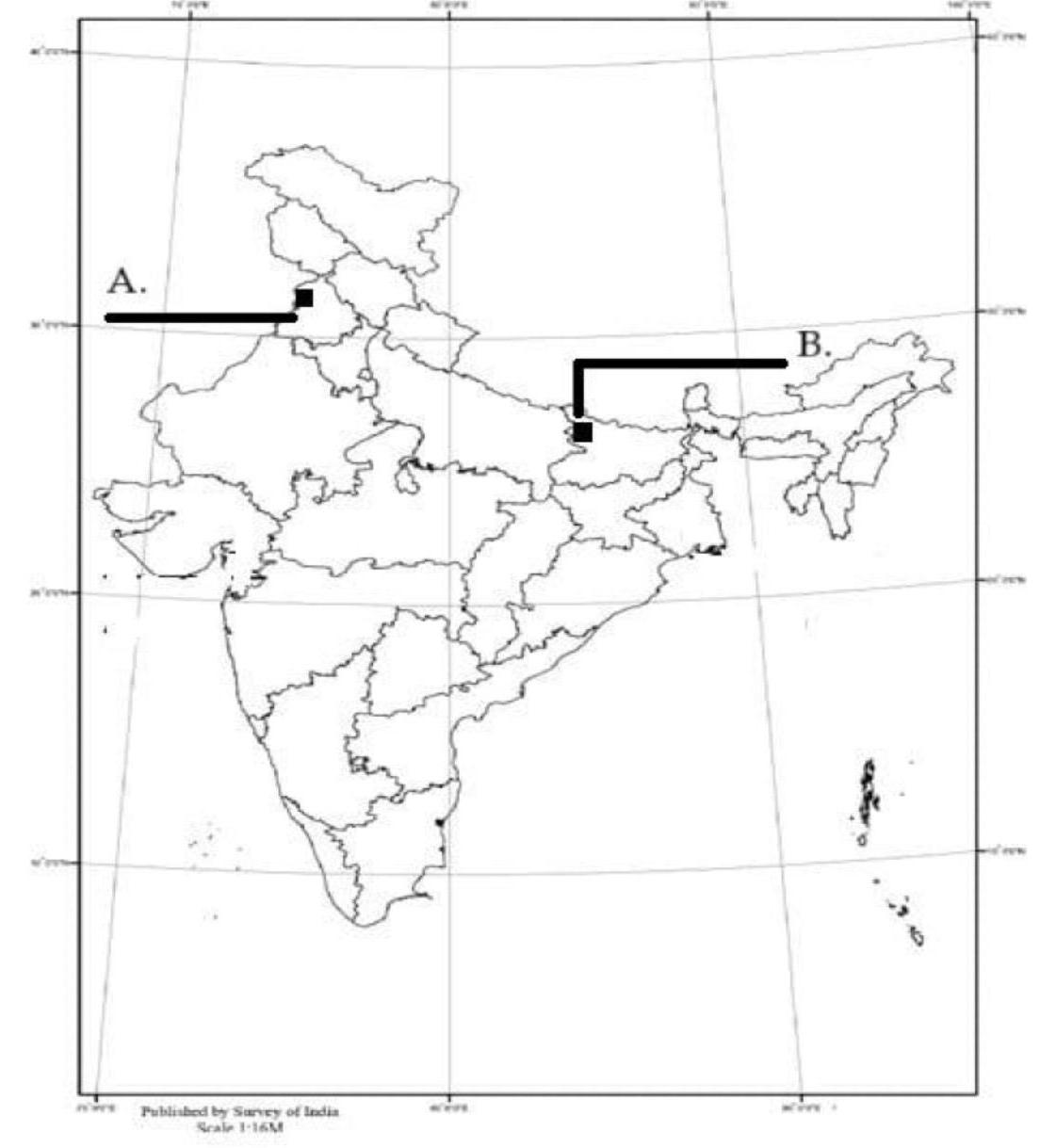
On the outline political map of India given below, identify and locate the following historical centres of the Indian National Movement :
(a) The place where Mahatma Gandhi broke the salt law, inaugurating the Civil Disobedience Movement.
(b) The place where the tragic Jallianwala Bagh incident took place in 1919.
[2 marks]
SECTION B
(Geography - 20 Marks)
Questions 10 to 19
A mineral deposit that is known to exist in a region and has the potential to satisfy human needs, but whose utilization has not been started due to lack of adequate capital or technology, is classified as a :
Match the soil types in Column I with their distinguishing characteristics in Column II :
Column I:
1. Black Soil
2. Laterite Soil
3. Arid Soil
Column II:
X. Rich in iron oxide and aluminium, formed due to intense leaching under high temperature and rainfall.
Y. High moisture retention capacity, self-ploughing nature, rich in calcium carbonate and clay.
Z. Sandy in texture and saline in nature, lacks humus and moisture.
Which of the following statements about placer deposits are correct?
(a) They occur as alluvial deposits in sands of valley floors and the base of hills.
(b) They generally consist of minerals that are easily corroded by water.
(c) Gold, silver, tin, and platinum are prominent minerals found in placer deposits.
(d) They are formed due to mechanical action of water without chemical weathering.
A steel manufacturing company requires iron ore with high magnetic qualities and up to 70 percent iron content. Which type of iron ore and mining belt should it prioritize?
Despite India having world-class capacity and efficiency in spinning cotton yarn, why is the weaving and processing sector fragmented and unable to use much of the high-quality yarn produced in the country?
Assertion (A): Road transport in India faces several infrastructural challenges such as unpaved surfaces, narrow bridges, and traffic congestion.
Reason (R): India has the smallest road network in the world, carrying less than 10 percent of total passenger traffic.
A drought-prone district in western Rajasthan wants to adopt traditional rainwater harvesting techniques. Suggest two traditional methods practiced in arid and semi-arid regions to conserve water.
[2 marks]
(A) Describe the geographical conditions required for the growth of tea in India, including climate, rainfall, and soil requirements.
OR
(B) Describe the climatic requirements, growing seasons, and two major producing zones of wheat in India.
[3 marks]
SOURCE-BASED ASSESSMENT (CASE STUDY)
Read the given text and answer the following questions :
"In India, joint forest management (JFM) programme furnishes a good example for involving local communities in the management and restoration of degraded forests. The programme has been in formal existence since 1988 when the state of Odisha passed the first resolution for joint forest management. JFM depends on the formation of local (village) institutions that undertake protection activities mostly on degraded forest land managed by the forest department. In return, the members of these communities are entitled to intermediary benefits like non-timber forest produces and share in the timber harvested by 'successful protection'. The clear lesson from the dynamics of both environmental destruction and reconstruction in India is that local communities everywhere have to be involved in some kind of natural resource management."
(18.1) What is the main objective of the Joint Forest Management (JFM) programme? [1 mark]
(18.2) Which Indian state passed the first formal resolution for JFM and in which year? [1 mark]
(18.3) What economic and environmental incentives do participating local communities receive under JFM? [2 marks]
MAP SKILL-BASED QUESTION (GEOGRAPHY)
On the outline political map of India given below, locate and label any three of the following features with appropriate symbols :
(i) Tehri Dam
(ii) Narora Nuclear Power Plant
(iii) Bailadila Iron Ore Mines
(iv) Marmagao Major Sea Port
[3 marks]
SECTION C
(Political Science - 20 Marks)
Questions 20 to 28
Assertion (A): India is a 'Holding Together' federation where power is divided between the central authority and constituent state units.
Reason (R): In India, the central government tends to have more powers vis-a-vis the states to maintain national unity and administrative integrity.
From a prudential viewpoint, which of the following is the most compelling argument in favor of power sharing in a democracy?
A political party conducts regular internal meetings, yet all key decisions and candidate nominations are made by one supreme family or top leader without consulting ordinary members. Which major challenge of political parties is highlighted here?
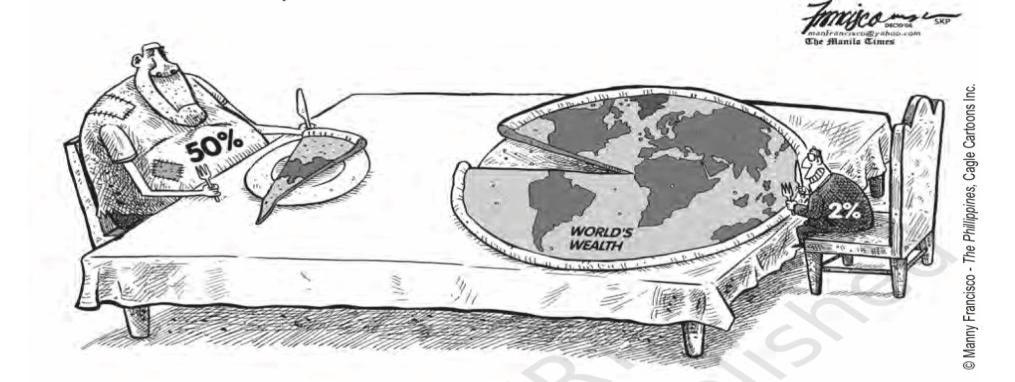
Which of the following options best signifies the political cartoon given below?
Explain two constitutional arrangements made by Belgian leaders to accommodate linguistic and regional diversity between 1970 and 1993.
[2 marks]
Why is a democratic government regarded as a better and more legitimate form of government than any other alternative? State three reasons.
[3 marks]
"The focus on caste in politics can sometimes give an impression that elections are all about caste and nothing else. That is far from true." Justify this statement with three arguments.
[3 marks]
(A) Highlight the major steps taken in the 1992 constitutional amendment (73rd and 74th Amendments) towards strengthening local self-government (decentralisation) in India.
OR
(B) Describe the three-fold distribution of legislative powers between the Union Government and the State Governments under the Constitution of India.
[5 marks]
SOURCE-BASED ASSESSMENT (CASE STUDY)
Read the given extract and answer the questions that follow :
"Political parties perform a series of crucial functions in modern representative democracies. Parties contest elections by putting up candidates nominated by party leaders or members. Parties put forward different policies and programmes and the voters choose from them. In a democracy, a large number of similar opinions have to be grouped together to provide a direction in which policies can be formulated by the government. This is what the parties do. A party reduces a vast multitude of opinions into a few basic positions which it supports. Those parties that lose in the elections play the role of opposition to the parties in power, by voicing different views and criticising government for its failures or wrong policies. Opposition parties also mobilise opposition to the government."
(28.1) How do political parties group together diverse public opinions? [1 mark]
(28.2) What essential role do parties that lose elections play in a democracy? [1 mark]
(28.3) Analyze why political parties are an indispensable necessity for modern representative democracies. [2 marks]
SECTION D
(Economics - 20 Marks)
Questions 29 to 37
Why do citizens of a country often hold differing and sometimes conflicting notions about what constitutes 'development'?
Recognize the correct classifications to complete the sector definitions :
1. Primary Sector : ________
2. Secondary Sector : ________
3. Tertiary Sector : Services that support production processes.
A country's total GDP is ₹$900\text{ crores}$. The primary sector contributes ₹$300\text{ crores}$ and the secondary sector contributes ₹$400\text{ crores}$. What is the contribution of the tertiary sector, and which sector contributes the most?
Why is money universally accepted as a medium of exchange in modern economies?
Which of the following elements is NOT included in the standard 'Terms of Credit' agreed upon between a lender and a borrower?
Assertion (A): Poor rural households in India are still largely dependent on informal sources of credit such as moneylenders and traders.
Reason (R): Formal commercial banks are not present everywhere in rural India, and obtaining bank loans requires collateral and comprehensive documentation that poor households lack.
In an agricultural family owning two hectares of land, all five members work on the plot. Even if two members are withdrawn to work in a nearby factory, total agricultural yield from the plot does not decline. Name and explain the type of unemployment depicted here.
[2 marks]
Explain how Self-Help Groups (SHGs) help the rural poor, particularly women, overcome the problem of lack of collateral while accessing credit.
[3 marks]
"Improvements in technology and liberalization of foreign trade and investment policies have been major factors that stimulated the globalization process." Elaborate this statement with five suitable arguments.
[5 marks]