
CBSE Class 12 APAAR ID (One Nation One Student ID) & LOC Final Verification: Guidelines for Parents & Students
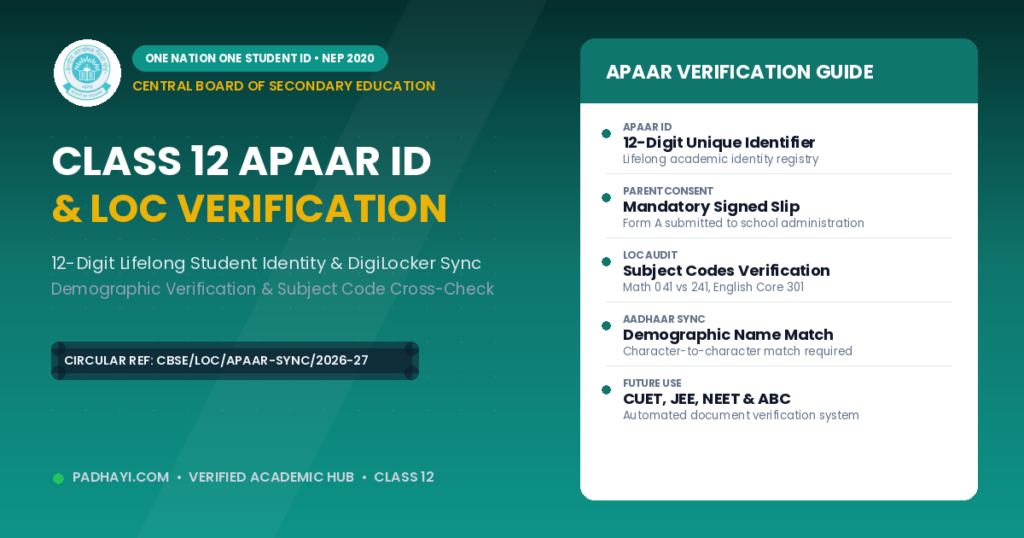
The Central Board of Secondary Education (CBSE), in coordination with the Ministry of Education, Government of India, has mandated the integration of the Automated Permanent Academic Account Registry (APAAR ID) with the List of Candidates (LOC) for all Class 12 students appearing for the 2026–2027 board examinations. Promulgated on October 10, 2026, via circular ref. no. CBSE/LOC/APAAR-SYNC/2026-27, this initiative forms the digital backbone of the National Education Policy (NEP) 2020 and National Credit Framework (NCrF).
Dubbed as “One Nation, One Student ID”, the 12-digit lifelong unique APAAR identifier digitally consolidates every candidate’s academic lifecycle—including CBSE Class 10 records, Class 12 marks, sports credentials, skill certifications, DigiLocker academic repositories, and future higher education credits for CUET, JEE, NEET, and university degree programs.
📌 Summary of the APAAR-LOC Mandate
- Universal Coverage: Mandatory linkage for all regular candidates enrolled in CBSE-affiliated schools across India and abroad.
- Strict Verification Deadline: Final demographic corrections and consent reconciliation must be completed by November 15, 2026.
- Parental Consent Requirement: Under digital personal data privacy statutes, schools must obtain written parental/guardian consent before generating or seeding APAAR IDs.
- Admit Card Synchronization: APAAR ID numbers will be permanently embossed on CBSE Class 12 Admit Cards, Digital Marksheets, and Migration Certificates.
Why APAAR ID is Critical for Class 12 Students: Long-Term Benefits
Many students view APAAR merely as administrative paperwork, but it plays a transformational role in post-school education and professional careers:
| Feature / Domain | How APAAR ID Works | Immediate & Future Benefit for Students |
|---|---|---|
| University Admissions (CUET/JEE/NEET) | Single-click identity verification pulling verified Class 10 & 12 marks directly from CBSE database. | Eliminates document forgery, tedious physical document attestation, and counseling discrepancies. |
| Academic Bank of Credits (ABC) | Directly links school educational records with the National Higher Education ABC system. | Allows seamless transfer of vocational, academic, and co-curricular credits under NEP 2020 guidelines. |
| DigiLocker Integration | Automated issuance of cryptographically signed digital marksheets, pass certificates, and migration cards. | Instant lifetime access to authenticated digital documents on mobile devices anytime, anywhere. |
| Scholarships & Education Loans | Direct integration with National Scholarship Portal (NSP) and Vidya Lakshmi loan platforms. | Rapid automated verification of student eligibility without multi-stage bureaucratic delays. |
Step-by-Step Parent & Student Workflow to Verify APAAR & LOC
To avoid last-minute errors on official board certificates, parents and students must execute the following four-step verification process:
- Parental Consent Submission: Schools distribute the standardized bilingual APAAR consent declaration. Parents must verify their child’s Aadhaar details, append their signature, and return the physical slip to the school administration.
- Aadhaar Demographic Reconciliation: The school enters the 12-digit Aadhaar number into the UDISE+ portal. For successful generation, the student’s name, date of birth, and gender in school registers must match Aadhaar data character-by-character.
- Draft LOC Audit by Parents: Schools print out candidate verification checklists. Parents and students must physically inspect the spelling of candidate name, mother’s name, father’s/guardian’s name, date of birth, photograph, and exact subject codes.
- Final Signature & Locking: Once reconciled, parents and candidates sign the LOC verification sheet. The school Principal countersigns and locks the batch on the CBSE Pariksha Sangam portal.
Solving Common Demographic Mismatch Bottlenecks
Demographic mismatch between Aadhaar records and CBSE Class 10 matriculation certificates is the single largest cause of APAAR generation failures. Here is how to resolve discrepancies swiftly:
- Name Spelling Discrepancy: CBSE records take legal precedence based on the Class 10 Grade Sheet. If Aadhaar differs (e.g., initials expanded or missing surname), the student must immediately visit a local Aadhaar Seva Kendra (ASK) to update Aadhaar demographics to mirror CBSE Class 10 records.
- Date of Birth Format Issues: Ensure Aadhaar possesses the full DD/MM/YYYY date format rather than merely a birth year. Update via municipal birth certificate at an authorized UIDAI center.
- Non-Aadhaar & International Candidates: Foreign nationals or NRI students enrolled in CBSE overseas affiliated schools can be registered using valid passport numbers through the special UDISE+ NRI exemption module.
Subject Code Verification Checklist for Class 12 Streams
An error in subject codes can cause catastrophic examination day failures. Cross-verify that your registered LOC subject codes match your intended study stream:
| Stream | Subject Name | Official Subject Code | Key Check |
|---|---|---|---|
| Science | Physics / Chemistry / Biology | 042 / 043 / 044 | Ensure practical code alignment |
| Science / Comm | Mathematics vs Applied Mathematics | 041 (Standard) vs 241 (Applied) | Crucial! Must match course opted |
| Commerce | Accountancy / Business Studies / Economics | 055 / 054 / 030 | Verify project assessment link |
| Language | English Core vs English Elective | 301 (Core) vs 001 (Elective) | Over 95% of candidates take 301 |
Frequently Asked Questions: Class 12 APAAR ID & LOC Verification
1. Is APAAR ID mandatory for private candidates and improvement exam students?
Yes. Under the Ministry of Education’s unified education stack, all private, compartment, and improvement candidates must also provide their 12-digit APAAR ID during the online portal submission. If you completed Class 10 from CBSE, your APAAR ID is automatically retrieved via your previous roll number and DigiLocker credentials.
2. Can parental consent be withdrawn after generating the APAAR ID?
Under the Digital Personal Data Protection (DPDP) Act, parents retain the legal prerogative to request data dissociation through a written application to the school head. However, withholding consent will necessitate manual verification of marksheets, offline migration paperwork, and manual documentation across CUET, NEET, and university admissions.
3. How does APAAR ID streamline CUET 2027 and JEE Main Application Portals?
The National Testing Agency (NTA) has integrated the APAAR API into examination portals. Entering your APAAR ID auto-populates personal details, category data, and verified academic scores, virtually eliminating registration rejection risks caused by manual typos.
4. What must students do if their school has made a clerical typo in the LOC?
Immediately submit a formal written representation with a certified copy of your Class 10 Grade Sheet to your School Principal before November 15. The school can submit an administrative correction request directly to the Regional Office via Pariksha Sangam before final roll numbers are generated.
Explore Relevant Board Exam Updates & Resources
Study Resources & Notes




Community Buzz

CBSE Sample Paper 2027 vs Actual Board Exam: How much harder are pre-boards compared to final papers?

Class 12 Reality Check: At what time do you actually enter “productive study mode”?

Genetics pedigree charts in Biology: The 5-second trick to spot Autosomal vs X-linked

Poll for Class 12 Commerce: What is your secret weapon for Business Studies keyword retention?
Comments (0)
No comments yet. Be the first to comment!
Please log in to comment
Log In