
CBSE Class 12 Exam Pattern & Competency Questions 2026-27: 50% Application Weightage & Marking Scheme
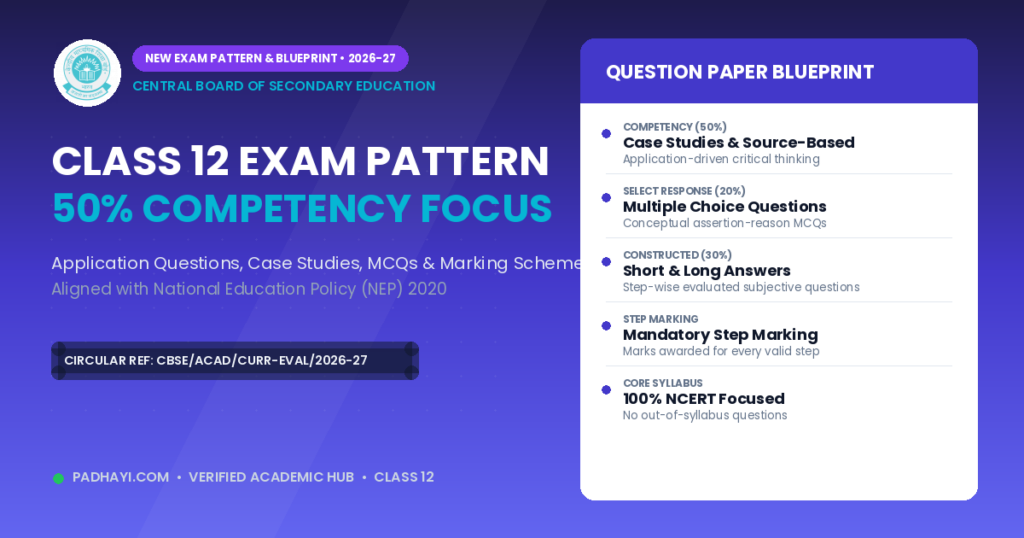
The Central Board of Secondary Education (CBSE) has finalized the structured question paper blueprint, competency weightage distribution, and official step-wise marking rubrics for the Class 12 Board Examinations 2026–2027. Promulgated in late October 2026 via circular ref. no. CBSE/ACAD/CURRICULUM/2026, the updated framework accelerates the transition from rote memorization toward deep conceptual comprehension, critical reasoning, and real-world problem application as envisioned by the National Education Policy (NEP 2020) and the National Curriculum Framework for School Education (NCF-SE).
The landmark development in this year’s assessment design is that Competency-Focused Questions now constitute a full 50% weightage across all major subjects in Class 12. This includes complex case-study problems, assertion-reason items, source-based historical excerpts, and data-driven scenario analyses. Traditional constructed response questions (short answer and long answer formats) have been condensed to 30%, while select-response objective questions (MCQs) maintain a 20% baseline across all theoretical papers.
📘 Key Pillars of Class 12 Exam Pattern (2026–27)
- Competency-Based Questions: 50% weightage (Case Studies, Assertion-Reason, Data Analysis)
- Objective / Multiple Choice Questions (MCQs): 20% weightage (Select-Response format)
- Constructed Response (Short & Long Answer): Reduced to 30% weightage
- Overall Choice: Zero overall choice; internal choice provided in roughly 33% of questions
- Evaluation Rubric: Step-wise marking strictly implemented across all analytical questions
Question Paper Typology & Marks Percentage Distribution
To help educators and students benchmark their preparation against official Board expectations, the comparative typology distribution across 70-mark and 80-mark theoretical question papers is tabulated below:
| Question Typology | Nature of Questions | Percentage Weightage | Marks in 70-Mark Paper (Science) | Marks in 80-Mark Paper (Com/Arts) |
|---|---|---|---|---|
| Competency-Focused Questions | Case-based problems, source analysis, assertion-reasoning, real-world data interpretation | 50% | 35 Marks | 40 Marks |
| Select Response Questions (MCQs) | Multiple choice single-option correct questions evaluating foundational concepts | 20% | 14 Marks | 16 Marks |
| Short Answer (SA) | Concise 2-mark and 3-mark analytical explanations and intermediate calculations | 18% – 20% | 13 – 14 Marks | 15 – 16 Marks |
| Long Answer (LA) | In-depth 5-mark comprehensive derivations, numerical problems, and comparative essays | 10% – 12% | 7 – 8 Marks | 8 – 9 Marks |
| Total Theory Evaluation | Theory Examination Component | 100% | 70 Marks | 80 Marks |
Subject-Wise Application Impact: What Changes for Students?
The 50% competency mandate affects how students must approach their daily revision across core academic streams:
1. Science Stream (Physics, Chemistry, Mathematics, Biology)
- Physics: Pure textbook derivation questions have been curtailed. Expect scenario-based derivations where examiners introduce modified boundary conditions (e.g., placing a dielectric slab of variable thickness inside a parallel plate capacitor, or calculating drift velocity under alternating temperatures).
- Chemistry: Organic Chemistry focuses heavily on reaction mechanisms and logical multi-step conversions. In Physical Chemistry, numerical problems integrate graphical analysis (e.g., Arrhenius plot activation energy slopes, zero-order versus first-order half-life plots).
- Mathematics: Calculus section features 4-mark case study problems derived from engineering, economics, or architectural contexts requiring students to set up differential equations or calculate maximum volume using derivatives.
2. Commerce Stream (Accountancy, Business Studies, Economics)
- Accountancy: Gone are straightforward balance sheet entries. Case problems present complex partnership restructuring scenarios where adjustments must be inferred from contextual partner agreements and market conditions.
- Business Studies: Over 60% of the paper consists of real-world corporate case studies. Merely explaining Fayol’s principles is insufficient; candidates must accurately diagnose which principle was violated and propose administrative remedies using NCERT keywords.
- Economics: Macroeconomics and Indian Economic Development papers present contemporary data tables (e.g., RBI monetary policy inflation charts, sectoral employment distribution) requiring analytical inference.
3. Humanities Stream (History, Political Science, Sociology)
- History & Political Science: Evaluators emphasize source-based comprehension. Students are given contemporary or historical excerpts (e.g., Bernier’s travel accounts, constituent assembly debates, Panchsheel treaty clauses) and must contextualize the author’s sociological perspective rather than reciting memorized timelines.
Step-Wise Marking Rubrics Demystified
CBSE evaluators operate under rigid, centralized marking schemes where credit is awarded in fractional half-marks for every verified logical step. Understanding how marks are allocated prevents avoidable grade penalties:
- Formula Stating (0.5 to 1 Mark): Even if your final arithmetic computation is erroneous, writing the correct standard formula (e.g., Biot-Savart Law equation, Bayes’ Theorem, or Goodwill capitalisation formula) secures guaranteed initial credit.
- Substitution of Given Values (0.5 to 1 Mark): Accurately substituting variables with correct unit conversions (e.g., converting cm to meters, or annual interest to monthly rates) earns intermediate marks.
- Final Answer with SI Units (0.5 to 1 Mark): Never leave numerical solutions as bare numbers. Always append the correct physical or monetary unit ($N/C$, $J$, $Omega$, or ₹). Omitting the unit results in a mandatory deduction of half a mark by board evaluators.
How to Excel in Competency-Based Assessments
- Focus on Concepts Over Cramming: When studying any chapter, constantly ask: “Where does this law apply in daily life?” and “What happens if one variable doubles while another is halved?”
- Analyze Official Sample Question Papers (SQPs): Download and dissect the official sample papers and marking schemes hosted on cbseacademic.nic.in. Compare your answer layout against the official model answers.
- Practice Chapter-Wise NCERT Solutions: Browse our complete conceptual solutions and exercise explanations in the Padhai Class 12 Resources Portal.
- Take Timed Sectional Tests: Test your case-study speed with past board question papers available in the Padhai Practice & PYQs Section.
Bloom’s Taxonomy Framework Behind the 2026–27 Paper Design
To eliminate ambiguity regarding how question papers are engineered, CBSE has adopted the cognitive domain taxonomy aligned with international benchmarking assessments:
| Cognitive Level | Competency Assessed | Target Weightage | Representative Question Types |
|---|---|---|---|
| Remembering (Knowledge) | Recalling facts, standard terms, definitions, laws, and basic principles | ~20% (14–16 Marks) | Direct MCQs, naming functional groups, stating fundamental postulates |
| Understanding (Comprehension) | Interpreting concepts, comparing, explaining trends, illustrating with diagrams | ~30% (21–24 Marks) | Explaining periodic anomalies, interpreting Ray diagrams, distinguishing terms |
| Applying (Application) | Applying concepts and formulas to solve numerical problems in novel situations | ~30% (21–24 Marks) | Numerical derivations, calculating firm goodwill, solving equilibrium expressions |
| Analyzing & Evaluating (Higher Order) | Synthesizing data, assessing case studies, justifying judgments with reasoning | ~20% (14–16 Marks) | Case-study 4-markers, source evaluation, Assertion-Reasoning dilemmas |
Anatomy of a 4-Mark Case-Study Question: How to Score Full Marks
Case study questions are specifically engineered to test your ability to extract relevant mathematical or scientific data from an introductory narrative. Follow this 3-step strategy:
- Scan Sub-Questions First Before Reading the Passage: Case-study passages in Physics and Mathematics often span 10 to 15 lines of background context. By reading the 3 or 4 mini-questions first, your brain filters out irrelevant narrative details and immediately flags the specific variables ($V$, $R$, $t$, $theta$) required for calculation.
- Treat Sub-Questions as Independent 1-Mark or 2-Mark Units: Sub-questions are modular. Even if you are uncertain about part (ii), parts (i) and (iii) frequently rely on foundational knowledge that can be answered completely independently.
- Write Clear Supporting Reasons for Assertion-Reason Questions: In Section A assertion-reason MCQs, do not just guess (A) or (B). Verify whether Reason ($R$) is merely a true independent statement OR if it directly explains why Assertion ($A$) occurs by connecting them with the word “because”.
Stay informed with real-time academic circulars on Padhai Class 12 Notifications. Verify all syllabus and pattern changes against the apex portal at cbseacademic.nic.in.
Study Resources & Notes


Community Buzz

CBSE Sample Paper 2027 vs Actual Board Exam: How much harder are pre-boards compared to final papers?

Class 12 Reality Check: At what time do you actually enter “productive study mode”?

Genetics pedigree charts in Biology: The 5-second trick to spot Autosomal vs X-linked

Poll for Class 12 Commerce: What is your secret weapon for Business Studies keyword retention?
Comments (0)
No comments yet. Be the first to comment!
Please log in to comment
Log In