
CBSE Mandatory CCTV Surveillance in Examination Centres: Infrastructure Guidelines & Security Norms
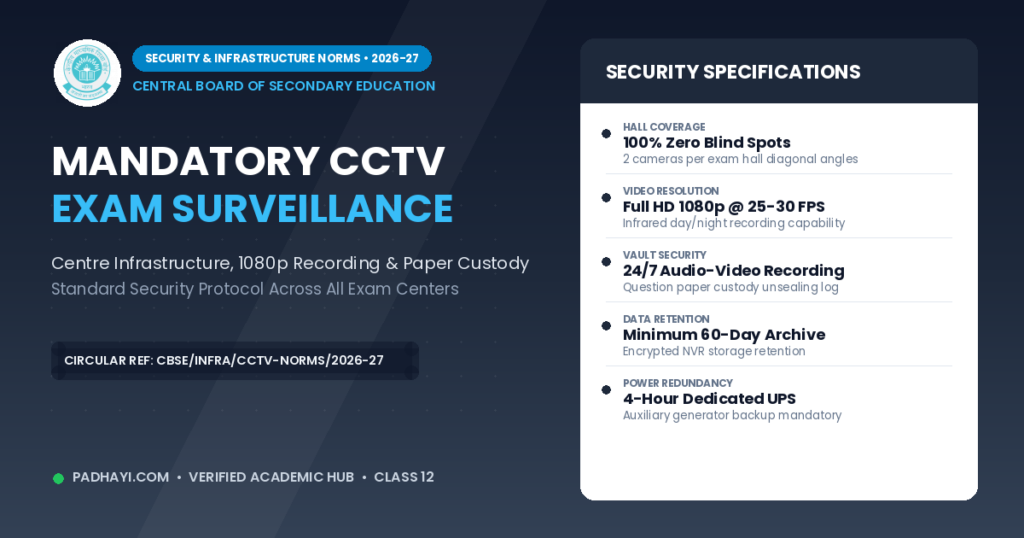
The Central Board of Secondary Education (CBSE) has released mandatory Infrastructure Norms and Technical Specifications for Closed-Circuit Television (CCTV) surveillance across all designated examination centres for the upcoming Class 10 and Class 12 Board Examinations 2026–2027. Issued on October 18, 2026, via circular ref. no. CBSE/INFRA/CCTV-NORMS/2026-27, the directives aim to create a leak-proof, foolproof examination ecosystem, eradicate impersonation, prevent unfair means, and guarantee nationwide parity.
Under the revised guidelines, every school designated as an examination centre must have fully functional, high-definition CCTV surveillance installed in all examination rooms, corridors, entry/exit gates, and confidential question paper custody vaults. Non-compliant centres will face immediate cancellation of centre status, financial penalties, and institutional disaffiliation proceedings.
🚨 Key Highlights of the CBSE CCTV Surveillance Directive
- 100% Coverage: Zero blind-spot coverage required across all active examination halls, corridors, and strongrooms.
- Technical Resolution: Minimum Full HD 1080p camera resolution with infrared day/night night vision and minimum 25-30 frames per second recording.
- Mandatory 60-Day Archival: All raw video footage must be preserved in encrypted Network Video Recorders (NVR) for at least 60 days following the conclusion of exams.
- Live Central Webcasting: Centre control rooms must maintain live streaming uplinks connecting to the CBSE Regional Office Command and Control Center.
- Uninterrupted Power Backup: Mandatory 4-hour dedicated UPS and generator redundancy to prevent surveillance blackouts during power grid outages.
Technical Specifications & Camera Placement Standards
CBSE has laid down rigorous architectural and technical requirements to ensure that surveillance recordings produce legally admissible, high-fidelity evidence:
| Examination Area | Minimum Camera Requirement | Field of View & Critical Focus Points |
|---|---|---|
| Standard Examination Room (24 to 30 Candidates) | 2 High-Definition Cameras (Opposite diagonal angles) | Complete coverage of every candidate desk, invigilator station, blackboard area, and entry door. Zero blind spots. |
| Confidential Vault / Strongroom (Paper Custody) | 2 HD Cameras (Continuous 24×7 Recording with Audio) | Clear focus on the iron safe/almirah lock, seal inspection table, and time-stamped unsealing of question paper parcels. |
| Centre Entry / Frisking Enclosures | 1 Wide-Angle Weatherproof Bullet Camera | Facial clarity of entering candidates, metal detector screening passage, and physical gate closure at 10:00 AM. |
| Corridors, Stairwells & Washroom Approaches | 1 Dome Camera per 30-meter corridor span | Monitoring student movement during permitted washroom breaks and preventing unauthorized loitering or material transfer. |
Protocol for Question Paper Unsealing & Answer Script Sealing
The circular establishes an immutable digital paper-trail for confidential operations carried out on exam days:
- Custody Retrieval (08:30 AM): The Centre Superintendent (CS) and CBSE-appointed External Observer retrieve sealed parcel boxes from designated custodian bank vaults under armed escort.
- Vault Recording (09:45 AM): Unsealing of the outer protective parcel occurs under continuous CCTV recording in the presence of at least four witnesses, including two independent assistant superintendents.
- Classroom Distribution (10:15 AM): Inner question paper envelopes are inspected by classroom invigilators; two student witnesses sign the envelope certifying that seals were intact prior to opening.
- Post-Exam Script Packaging (01:45 PM): Answer booklets are collected, counted, bundled, and sealed into tamper-evident bags directly under CCTV cameras before dispatch to regional collection centres.
Data Privacy Safeguards & Footage Access Restrictions
To prevent misuse and protect the privacy of students and invigilating faculty, CBSE has instituted strict security firewalls:
- Restricted Access: Only the Centre Superintendent, Regional Officer, and CBSE Cyber Security Cell possess credentials to access live camera feeds or archival recordings.
- Prohibition of Public Broadcast: Schools are strictly barred from sharing, circulating, or publishing examination CCTV recordings on social media, institutional websites, or messaging groups.
- Investigative Audits: In the event of reported Unfair Means (UFM) or mass malpractice allegations, the Board’s high-level Scrutiny Committee summons the unedited footage to examine candidate conduct frame-by-frame.
Strict Actions Against Non-Compliant Centres
Schools that fail to fulfill the mandatory CCTV specifications by February 1, 2027, will be summarily struck off the approved list of board examination centres. Students assigned to defaulting schools will be reallocated to neighboring model institutions, and the defaulting management will face de-affiliation proceedings under Chapter 12 of CBSE Affiliation Bye-Laws.
Student Rights, Privacy & Frequently Asked Questions Regarding CCTV Surveillance
While the implementation of CCTV surveillance has been instituted primarily to protect honest students and eliminate external interference, candidates frequently ask important practical questions regarding its operational impact:
1. Are CCTV cameras installed inside student washrooms or private spaces?
Strictly No. Under constitutional privacy guarantees and Child Protection Acts, CCTV cameras are strictly prohibited inside restrooms or toilets. Surveillance is restricted solely to external corridors, washroom approach entryways, staircases, classrooms, and administrative offices to prevent unauthorized physical interactions.
2. Do classroom examination cameras record audio conversations?
Audio recording is mandated exclusively inside the Confidential Strongroom / Vault during question paper unsealing and answer script packaging. General classroom cameras record high-definition video without ambient audio capture to avoid unnecessary acoustic interference and preserve candidate focus.
3. Can a student falsely accused of Unfair Means (UFM) appeal for CCTV review?
Yes, absolutely. If a candidate believes an invigilator or flying squad has wrongly booked them under UFM regulations, they or their guardian have the legal right to request an evidentiary review before the CBSE Regional Examination Committee. The Board summons the unedited time-stamped video footage for objective forensic verification.
4. What happens if an electrical power failure occurs at the exam centre?
All accredited centres are legally mandated to deploy automated dual-redundancy power solutions: an instant inverter/UPS battery system ensuring minimum 4 hours of camera operation and a heavy-duty auxiliary diesel generator. A total surveillance blackout during active exam hours triggers an automated alert at the Regional Control Room and warrants a mandatory physical spot inspection.
Relevant Board Exam 2027 Notifications & Resources
Study Resources & Notes




Community Buzz

CBSE Sample Paper 2027 vs Actual Board Exam: How much harder are pre-boards compared to final papers?

Class 12 Reality Check: At what time do you actually enter “productive study mode”?

Genetics pedigree charts in Biology: The 5-second trick to spot Autosomal vs X-linked

Poll for Class 12 Commerce: What is your secret weapon for Business Studies keyword retention?
Comments (0)
No comments yet. Be the first to comment!
Please log in to comment
Log In