
If $\alpha$ and $\beta$ are the zeroes of polynomial $3x^{2}+6x+k$ such that $\alpha+\beta+\alpha\beta=-\frac{2}{3}$, then the value of k is:
[1]
Two polynomials are shown in the graph below. The number of distinct zeroes of both the polynomials is :
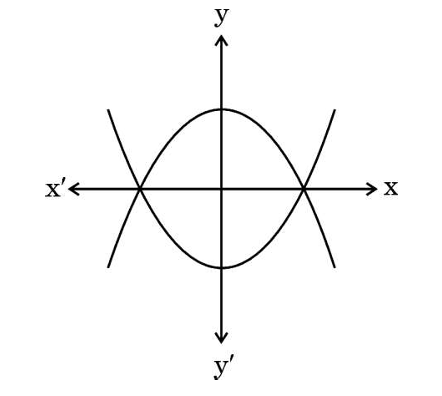
[1]
Find the zeroes of the polynomial $p(x)=x^{2}+\frac{4}{3}x-\frac{4}{3}$
[2]
Find a quadratic polynomial whose sum and product of zeroes are 0 and -9, respectively.
Also, find the zeroes of the polynomial so obtained.
[3 marks]
If the sum of zeroes of the polynomial $p(x)=2x^{2}-k\sqrt{2}x+1$ is $\sqrt{2}$, then value of k is:
[1 mark]
The zeroes of a polynomial $x^{2}+px+q$ are twice the zeroes of the polynomial $4x^{2}-5x-6$. The value of p is :
[1 mark]
Directions: In Q. No. 19 and 20 a statement of Assertion (A) is followed by a statement of Reason (R). Choose the correct option.
(a) Both, Assertion (A) and Reason (R) are true and Reason (R) is correct explanation of Assertion (A).
(b) Both, Assertion (A) and Reason (R) are true but Reason (R) is not correct explanation for Assertion (A).
(c) Assertion (A) is true but Reason (R) is false.
(d) Assertion (A) is false but Reason (R) is true.
Assertion (A): If the graph of a polynomial touches x-axis at only one point, then the polynomial cannot be a quadratic polynomial.
Reason (R): A polynomial of degree $n(n>1)$ can have at most n zeroes.
[1 mark]
For what value of $k$, the product of zeroes of the polynomial $kx^{2}-4x-7$ is $2$?
[1 mark]
If one of the zeroes of the quadratic polynomial $(\alpha-1)x^{2}+\alpha x+1$ is $-3$, then the value of $\alpha$ is:
[1 mark]
Directions: In Q. No. 19 and 20, a statement of Assertion (A) is followed by a statement of Reason (R). Select the correct option from the following options:
- (a) Both, Assertion (A) and Reason (R) are true. Reason (R) explains Assertion (A) completely.
- (b) Both, Assertion (A) and Reason (R) are true. Reason (R) does not explain Assertion (A).
- (c) Assertion (A) is true but Reason (R) is false.
- (d) Assertion (A) is false but Reason (R) is true.
Assertion (A): Zeroes of a polynomial $p(x)=x^{2}-2x-3$ are $-1$ and $3$.
Reason (R): The graph of polynomial $p(x)=x^{2}-2x-3$ intersects x-axis at $(-1, 0)$ and $(3, 0)$.
[1 mark]
The graph of \( y=p(x) \) is shown in the figure for some polynomial \( p(x) \). The number of zeroes of \( p(x) \) is/are:
[1 mark]
The sum and the product of zeroes of the polynomial \( p(x)=x^{2}+5x+6 \) are respectively
[1 mark]
If \( \alpha, \beta \) are zeroes of the quadratic polynomial \( x^{2}+3x+2 \), find a quadratic polynomial whose zeroes are \( \alpha+1, \beta+1 \).
[3 marks]
The graph of \( y=p(x) \) is given, for a polynomial \( p(x) \). The number of zeroes of \( p(x) \) from the graph is
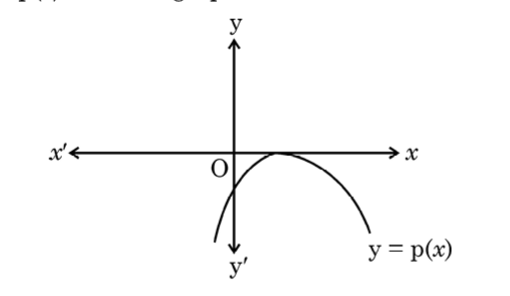
[1 mark]
If \( \alpha \), \( \beta \) are the zeroes of a polynomial \( p(x)=x^{2}+x-1 \), then \( \frac{1}{\alpha}+\frac{1}{\beta} \) equals to
[1 mark]
Which of the following is a quadratic polynomial having zeroes \( \frac{-2}{3} \) and \( \frac{2}{3} \)?
[1 mark]
If $f(x) = px^2 + qx + r$, $p \neq 0$ and $p + r = q$, then one of the zeroes of $f(x)$ is :
If $\alpha$ and $\beta$ are the zeroes of the quadratic polynomial $p(x) = x^2 - 4x + 5$, form a quadratic polynomial whose zeroes are $2\alpha$ and $2\beta$.
[3 marks]
The number of polynomials having $-2$ and $5$ as their zeroes is :