
Assertion (A): If we join two hemispheres of same radius along their bases, then we get a sphere.
Reason (R): Total Surface Area of a sphere of radius r is $3\pi r^{2}$.
[1]
A room is in the form of a cylinder surmounted by a hemispherical dome. The base radius of the hemisphere is half of the height of the cylindrical part. If the room contains $\frac{1408}{21}\text{ m}^{3}$ of air, find the height of the cylindrical part. (Use $\pi=\frac{22}{7}$).
[3]
For which of the following solids is the lateral/curved surface area and total surface area the same?
[1 marks]
(a) A toy is in the form of a cone surmounted on a hemisphere. The cone and hemisphere have the same radii. The height of the conical part of the toy is equal to the diameter of its base. If the radius of the conical part is 5 cm, find the volume of the toy.
OR
(b) A cubical block is surmounted by a hemisphere of radius 3.5 cm. What is the smallest possible length of the edge of the cube so that the hemisphere can totally lie on the cube? Find the total surface area of the solid so formed.
[5 marks]
A solid sphere is cut into two hemispheres. The ratio of the surface areas of sphere to that of two hemispheres taken together, is :
[1 mark]
The volume of the largest right circular cone that can be carved out from a solid cube of edge 2 cm is:
[1 mark]
The difference between the outer and inner radii of a hollow right circular cylinder of length 14 cm is 1 cm. If the volume of the metal used in making the cylinder is $176~cm^{3}$, find the outer and inner radii of the cylinder.
[3 marks]
The radius of a sphere is $\frac{7}{2}$ cm. The volume of the sphere is :
[1 mark]
The height and radius of a right circular cone are $24$ cm and $7$ cm respectively. The slant height of the cone is :
[1 mark]
(A) A solid is in the form of a cylinder with hemi-spherical ends of same radii. The total height of the solid is $20$ cm and the diameter of the cylinder is $14$ cm. Find the surface area of the solid.
OR
(B) A juice glass is cylindrical in shape with hemi-spherical raised up portion at the bottom. The inner diameter of glass is $10$ cm and its height is $14$ cm. Find the capacity of the glass. (use $\pi=3.14$)
[3 marks]
The volume of a cone of radius 'r' and height '\( 3r \)' is:
[1 mark]
A vessel is in the form of a hemispherical bowl surmounted by a hollow cylinder of same diameter. The diameter of the hemispherical bowl is 14 cm and the total height of the vessel is 13 cm. Find the inner surface area of the vessel. Also, find the volume of the vessel.
[5 marks]
Curved surface area of a cylinder of height 5 cm is \( 94.2 \text{ cm}^{2} \). Radius of the cylinder is (Take \( \pi=3.14 \))
[1 mark]
The curved surface area of a cone having height 24 cm and radius 7 cm, is
[1 mark]
(a) A room is in the form of cylinder surmounted by a hemi-spherical dome. The base radius of hemisphere is one-half the height of cylindrical part. Find total height of the room if it contains \( \left(\frac{1408}{21}\right) \text{ m}^{3} \) of air. (Take \( \pi=\frac{22}{7} \))
OR
(b) An empty cone is of radius 3 cm and height 12 cm. Ice-cream is filled in it so that lower part of the cone which is \( \left(\frac{1}{6}\right)^{th} \) of the volume of the cone is unfilled but hemisphere is formed on the top. Find volume of the ice-cream. (Take \( \pi=3.14 \))
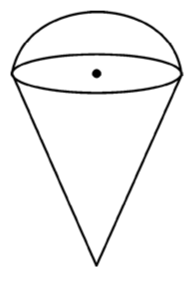
[3 marks]
A solid metallic sphere of radius 3 cm is melted and recast into the shape of a solid cylinder of radius 2 cm.
Find the height of the cylinder.
[2 marks]
(a) A spherical glass vessel has a cylindrical neck 8 cm long and 1 cm in radius. The radius of the spherical part is 9 cm. Find the amount of water (in litres) it can hold, when filled completely.
OR
(b) From a solid cylinder, whose height is 2.4 cm and diameter 1.4 cm, a conical cavity of the same height and same diameter is hollowed out. Find the total surface area of the remaining solid.
[4 marks]
A solid metallic sphere of radius 10.5 cm is melted and recast into a number of smaller cones, each of radius 3.5 cm and height 3 cm. Find the number of cones so formed.
[2 marks]
(a) From a solid cylinder of height 30 cm and radius 7 cm, a conical cavity of height 24 cm and same radius is hollowed out. Find the total surface area of the remaining solid.
OR
(b) Water in a canal, 8 m wide and 6 m deep, is flowing with a speed of \(12~\text{km/hour}\). How much area will it irrigate in one hour, if 0.05 m of standing water is required?
[4 marks]
Three cubes each of edge $4\text{ cm}$ are joined end to end. The total surface area of the resulting cuboid is :
(A) A tent is in the shape of a cylinder surmounted by a conical top. If the height and diameter of the cylindrical part are $2.1\text{ m}$ and $4\text{ m}$ respectively, and the slant height of the top is $2.8\text{ m}$, find the area of the canvas used for making the tent. Also, find the cost of the canvas of the tent at the rate of ₹$500\text{ per m}^2$. (Note that the base of the tent will not be covered with canvas). $\left[\text{Take } \pi = \frac{22}{7}\right]$
OR
(B) A solid wooden toy is in the form of a hemisphere surmounted by a cone of same radius. The radius of the hemisphere is $3.5\text{ cm}$ and the total height of the toy is $15.5\text{ cm}$. Find the total surface area and volume of the toy.
[5 marks]
A solid toy is in the form of a hemisphere surmounted by a right circular cone of the same radius, as shown in the figure below. The height of the cone is $2\text{ cm}$ and the diameter of the base is $4\text{ cm}$. Determine the volume of the toy. If a right circular cylinder circumscribes the toy, find the difference of the volumes of the cylinder and the toy. $(\text{Take } \pi = 3.14)$

[5 marks]