

Class 10 boards can feel confusing even before the actual preparation starts. There are chapters to finish, practical and internal assessment marks to think about, previous-year questions to solve, and then the big question: how many marks does each subject actually carry?
If you are preparing for the CBSE Class 10 Board Exams 2026-27, knowing the exam pattern early can make your preparation much more organised. You do not need to study every chapter in exactly the same way. Understanding the marks distribution helps you decide where to spend more time and how to practise.
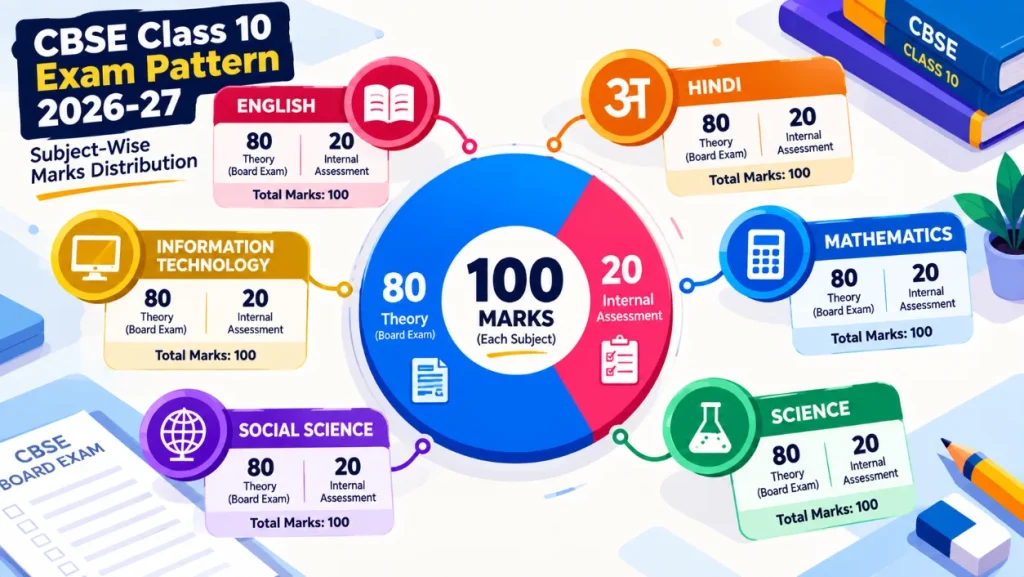
For most major Class 10 subjects, the assessment is divided between the written board examination and internal assessment. The written examination generally carries 80 marks, while 20 marks are allotted through internal assessment, making a total of 100 marks.
In this guide, we will break down the CBSE Class 10 exam pattern 2026-27 subject by subject, explain the question-paper structure, discuss internal assessment, and share a practical way to prepare without turning your study table into a battlefield.
Note: CBSE can revise examination schemes, syllabi, sample papers or assessment instructions. Students should always cross-check the latest information published by CBSE and the CBSE Academic website before relying on a particular paper format.
Check the CBSE Class 10 syllabus on Padhayi before planning your chapter-wise preparation.
CBSE Class 10 Exam Pattern 2026-27 at a Glance
The easiest way to understand the Class 10 assessment structure is to split it into two parts:
| Assessment Component | Marks |
|---|---|
| Board Examination / Theory | 80 Marks |
| Internal Assessment | 20 Marks |
| Total | 100 Marks |
This 80 + 20 structure is important because your final subject score is not based only on the three-hour written paper. Internal assessment also contributes to the final result.
That means ignoring school-based assessments until the last minute is not a great idea. Those 20 marks are part of your overall subject score, so regular classwork, periodic tests, activities and other assessment components can matter.
CBSE Class 10 Subject-Wise Marks Distribution 2026-27
For the major Class 10 subjects, the broad marks distribution is as follows:
| Subject | Theory / Board Exam | Internal Assessment | Total |
|---|---|---|---|
| Mathematics | 80 | 20 | 100 |
| Science | 80 | 20 | 100 |
| Social Science | 80 | 20 | 100 |
| English | 80 | 20 | 100 |
| Hindi | 80 | 20 | 100 |
The exact question types and section-wise distribution can vary between subjects. So, do not assume that an 80-mark Maths paper will look exactly like an 80-mark English or Social Science paper.
CBSE Class 10 Mathematics Exam Pattern 2026-27
Mathematics is an 80-mark theory subject along with 20 marks of internal assessment. The board paper tests more than just whether you remember formulas. You need to be comfortable with calculations, concepts, applications and different types of questions.
For Mathematics, students should prepare the complete prescribed syllabus rather than betting everything on a few chapters. Questions can test concepts in direct as well as application-based ways.
Some of the major areas covered in Class 10 Mathematics include Real Numbers, Polynomials, Pair of Linear Equations, Quadratic Equations, Arithmetic Progressions, Triangles, Coordinate Geometry, Trigonometry, Circles, Areas Related to Circles, Surface Areas and Volumes, Statistics and Probability.
If you want to practise questions chapter by chapter, you can use the CBSE Maths PYQs collection on Padhayi.
You can also practise individual topics such as Quadratic Equations PYQs, Triangles PYQs and Statistics PYQs.
Quick tip: Do not just solve a question and move on. Check why your method worked. In Mathematics, understanding the process usually saves more time than memorising ten similar solutions.
CBSE Class 10 Science Exam Pattern 2026-27
CBSE Class 10 Science generally follows the same broad 80 + 20 assessment structure. The written examination carries 80 marks and internal assessment contributes another 20 marks.
Science is a mixed subject. You have Physics, Chemistry and Biology topics, so your preparation needs a little variety too. One day you may be solving a numerical from Electricity, and the next you are revising biological processes. That is normal.
Theory preparation should include concepts, diagrams, equations, definitions, applications and numerical problems wherever relevant.
Padhayi has a dedicated CBSE Science PYQ collection for chapter-wise practice.
For example, you can practise Electricity PYQs, Light Reflection and Refraction PYQs and Life Processes PYQs.
Students can also use Class 10 Science notes for quick revision after completing a chapter.
CBSE Class 10 Social Science Exam Pattern 2026-27
Social Science is another 80-mark theory subject with 20 marks assigned to internal assessment.
The subject brings together different areas including History, Geography, Political Science and Economics. The biggest mistake students often make is treating Social Science as one giant memorisation exercise.
It is much easier to handle when you divide it into smaller sections and practise the type of questions each section demands.
History may require you to understand events, developments and their connections. Geography can involve concepts, resources, maps and applications. Civics requires clarity about political concepts, while Economics becomes easier when you understand the examples behind the definitions.
You can use the CBSE Social Science PYQs on Padhayi for practice.
For revision, Padhayi also has subject-specific resources such as Geography notes, Economics resources and Civics notes.
Do not ignore map-related preparation either. It is one of those things that is much easier when practised regularly instead of being squeezed into the final few days.
CBSE Class 10 English Exam Pattern 2026-27
English is assessed through an 80-mark written examination and 20 marks of internal assessment.
The written paper broadly tests areas such as reading, writing and grammar, along with literature. The exact structure should be checked against the latest official CBSE sample question paper and curriculum for the academic session.
For literature preparation, focus on understanding the chapter instead of memorising ready-made answers word for word. If you understand the characters, events, central ideas and important details, writing an answer in your own words becomes much easier.
Padhayi’s Class 10 English notes can be used for revision, while chapter-specific resources such as A Letter to God notes can help you revise individual chapters.
CBSE Class 10 Hindi Exam Pattern 2026-27
Depending on the Hindi course chosen by the student, the prescribed books and syllabus can differ. The broad assessment structure follows the theory and internal assessment model, but students should check the syllabus and sample paper for their specific Hindi course.
Hindi preparation should cover literature, reading comprehension, grammar and writing skills according to the prescribed course.
For literature, do not try to memorise every answer like a photocopier. Read the chapter or poem, understand its central idea and then practise writing answers using the important points.
Padhayi also provides Class 10 Hindi resources for revision.
What About the 20 Marks of Internal Assessment?
The 20 internal assessment marks are an important part of the overall 100-mark subject structure.
Internal assessment is handled through school-based assessment activities prescribed by CBSE. Depending on the subject and applicable scheme, these can include periodic tests, multiple assessment activities, portfolio work, subject enrichment activities and other components.
The exact breakup should be checked against the official CBSE curriculum for the relevant academic session because assessment guidelines can be updated.
The simple takeaway is this: do not treat internal assessment as free marks that you can ignore. Keep your school work organised, take periodic tests seriously and complete assigned activities properly.
Are CBSE Class 10 Questions Only Direct?
No. Students should be prepared for different styles of questions.
CBSE has increasingly emphasised competency-based assessment, which means you may encounter questions that require you to apply a concept to a situation rather than simply reproduce a line from the textbook.
That does not mean every question will suddenly become extremely difficult. It simply means knowing the definition is not always enough. You should understand what the concept means and how it works.
This is where previous-year questions become useful. They give you an idea of how concepts can be tested in an actual examination.
Padhayi’s CBSE 2025 PYQs and CBSE 2024 PYQs can be useful for getting familiar with past papers.
How to Prepare According to the Exam Pattern
Once you know the structure, your preparation becomes much less random.
1. Finish the syllabus before chasing shortcuts
Previous-year questions are useful, but they should not become an excuse to skip chapters. First understand the prescribed syllabus and make sure every topic gets at least one proper revision.
You can keep the Class 10 syllabus open while making your study checklist.
2. Practise questions after every chapter
Do not wait until January or February to start solving questions. After finishing a chapter, solve questions based on it. This quickly shows whether you actually understood the chapter or simply recognised the words while reading.
3. Use previous-year papers later as full tests
Initially, chapter-wise PYQs are easier to manage. Once you have covered most of the syllabus, start solving complete papers under timed conditions.
The point is not just to see how many questions you got right. Pay attention to time management, presentation and the questions where you got stuck.
4. Do not neglect internal assessment
School assessments may feel less important compared with the board examination, but the marks are part of your final subject score. Keep your projects, activities and tests on track throughout the year.
5. Practise writing answers
This is especially important for Science, Social Science and languages. Reading an answer and writing one are two completely different things. Your brain may say, “Yeah, I know this,” until you actually have to put it on paper.
Regular writing practice makes the difference.
Where to Check the Official CBSE Information?
For anything that can affect your board examination, the official CBSE sources should be your final reference. This includes the syllabus, curriculum, sample question papers, assessment instructions and examination-related notifications.
Sample papers are particularly useful because they show the structure and style of questions more clearly than a simple marks table.
Final Takeaway
The CBSE Class 10 Exam Pattern 2026-27 is easier to understand once you stop looking at it as one huge board exam and break it subject by subject.
For the major subjects discussed here, the broad structure is 80 marks for the written examination and 20 marks for internal assessment, making 100 marks in total. However, the actual question-paper structure, sections and question types can differ between subjects.
The smartest way to prepare is not to spend weeks hunting for a supposed “most important chapter” and ignore everything else. Cover the syllabus, understand the concepts, practise different question formats, solve previous-year papers and keep your internal assessment work on track.
And when CBSE releases or updates official material for the 2026-27 session, check that material before making your final preparation plan. A five-minute check of the official syllabus or sample paper can save you from following an outdated PDF or random social-media post.
If you want to continue preparing on Padhayi, you can explore the Class 10 section for syllabus, notes, PYQs and practice resources in one place.













Comments (0)
No comments yet. Be the first to comment!
Please log in to comment
Log In