
Class 10 SST Complete NCERT Board Course: Animated History, Civics, Geography & Economics | Digraj Sir
Course Content





Mastering Class 10 CBSE Social Science: Complete 4-in-1 Board Preparation Blueprint
Social Science in Class 10 is an essential academic pillar that nurtures informed, critical, and socially conscious citizens. Far from being a mere exercise in memorizing historical dates, geological classifications, or legal articles, the subject investigates how societies organize themselves, navigate political power, distribute economic resources, and preserve ecological balance. Developed in direct collaboration with India’s most admired Social Science educator, Digraj Singh Rajput, this comprehensive NCERT masterclass batch integrates all four disciplinary domains—History, Political Science (Civics), Geography, and Economics—into a unified, engaging, and high-scoring learning experience for the 2026-27 CBSE Board Examinations.
Curriculum Blueprint and Section Breakdown
The CBSE Class 10 Social Science curriculum is equally partitioned into four specialized subject areas, each contributing precisely 20 marks to the 80-mark written theory examination (alongside 20 marks in internal school assessments):
- India and the Contemporary World – II (History, 20 Marks): Tracing the global evolution of modern political consciousness, from the rise of nationalism in Europe and the anti-colonial struggle in India to the making of a global economy and print culture’s democratic revolution. Questions emphasize chronological cause-and-effect sequences, socio-political movements, subaltern participation, and map identification of national movement centers.
- Contemporary India – II (Geography, 20 Marks): Investigating spatial resource distribution, sustainable development frameworks, water management, agricultural seasons, mineral resources, manufacturing industries, and transport networks. Assessment includes rigorous map work (identification and locating/labeling of major dams, thermal/nuclear power plants, iron and steel hubs, software technology parks, and sea ports).
- Democratic Politics – II (Civics/Political Science, 20 Marks): Analyzing institutional mechanics, constitutional power sharing, federal division of authority, gender-religion-caste intersections, political party functions, and democratic outcomes. Focus rests on comparative case studies (Belgium vs. Sri Lanka) and institutional accountability.
- Understanding Economic Development (Economics, 20 Marks): Deconstructing developmental indicators (Per Capita Income vs. UNDP Human Development Index), primary/secondary/tertiary employment sectors, formal and informal credit systems, globalization dynamics, and consumer rights.
The Digraj Sir Storytelling Pedagogical Approach
Digraj Singh Rajput is renowned for transforming dense historical texts and abstract political concepts into vivid, story-driven narratives. In this masterclass:
- Narrative Contextualization: History is taught not as isolated years and treaties, but as dramatic human stories filled with competing interests, leadership choices, and popular struggles. When students understand why the Non-Cooperation Movement was suspended after Chauri Chaura or why Belgium reformed its constitution four times, memorization becomes effortless.
- High-Impact Flowcharts and Mind Maps: Every chapter is organized around structured visual flowcharts that condense 30 pages of NCERT textbook prose into clear, interconnected concept nodes.
- Point-Wise Answer Structuring: CBSE examiners reward structured, bulleted answers with underlined keywords rather than dense paragraphs. We teach students how to formulate 3-mark and 5-mark answers featuring a one-sentence introduction, 3 to 5 numbered sub-points with bold headings, and a concise concluding summary.
- Map-Work Precision: The 5 mandatory map marks (2 in History, 3 in Geography) can make the difference between 95 and 100. We provide precise coordinate locator guides for all board-prescribed map items.
CBSE Board Question Paper Architecture & Time Management
The Class 10 Social Science theory paper consists of 37 compulsory questions categorized into six distinct operational sections:
- Section A (20 Marks): 20 Multiple Choice Questions (including picture-based, chronologically arranged, and assertion-reason questions). Allocate approximately 25 minutes.
- Section B (8 Marks): 4 Very Short Answer questions carrying 2 marks each (maximum 40 words). Allocate approximately 15 minutes.
- Section C (15 Marks): 5 Short Answer questions carrying 3 marks each (maximum 60 words). Allocate approximately 35 minutes.
- Section D (20 Marks): 4 Long Answer questions carrying 5 marks each (maximum 120 words). Allocate approximately 50 minutes.
- Section E (12 Marks): 3 Case-Based/Source-Based passage units carrying 4 marks each with internal analytical sub-parts. Allocate approximately 30 minutes.
- Section F (5 Marks): Map Skill-Based question (2 marks History, 3 marks Geography). Allocate 10 minutes, leaving a 15-minute final review window.
Course Organization Overview
| Module Section | Chapters Explored | Key Concepts & Focus Areas | Board Weightage |
|---|---|---|---|
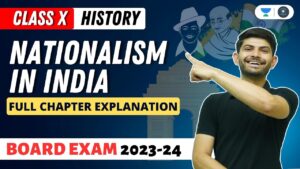
| History Core | Nationalism in India (Complete Chapter + PYQs) | Rowlatt Act, Non-Cooperation, Civil Disobedience, Simon Commission, Dandi March, Map items | 10 Marks |
| Civics Core | Power Sharing & Federalism | Belgium vs Sri Lanka, horizontal/vertical power sharing, Union/State/Concurrent lists, decentralization | 10 Marks |
| Geography & Economics | Resources & Development, Development (Economics) | Soil classification, land use, sustainable development, Per Capita Income vs HDI indicators | 10 Marks |
Examiner Advice for Writing High-Scoring Board Answers
To stand out in the evaluation pile, always begin 5-mark answers with a clear contextual sentence. Divide your answer into distinct themed subheadings (for example, when discussing the limitations of the Civil Disobedience Movement, use clear subheadings: ‘Dalit Participation and Poona Pact’, ‘Muslim Political Organizations’, and ‘Industrial Working Class Alienation’). Underline crucial historical dates, treaty names, and constitutional articles using a sharp pencil. Ensure your handwriting is spacious and legible. Through the structured video lectures, curated notes, and interactive practice provided in this masterclass, mastering Class 10 Social Science will become the most rewarding part of your board preparation.
Classes & Batches

Class 10 English Board Express: First Flight Prose, Poetry Analysis & Core Grammar Rules | Dear Sir

Class 10 Maths Full Syllabus NCERT Masterclass: Chapter-Wise Concepts, Proofs & Shortcut Tricks | Dear Sir

Class 10 Science Full Syllabus Batch 2026-27: Complete NCERT Lectures, Concept Notes & PYQs | PW Foundation
Study Resources & Notes

NCERT Class 10 Hindi Book PDF (Sparsh Part 2)

CBSE Class 10 Hindi PYQs with Solution

CBSE Class 10 Information Technology PYQs with Solution

NCERT Class 10 Economics Book PDF (Understanding Economic Development)
Quick Practice & Sets

CBSE Class 10 Science 30-Minute Rapid Chapter Mocks

CBSE Class 10 Science Chapter-wise Assertion & Reason Bank

CBSE Class 10 Maths Standard Timed Chapter Mocks



Comments (0)
No comments yet. Be the first to comment!
Please log in to comment
Log In