

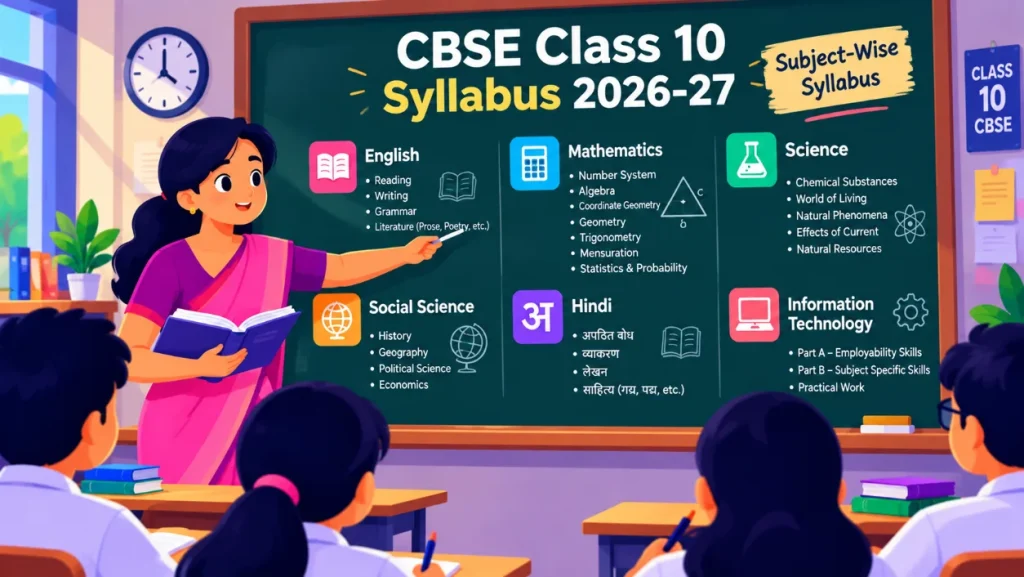
If you are in Class 10 and searching for the CBSE Class 10 Syllabus 2026-27, you are probably trying to figure out one simple thing: what exactly do I have to study for the board exams?
And honestly, checking the syllabus at the beginning of the session is one of the best things you can do. It gives you a clear idea of the chapters, topics and assessment structure before you start making a study plan.
The CBSE Class 10 syllabus covers subjects such as Mathematics, Science, Social Science, English and Hindi, along with other language and skill-based subjects depending on the student’s subject combination.
In this guide, we have covered the CBSE Class 10 syllabus 2026-27 subject-wise, the broad examination pattern, internal assessment, and a few practical tips to use the syllabus properly instead of simply downloading it and forgetting about it.
Important: CBSE can update curriculum documents, assessment guidelines or sample papers. Students should always verify the latest syllabus and examination information from the official CBSE Academic website before finalising their preparation.
Check the CBSE Class 10 Syllabus 2026-27 on Padhayi
CBSE Class 10 Syllabus 2026-27: Overview
The Class 10 syllabus is designed around different academic subjects and assessment components. For the main board subjects, students generally have to prepare for both the written examination and internal assessment.
| Subject | Board Examination | Internal Assessment | Total |
|---|---|---|---|
| Mathematics | 80 Marks | 20 Marks | 100 Marks |
| Science | 80 Marks | 20 Marks | 100 Marks |
| Social Science | 80 Marks | 20 Marks | 100 Marks |
| English | 80 Marks | 20 Marks | 100 Marks |
| Hindi | 80 Marks | 20 Marks | 100 Marks |
The exact structure can vary depending on the subject and course. Therefore, students should check the relevant CBSE curriculum and sample question paper for their particular subject.
CBSE Class 10 Mathematics Syllabus 2026-27
Mathematics is one of the subjects where having the syllabus in front of you can save a lot of unnecessary stress. Instead of jumping between random chapters, you can track your preparation topic by topic.
The major areas of the Class 10 Mathematics curriculum include:
- Number Systems and Real Numbers
- Algebra
- Coordinate Geometry
- Geometry
- Trigonometry
- Mensuration
- Statistics
- Probability
Important chapters students generally encounter in the prescribed Class 10 Mathematics curriculum include Real Numbers, Polynomials, Pair of Linear Equations in Two Variables, Quadratic Equations, Arithmetic Progressions, Triangles, Coordinate Geometry, Introduction to Trigonometry, Some Applications of Trigonometry, Circles, Areas Related to Circles, Surface Areas and Volumes, Statistics and Probability.
Do not make the mistake of deciding that a chapter is unimportant just because you find it difficult. A difficult chapter often becomes much easier after you solve a few questions systematically.
For practice, you can use the CBSE Class 10 Maths PYQs available on Padhayi.
You can also practise individual chapters such as Real Numbers, Quadratic Equations, Coordinate Geometry and Probability.
CBSE Class 10 Science Syllabus 2026-27
Science is divided across different branches, so it helps to prepare it in smaller sections rather than treating the entire subject as one giant chapter.
The Class 10 Science syllabus includes concepts from Chemistry, Biology, Physics and related environmental topics.
Major areas include:
- Chemical Reactions and Equations
- Acids, Bases and Salts
- Metals and Non-metals
- Carbon Compounds
- Life Processes
- Control and Coordination
- How Do Organisms Reproduce?
- Heredity
- Light
- The Human Eye and the Colourful World
- Electricity
- Magnetic Effects of Electric Current
- Our Environment
Science preparation should not be limited to reading the textbook. Make sure you understand diagrams, chemical equations, numerical problems, definitions and applications wherever they are relevant.
Padhayi has a dedicated CBSE Class 10 Science PYQ section for practice.
For revision, you can also explore Class 10 Science notes.
If you are working chapter by chapter, resources such as Electricity notes and Life Processes notes can be used alongside question practice.
CBSE Class 10 Social Science Syllabus 2026-27
Social Science is made up of four major areas: History, Geography, Political Science and Economics.
This is one subject where organisation matters a lot. If you try to memorise the entire syllabus in one go, things can get messy pretty quickly.
History
The prescribed History syllabus covers important developments connected with nationalism, industrialisation, globalisation and the development of print culture.
Major chapters include:
- The Rise of Nationalism in Europe
- Nationalism in India
- The Making of a Global World
- The Age of Industrialisation
- Print Culture and the Modern World
You can revise the subject using the Class 10 History notes available on Padhayi.
Geography
Class 10 Geography deals with resources, agriculture, industries, energy resources and India’s economic geography.
The major chapters include:
- Resources and Development
- Forest and Wildlife Resources
- Water Resources
- Agriculture
- Minerals and Energy Resources
- Manufacturing Industries
- Lifelines of National Economy
Students can use the Class 10 Geography notes for revision and the Social Science PYQs for practice.
Political Science
Political Science, or Civics, focuses on concepts related to power sharing, federalism, democracy, political parties and democratic outcomes.
The major chapters include:
- Power Sharing
- Federalism
- Gender, Religion and Caste
- Political Parties
- Outcomes of Democracy
For quick revision, you can explore Class 10 Civics notes.
Economics
Economics covers basic concepts related to development, sectors of the economy, money and credit, globalisation and consumer rights.
The major chapters include:
- Development
- Sectors of the Indian Economy
- Money and Credit
- Globalisation and the Indian Economy
- Consumer Rights
Students can also refer to Class 10 Economics resources while revising the subject.
CBSE Class 10 English Syllabus 2026-27
English preparation is usually divided across reading, writing and grammar, along with literature prescribed by CBSE.
The literature component includes the prescribed textbooks and their chapters, poems and supplementary reading material according to the student’s course.
Instead of memorising model answers line by line, focus on understanding the story, characters, themes, important events and central ideas. This makes it much easier to frame answers in your own words.
Padhayi provides Class 10 English notes for revision.
You can also find chapter-specific material, such as A Letter to God notes, when you want to revise one chapter instead of opening the entire syllabus again.
CBSE Class 10 Hindi Syllabus 2026-27
Hindi syllabus and textbooks depend on the Hindi course selected by the student. Therefore, students should first confirm whether they are studying the applicable Hindi course and then follow the prescribed books and curriculum.
The preparation generally involves literature, reading comprehension, grammar and writing skills as prescribed for the course.
For literature, understanding the meaning and central idea of the lesson is much more useful than blindly memorising answers.
Padhayi also has Class 10 Hindi resources that can be used for revision.
CBSE Class 10 Exam Pattern 2026-27
For the major Class 10 subjects, the broad assessment structure is generally divided into an 80-mark theory examination and 20 marks of internal assessment.
| Component | Marks |
|---|---|
| Theory / Board Examination | 80 |
| Internal Assessment | 20 |
| Total | 100 |
The exact question-paper structure is subject-specific. Students may encounter different combinations of objective questions, short-answer questions, long-answer questions, case-based questions and other competency-focused formats.
For that reason, simply knowing that a subject has an 80-mark paper is not enough. You should also look at the latest official sample question paper for that subject.
What Is Internal Assessment in Class 10?
The internal assessment component contributes to the final subject score. It is conducted through school-based activities according to the applicable CBSE assessment scheme.
Depending on the subject, assessment can include periodic tests, multiple assessment activities, portfolio work, subject enrichment activities and other prescribed components.
The exact allocation can differ according to the subject and the current CBSE guidelines.
So yes, your school work matters. Leaving everything until the board exams while ignoring internal assessments is not a particularly clever strategy.
Is the CBSE Class 10 Syllabus the Same as Previous Years?
Students should not automatically assume that the 2026-27 syllabus is identical to an older syllabus.
CBSE may revise chapters, topics, learning outcomes, assessment guidelines or examination structures from one academic session to another. This is why an old PDF shared in a WhatsApp group should not become your final source of truth.
Use the latest curriculum published by CBSE and compare it with your school’s academic plan.
The official CBSE website is available at cbse.gov.in, while academic curriculum and related resources are available through the CBSE Academic website.
How to Use the Syllabus for Board Preparation
Downloading the syllabus is easy. Actually using it is where the useful part begins.
Make a chapter checklist
Turn the syllabus into a simple checklist. Every time you complete a chapter, mark it as completed. Once you start doing this across five subjects, your preparation becomes much easier to track.
Separate learning from revision
Do not count watching a lecture or reading a chapter as revision. First understand the chapter, then practise questions, and later revise it.
Use PYQs after studying a topic
Previous-year questions help you understand how a concept can actually appear in an examination.
You can explore CBSE 2025 PYQs and CBSE 2024 PYQs on Padhayi.
Keep difficult chapters visible
Do not hide the chapters you dislike at the bottom of your notebook. Keep a separate list of difficult topics and return to them regularly. A chapter that feels horrible today can become surprisingly manageable after two or three rounds of practice.
Practise full papers before the boards
Once you have completed most of the syllabus, start solving complete question papers under timed conditions. This helps you understand whether your preparation works when the clock is actually running.
CBSE Class 10 Syllabus 2026-27: FAQs
Where can I check the CBSE Class 10 syllabus for 2026-27?
The latest official curriculum should be checked through the CBSE Academic website. You can also use the Class 10 syllabus page on Padhayi for a student-friendly reference.
How many marks is the Class 10 board examination?
For the major Class 10 subjects, the broad structure is generally 80 marks for the written examination and 20 marks for internal assessment, giving a total of 100 marks.
Does CBSE Class 10 have internal assessment?
Yes. Internal assessment forms part of the overall assessment for the major Class 10 subjects. The exact components depend on the subject and applicable CBSE guidelines.
Should I study from the syllabus or the textbook?
Use both. The syllabus tells you what is prescribed, while the prescribed textbook provides the detailed material you need to study. Your preparation should also include question practice and revision.
Are previous-year questions useful for Class 10 boards?
Yes. PYQs are useful for understanding question styles, practising concepts and becoming familiar with the examination. However, they should supplement your syllabus and textbook preparation rather than replace them.
Final Thoughts
The CBSE Class 10 Syllabus 2026-27 should be the starting point of your board preparation, not just another PDF sitting somewhere in your Downloads folder.
Start by checking the prescribed syllabus for every subject. Break large subjects into smaller sections, finish chapters systematically, practise questions regularly and keep an eye on the latest CBSE sample papers.
For Mathematics and Science, question practice is particularly important. For Social Science and languages, combine conceptual understanding with writing practice. And across every subject, do not leave revision until the final few weeks.
Most importantly, check the latest official CBSE curriculum whenever there is an update. The syllabus is your roadmap. You do not need to memorise the roadmap, but it helps to know where you are going.
For more Class 10 study material, you can explore the Padhayi Class 10 section for syllabus, notes, PYQs and practice resources.













Comments (6)
Please log in to comment
Log In