

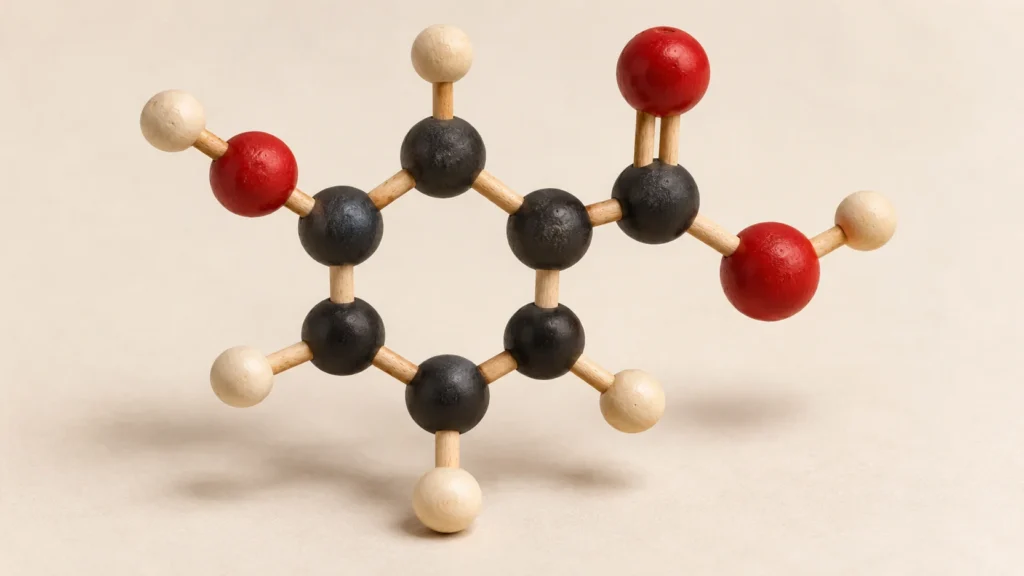
A carbon structure can look convincing because it has a tidy chain and familiar letters. Yet a single missing hydrogen or an extra bond can make the drawing chemically inconsistent. Before naming an organic compound, check whether each atom has the expected number of bonds in the simple structures you are studying.
This guide focuses on carbon’s tetravalency, hydrogen’s single bond and the way single, double and triple bonds affect a structure. We will use original checking tasks rather than long naming lists. The purpose is to make a structural formula something you can reason about, not just a picture to copy.
Count bonds around each carbon
In the ordinary neutral carbon compounds introduced at this level, carbon forms four covalent bonds. A single bond contributes one bond to each attached atom, a double bond contributes two, and a triple bond contributes three.
Hydrogen forms one bond. Oxygen commonly forms two in the simple examples, while chlorine commonly forms one. These patterns are useful for checking the familiar molecular structures in the chapter; they are not a complete description of every chemical species you may encounter in advanced chemistry.
Start with one carbon at a time. Counting only the total number of lines in the whole molecule can hide a carbon that has five bonds and another that has only three.
Example 1: a single-bond carbon chain
Consider a chain of three carbon atoms connected by single bonds: C–C–C. Each end carbon already has one bond to carbon, leaving three bonds for hydrogen. The middle carbon has two carbon-carbon bonds, leaving two bonds for hydrogen.
The completed structure is CH₃–CH₂–CH₃, with molecular formula C₃H₈. This is propane. Count the hydrogen atoms as 3 + 2 + 3 = 8 rather than attaching the same number to every carbon.
The end and middle positions have different available bonds. This explains why repeating CH₃ at every position would give the central carbon too many attachments in a continuous chain.
Example 2: a double bond changes the hydrogen count
Now consider two carbon atoms joined by a double bond. Each carbon has already used two of its four bonding capacities in the carbon-carbon connection, leaving two bonds for hydrogen.
The structure is CH₂=CH₂ and the formula is C₂H₄, ethene. A carbon-carbon double bond is not a decoration added on top of the same hydrogen pattern as ethane. The hydrogen count must change to keep each carbon’s total at four.
For comparison, ethane is CH₃–CH₃, or C₂H₆. The two formulas differ because the carbon-carbon bonding differs. Always check the drawn structure rather than deciding the hydrogen count from the carbon count alone.
Example 3: a triple bond
With C≡C, each carbon uses three bonds in the connection between the carbons. Each has room for one hydrogen bond. The structure is HC≡CH and the formula is C₂H₂, ethyne.
The sequence ethane, ethene and ethyne is a useful comparison: two carbons with single, double and triple bonds correspond to six, four and two hydrogen atoms in these simple open-chain examples.
Do not generalise that comparison to every molecule containing two carbons. Oxygen, halogens, rings and functional groups change what else is attached. The local valency check remains useful even when a simple hydrocarbon formula is no longer enough.
Identify the functional group after checking the skeleton
A functional group is the atom or group associated with characteristic chemical behaviour. In ethanol, CH₃–CH₂–OH, the hydroxyl group is attached to the carbon chain. Check that the oxygen has one bond to carbon and one to hydrogen.
In ethanoic acid, CH₃–COOH, the carboxyl group includes a carbon double-bonded to one oxygen and single-bonded to another oxygen. That group contains its own carbon atom, which must be included in the total carbon count.
A common mistake is to count only the visible CH₃ part and call ethanoic acid a one-carbon compound. The carbon in COOH is just as much part of the molecule as the carbon written at the start.
Use naming as a description of the structure
For the simple examples at this level, the carbon count provides a name stem such as meth-, eth- or prop-. The bond pattern or functional group then affects the ending. A name should match the structure you actually drew.
Before giving a name, ask: how many carbons are present, what kind of carbon-carbon bonds occur, and is there a relevant functional group? Answering those questions in that order is more reliable than guessing from a familiar-looking fragment.
For more complex structures, formal naming rules have additional details. Stay with the structures and conventions required by the question rather than inventing a name from one visible group.
Original error-checking task
A student draws CH₃=CH₃ and labels it ethene. What needs correction? Each carbon has three hydrogen bonds plus a double bond to carbon, for a total of five. That violates the intended tetravalency check.
Keeping the double bond requires changing each CH₃ to CH₂, giving CH₂=CH₂. Keeping the three hydrogens on each carbon instead requires a single carbon-carbon bond, giving ethane. The correction depends on which compound the student intends to represent.
When checking a condensed formula, expand the part that confuses you rather than redrawing every atom. For CH₃OH, show the carbon bonded to three hydrogens and to oxygen, then show oxygen bonded to hydrogen. The four-bond carbon and two-bond oxygen patterns become visible immediately. This small expansion is often enough to find an error.
Practise reconstructing rather than tracing
Draw methane, ethane, ethene, ethyne and ethanol from memory. Count bonds around each non-hydrogen atom, then count the atoms to obtain the molecular formula. If the formula and the drawing disagree, identify the exact atom causing the mismatch.
Check the examples in the Carbon and Its Compounds textbook chapter and compare your reasoning with the Carbon Compounds NCERT solutions. For additional application questions, use the Science chapter-wise practice collection and select the carbon-compound material relevant to your study.
A structure is strongest when you can explain every bond in it. Once that becomes routine, molecular formulas and simple names are much easier to check without relying on visual memory alone.












Comments (0)
No comments yet. Be the first to comment!
Please log in to comment
Log In