

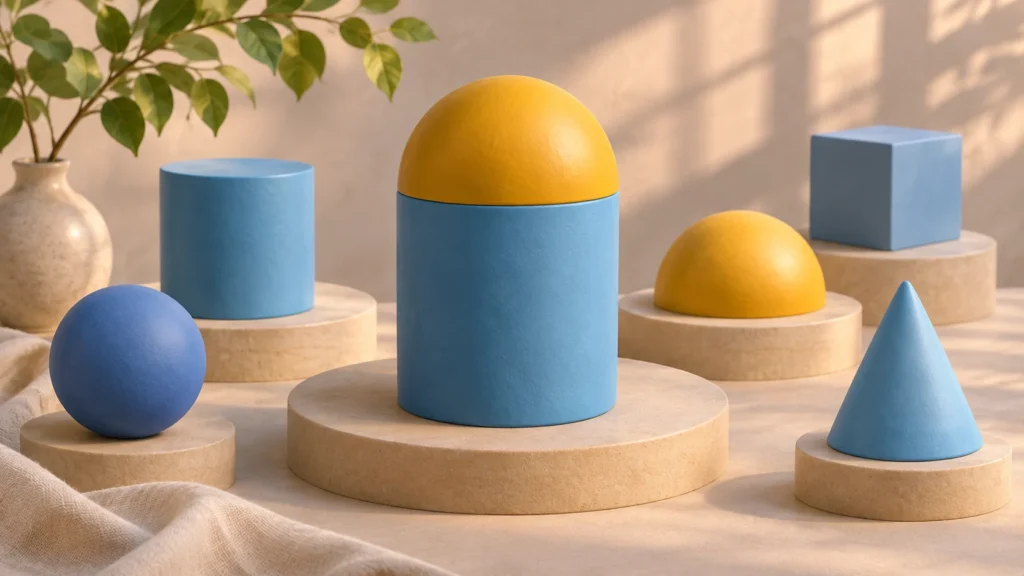
A solid made by joining two familiar shapes can have a surface area that is smaller than the sum of their separate surface areas. The reason is simple: the joined faces are inside the object. They are no longer exposed to paint, air or wrapping.
That observation matters more than memorising another long formula. For a combined solid, list the visible curved and flat surfaces, then add only those required by the question. We will use original examples involving cylinders, hemispheres and cones. The Surface Areas and Volumes textbook chapter is a useful reference for each individual shape.
Separate exposed surface from total material
When a hemisphere is attached to the top of a cylinder with the same radius, their circular joining faces disappear inside the combined object. The outside includes the cylinder’s curved side, the hemisphere’s curved surface and, if closed, the cylinder’s bottom base.
It does not include the top circular face of the cylinder or the flat circular base of the hemisphere. Counting those faces would add the hidden joining region twice.
Before using a formula, make a rough sketch and mark every exposed piece. If the question asks for painting only the curved outside, the bottom base may also be excluded. The wording decides which surfaces matter.
Original example: a cylinder with a dome
Practice problem: A solid consists of a cylinder of radius 7 cm and height 10 cm, topped by a hemisphere of the same radius. The bottom is closed. Find the total exposed surface area.
The cylinder’s curved area is 2πrh = 2π × 7 × 10 = 140π cm². The hemisphere’s curved area is 2πr² = 2π × 49 = 98π cm².
The bottom circular base contributes πr² = 49π cm². Adding only those three exposed pieces gives 287π cm². If π = 22/7 is required, this is 902 cm².
Using the cylinder’s total area plus the hemisphere’s total area would count the hidden join twice. You would then need to subtract two circular areas to recover the correct exposed surface.
Why a hemisphere has two different area formulas
The curved surface area of a hemisphere is 2πr². Its total surface area is 3πr² because a flat circular base adds another πr².
A standalone solid hemisphere placed on a table may have its flat face hidden from view, but whether you include that face depends on the requested surface. If the question asks for the entire surface of the detached solid, include the base.
For a hemisphere joined to another solid, the base is internal. Use the curved formula for the dome part unless a more unusual arrangement exposes part of that base.
Original example: a cone on a cylinder
A cone of radius 3 cm and vertical height 4 cm sits on a cylinder of the same radius and height 8 cm. The object has a closed bottom. Find its exposed surface area.
The cone’s curved area uses slant height l, not vertical height. Here l = √(3² + 4²) = 5 cm. Therefore cone curved area = πrl = 15π cm².
The cylinder curved area is 2π × 3 × 8 = 48π cm², and the bottom base is 9π cm². The exposed total is 72π cm².
The cone’s circular base and cylinder’s top are joined internally. Do not include either. Also do not use the object’s total height, 12 cm, as the cylinder height; each shape retains its own dimensions.
Use shared dimensions carefully
When two shapes meet exactly along a circular face, their joining radii must agree. A problem may give a diameter of 6 cm for one part and a radius of 3 cm for the other; those are consistent descriptions of the same join.
If the radii differ, part of a flat circular surface may remain exposed as a ring. Then the simple same-radius formula no longer captures the full exterior.
For a small dome on a wider cylinder, the uncovered top ring has area πR² − πr², where R is the cylinder radius and r is the dome’s base radius. Draw the join before deciding which circular regions disappear.
Surface area and volume combine differently
For nonoverlapping solid parts joined along a face, the total volume is the sum of their volumes. The shared face has no volume to subtract. Surface area, however, loses the two joining faces from the exterior.
In the cylinder-and-hemisphere example, the volume would be πr²h + (2/3)πr³. That is a different task from adding exposed areas and has cubic units.
A question about paint or polishing usually concerns surface area; a question about capacity or material quantity often concerns volume. Read the exact wording instead of choosing a formula solely from the picture.
Check the units and scale
Every surface term must have square units. If you add 2πrh to πr², both have units of length squared. Accidentally adding a height by itself, such as 10 cm, would combine unlike quantities.
If all linear dimensions double, the exposed area scales by four, while volume scales by eight. This gives a useful check when a question compares two similar combined solids.
Keep π symbolic until the final step where practical. Exact expressions make it easier to see which area pieces have been included and avoid repeated rounding.
Try a smaller dome problem
A cylinder of radius 4 cm and height 6 cm has a hemispherical top of radius 4 cm and a closed bottom. The curved cylinder contributes 48π, the dome contributes 32π and the bottom contributes 16π.
The exposed surface area is 96π cm². If the question asks for only the curved exterior, remove the bottom term and report 80π cm². The geometry is unchanged; the requested surfaces differ.
Practise making the surface list
Compare your list of exposed pieces with the Surface Areas and Volumes NCERT solutions. Then choose a fresh combined-solid item from the chapter-wise mensuration practice collection.
Write the list before the arithmetic: cylinder curve, dome curve, bottom base, or whatever the object actually exposes. That short inventory is the most dependable way to prevent hidden faces from entering the answer.












Comments (0)
No comments yet. Be the first to comment!
Please log in to comment
Log In