

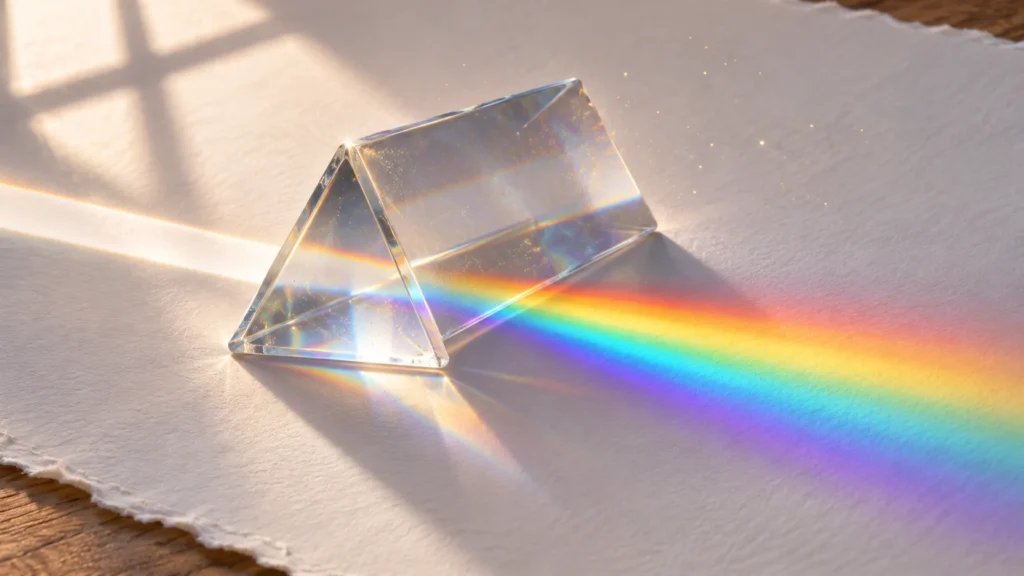
A prism makes a spectrum, while the sky looks blue. Both involve light, but they are explained by different processes. Dispersion separates components because their propagation through a medium differs. Scattering redirects light through interactions with particles or fluctuations in a medium.
The distinction matters because memorised colour words can tempt you to use the same explanation everywhere. We will connect each process to its mechanism, then use prism, sky and sunset examples to show what the words actually mean.
White light contains a range of wavelengths
White light can contain a mixture of visible wavelengths. In a simplified school spectrum, the colours are named from violet through red, but the physical spectrum is continuous rather than seven sharply separated stripes.
A transparent prism does not manufacture all those colours from nothing. It changes their directions differently, making the components more spatially separated.
This is a useful first check: when an answer says the prism “adds colour to white light”, replace that with the idea of separating components already present in the incident light.
Dispersion depends on wavelength
The refractive index of a material can vary with wavelength. In ordinary glass under the familiar visible-light conditions, shorter visible wavelengths are generally refracted more strongly than longer ones.
As light passes through the prism’s surfaces, different wavelengths emerge in different directions. The resulting spread is called dispersion. Violet is more deviated than red in the standard school glass-prism example.
Do not interpret the coloured rays as light travelling at different vacuum speeds. All electromagnetic wavelengths have the same speed in vacuum. Their speeds in a material differ because the material’s refractive behaviour depends on wavelength.
A second prism can recombine the components
A suitable arrangement of prisms can bring the separated components together again to produce white light. This supports the idea that the first prism separated the mixture rather than permanently staining the light.
The arrangement and alignment matter. Simply placing any second prism anywhere does not guarantee perfect recombination. In a written question, follow the stated geometry.
The broader lesson is that dispersion is a change in the directions of wavelength components. It is not the same as absorbing all colours except one, which is another way coloured appearances can arise.
Scattering redirects light
Scattering occurs when light interacts with particles or variations in a medium and is redirected. The amount and angular pattern depend on factors including particle size and wavelength.
For particles much smaller than visible wavelengths, the familiar Rayleigh-scattering model predicts much stronger scattering at shorter wavelengths. The wavelength dependence is often summarised as an inverse fourth-power relationship.
This is different from a prism giving different refracted directions at smooth boundaries. The sky does not behave as one giant glass prism separating white light into a neat row of colours.
Why the daytime sky appears blue
Sunlight passing through the atmosphere is scattered by molecules and other small-scale components. Shorter visible wavelengths are scattered more strongly than longer red wavelengths in the relevant molecular-scattering model.
Light scattered toward an observer from many directions contributes to the sky’s colour. The familiar blue appearance also depends on the incoming solar spectrum and the sensitivity of human vision.
This is why “violet scatters more, so the sky must look violet” is too simple. The physical scattering strength is one part of the explanation; the available spectrum and visual response also matter.
Why the Sun can look redder near the horizon
When the Sun is low in the sky, sunlight reaching an observer travels through a longer atmospheric path than it does when the Sun is high overhead in the familiar geometric comparison.
More of the shorter-wavelength light is scattered out of the direct beam along that path. The transmitted light can therefore be relatively enriched in red and orange components.
The Sun itself has not suddenly changed into a red light source because evening arrived. The path through the atmosphere changes the balance of light reaching the observer. Clouds, dust and other atmospheric conditions can further influence the appearance.
Do not use one scattering rule for every particle
The strong short-wavelength preference applies to particles much smaller than the wavelength in the simplified Rayleigh case. Larger particles can scatter visible wavelengths more similarly, contributing to white or grey appearances in clouds and other settings.
Therefore “all scattering makes things blue” is wrong. You need the size regime and conditions. A classroom Tyndall-effect example shows a beam becoming visible through scattering, but the exact observed colour depends on the setup.
Keep this distinction modest in an exam answer. Explain the mechanism relevant to the question rather than adding every advanced scattering category.
Original sorting task
Classify these descriptions: a spectrum after a glass prism; a visible light path in a suitable colloidal mixture; blue sky; and a reddish direct Sun near the horizon. The first is dispersion. The others involve scattering and the changing light reaching the observer.
Now explain one difference between the first and second examples. The prism redirects wavelength components through refraction at its surfaces, while the colloidal mixture redirects light through interactions with dispersed particles.
A second question asks whether the colours travel at different speeds in vacuum. They do not. The wavelength-dependent behaviour discussed for the prism concerns propagation in the material.
A useful verbal check is to ask where the light is redirected. In the prism example, refraction at the shaped boundaries separates the outgoing wavelength components. In atmospheric scattering, interactions throughout the medium send light into different directions. The resulting colours can be familiar, but the route producing them is not the same. Naming that route is the core of a good explanation.
Practise naming the mechanism
Review the Human Eye and Colourful World textbook chapter and label each example with its process before learning the full explanation. Compare your reasoning with the Human Eye NCERT solutions.
Then choose a colour-of-light question from the Human Eye practice collection. Begin with “This is dispersion because…” or “This is scattering because…” and complete the mechanism. Starting with the cause keeps a familiar colour from pulling you toward the wrong explanation.












Comments (0)
No comments yet. Be the first to comment!
Please log in to comment
Log In