

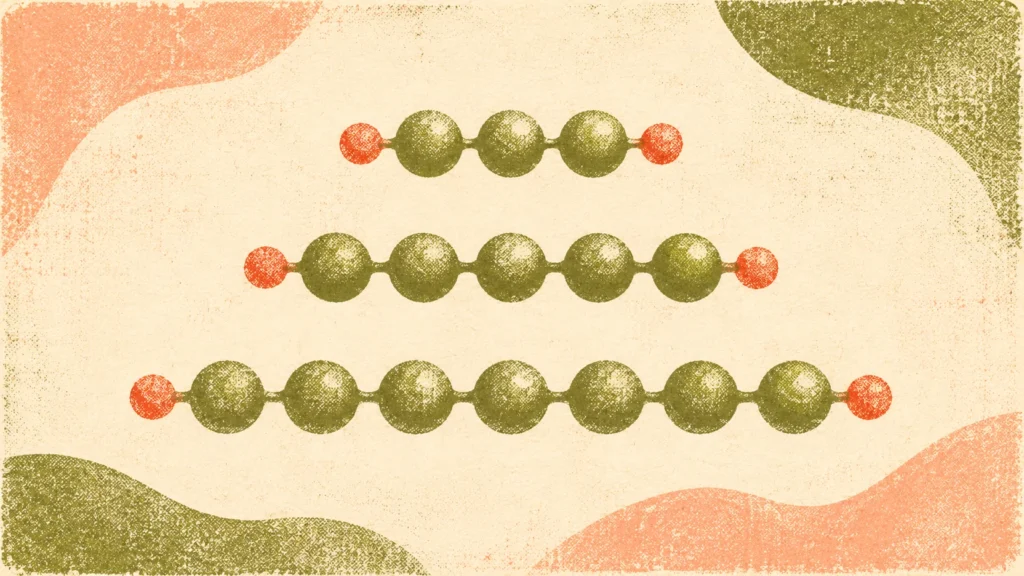
Two organic compounds may look similar because both contain carbon and hydrogen. That alone does not put them in the same homologous series. You need to examine the functional group and the repeating change from one member to the next.
A homologous series is useful because it organises many compounds into a family with a common structural pattern and related chemical behaviour. This article shows how to recognise that family, interpret the CH₂ difference and avoid confusing a shared element with a shared functional group.
Look for the feature that stays the same
Members of a homologous series have the same functional group and a common general formula within the family being considered. Consecutive members differ by one carbon atom and two hydrogen atoms, written as a CH₂ unit.
The shared functional group helps explain similar chemical properties. The growing carbon chain helps explain gradual changes in some physical properties. Those two ideas belong together: a stable chemical feature sits within molecules whose overall size increases.
Do not expect every physical property to remain identical. If all properties were exactly the same, there would be little reason to distinguish the members as separate compounds.
Use alkanes as a first pattern
For simple open-chain saturated hydrocarbons, the alkane formula is CₙH₂ₙ₊₂. Methane is CH₄, ethane is C₂H₆, and propane is C₃H₈. Moving from one to the next adds CH₂.
Compare the differences explicitly: C₂H₆ minus CH₄ gives one extra carbon and two extra hydrogens. C₃H₈ compared with C₂H₆ gives the same change. This is a composition comparison, not an instruction to subtract actual molecules in a reaction.
All these examples have only single carbon-carbon bonds in the relevant open-chain structures. A compound with a different bonding pattern should not be placed in the alkane series merely because its carbon count fits a familiar number.
A functional group gives another family
Consider methanol, CH₃OH, and ethanol, C₂H₅OH. Both contain a hydroxyl group attached in the alcohol structure, while ethanol has one additional CH₂ unit compared with methanol.
The OH group is the important shared functional feature here. Simply finding oxygen in two compounds is not enough. Ethanol and ethanoic acid both contain oxygen, but they have different functional groups and do not belong to the same homologous series.
Write the functional group clearly when comparing formulas. Condensed formulas such as C₂H₅OH make the alcohol group easier to see than a molecular formula that lists only total atom counts.
Why the mass difference is fourteen
A CH₂ unit contributes approximately 12 units from carbon and 2 from the two hydrogen atoms, giving a relative molecular mass difference of 14 between consecutive members.
This is a useful check, but use it together with the structural condition. Two unrelated compounds can happen to have molecular masses differing by 14. A numerical gap alone does not establish a homologous series.
Similarly, a pair several steps apart may differ by more than one CH₂ unit and still belong to the same series. Methane and propane are not consecutive members, but both are alkanes. Their difference corresponds to two CH₂ steps.
Separate similar chemical behaviour from gradual physical change
Members share a functional group, so they often undergo related kinds of chemical reactions. The growing carbon chain changes molecular size and intermolecular interactions, which can produce trends in physical properties such as boiling point.
In many familiar homologous series, boiling points tend to increase as chain length increases. Solubility in water may also change as the nonpolar carbon portion becomes larger. These are trends to interpret in the context of the family, not a claim that every property rises smoothly in every possible comparison.
An answer such as “all members have the same boiling point because they share a functional group” confuses chemical similarity with complete physical identity.
Original sorting task
Sort these into suitable pairs: CH₄, C₂H₆, CH₃OH and C₂H₅OH. Methane and ethane form one pair of consecutive alkane members. Methanol and ethanol form a pair of consecutive alcohol members.
Now compare C₂H₆ with C₂H₅OH. They have the same number of carbon atoms but different functional structures. Equal carbon count does not make them homologues.
Compare CH₃OH with C₂H₆. Their overall formulas may both look small and simple, but the alcohol group appears in only one. A good classification begins with functional structure, not with molecule size alone.
Work out a missing member
Suppose a simple alkane series lists C₂H₆, __, C₄H₁₀. The missing consecutive member is C₃H₈, because each step adds CH₂. Check it against CₙH₂ₙ₊₂ with n = 3: the hydrogen count is 8.
For the alcohol sequence CH₃OH, C₂H₅OH, __, the next simple member can be written C₃H₇OH. The OH group remains while the carbon-containing portion grows by CH₂.
When isomerism becomes possible, a molecular formula can correspond to more than one structure. A series pattern tells you the composition family; it does not always identify one unique structural arrangement.
Use a three-part answer
If asked why compounds belong to the same homologous series, state the common functional group or family pattern, show the CH₂ difference for consecutive members, and mention their related chemical properties when relevant.
If asked for a general formula, be clear which family and structural conditions it describes. The alkane formula CₙH₂ₙ₊₂ applies to the simple open-chain saturated hydrocarbon family, not to every organic compound containing only carbon and hydrogen.
Keep consecutive members separate from any two members of a series. If two alcohols differ by two CH₂ units, there is a member between them in the simple chain sequence. They can still belong to the same family. The word consecutive adds a condition about neighbouring positions, just as it does in a numerical sequence.
Practise with the structures visible
Use the Carbon and Its Compounds textbook chapter to compare structural and molecular formulas. Then review the Carbon Compounds NCERT solutions after trying a series question independently.
For a fresh task from the Science chapter-wise practice collection, circle the functional group before comparing carbon counts. That order keeps the chemistry in control of the pattern and prevents a numerical coincidence from becoming a mistaken classification.












Comments (0)
No comments yet. Be the first to comment!
Please log in to comment
Log In