

A long paragraph in a Maths question can look harder than the calculation inside it. Before reaching for a formula, turn the story into three things: the information given, the quantity being asked for, and a small sketch or equation.
Here is a practical way to approach Class 10 Maths case-study questions, followed by an original worked example. If a concept needs a refresh first, use the Class 10 Maths NCERT solutions to understand the method, then try a fresh question without looking at the answer.
Read the sub-questions before doing the calculation
Read the situation once, then look at what each part asks you to find. One part might ask for an expression, another for an area, and another for an explanation. Writing a page of calculations before checking those instructions can send you in the wrong direction.
On rough paper, make a short list:
- Given: lengths, prices, coordinates or other useful values.
- Find: the exact quantity requested in this part.
- Connection: the formula, relationship or diagram that links them.
A diagram in the question may help you understand the setup, but use the stated measurements rather than guessing a length from how the picture looks.
Worked example: a garden with an inside path
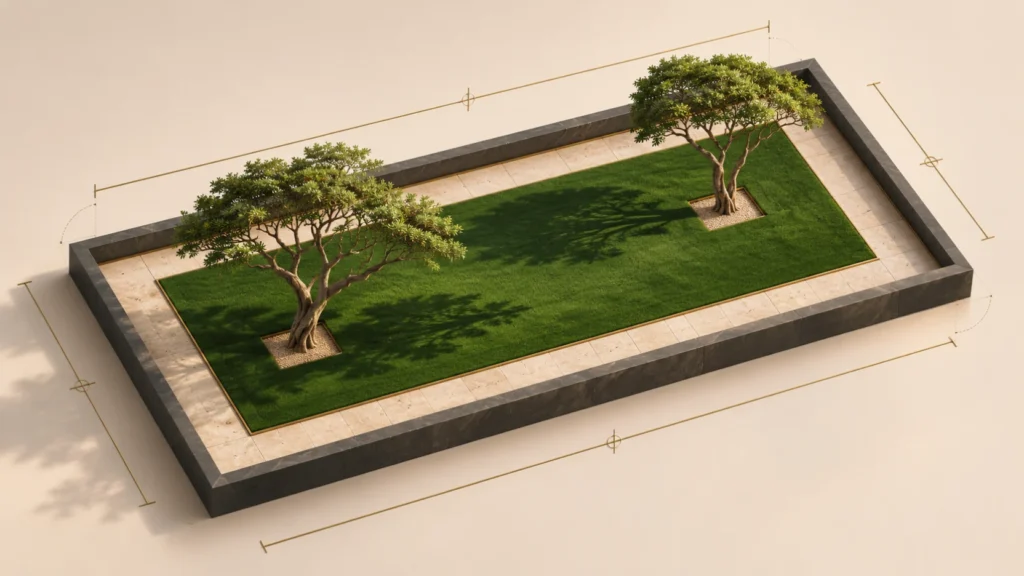
Original practice example, not a CBSE question: A rectangular school garden measures 18 m by 12 m. A path 1 m wide runs all around the inside edge. The remaining middle portion is planted with grass.
Try these three tasks before reading the solution: find the dimensions of the grassy rectangle, calculate its area, and calculate the area covered by the path.
1. Sketch the outer and inner rectangles
The path uses 1 m at both ends of each dimension. That means the grassy portion is 18 − 2 = 16 m long and 12 − 2 = 10 m wide. Subtracting only 1 m from each dimension would leave out the path on the opposite side.
2. Calculate the area actually requested
Grassy area = 16 × 10 = 160 m². The whole garden covers 18 × 12 = 216 m², so the path covers 216 − 160 = 56 m².
3. Check whether the answer fits the situation
The grass and path together should occupy the original garden: 160 + 56 = 216 m². The units are square metres because the question asks for area. This check catches two common slips: mixing up area and perimeter, and subtracting the path width from just one side.
What if the next part changes the condition?
Suppose a follow-up asks for the grassy area when the path is 2 m wide instead. Start with the new condition: the inner dimensions become 14 m and 8 m, giving 112 m². Do not automatically reuse the previous dimensions.
Likewise, read whether a question says “inside” or “outside”. Those words change the model. A familiar-looking story is a reason to read carefully, not a reason to skip straight to a remembered answer.
A short practice task for today
If you need the textbook itself, use the official NCERT online textbook portal and select the book prescribed for your class and course.
- Choose one question from the Maths Standard chapter-wise PYQ collection that matches a topic you have studied.
- Write “given, find, connection” before solving it.
- Check the solution only after your own attempt. Record the first step where your reasoning went wrong, rather than copying the entire answer.
For paper-format practice, use the official CBSE Class X sample papers and marking schemes for 2026–27. Select Mathematics Basic or Standard to match your course. Use the marking scheme to review the question you attempted; a practice example here is not a prediction of the board paper.
Which part slows you down most: understanding the paragraph, choosing the relationship, or checking the calculation?












Comments (0)
No comments yet. Be the first to comment!
Please log in to comment
Log In