

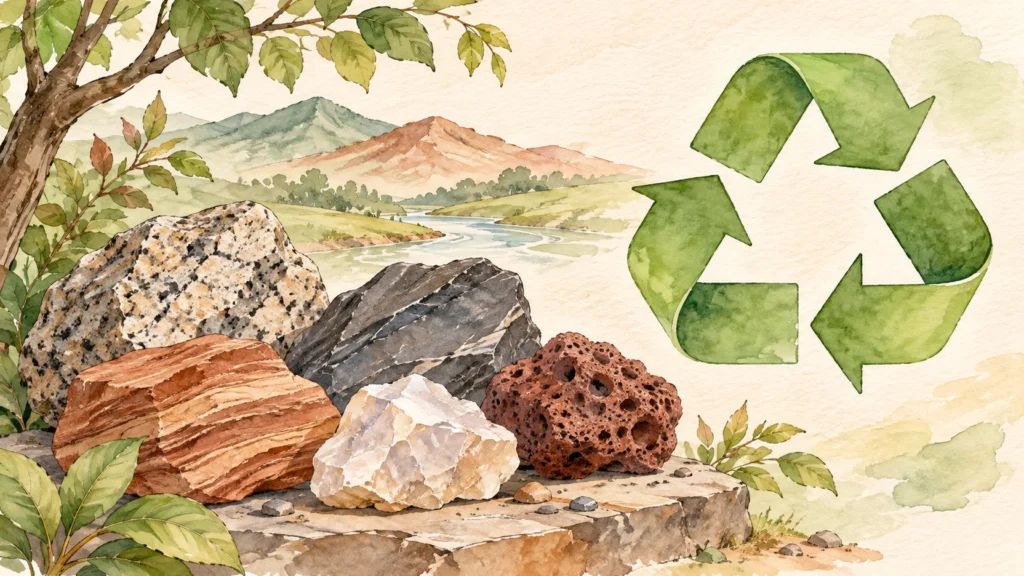
“Minerals are limited, so we should conserve them” is a reasonable starting point. A developed Geography answer goes further. It explains the difference between a geological stock and the rate of use, the impacts of extraction, and the ways efficiency and recycling can reduce pressure on resources.
Conservation does not simply mean leaving every mineral untouched. It means using resources carefully while considering present needs and future possibilities. The Minerals and Energy Resources notes provide the chapter structure; this guide shows how to connect the reasons for conservation to practical concepts.
Formation and use occur on different timescales
Many mineral resources form through geological processes over very long periods. Human extraction and use can draw on those stocks much faster than comparable deposits are formed.
This mismatch explains why a resource can be valuable and widely used yet still require conservation. The question is not whether another mineral particle will ever form anywhere. It is whether usable deposits can be replenished on a timescale relevant to human demand.
In an answer, state the timescale connection rather than saying minerals “never form”. A careful explanation distinguishes geological formation from practical renewal within a human planning period.
Availability is not the same as easy access
A mineral may exist in the Earth’s crust without being equally concentrated or equally accessible everywhere. Extraction depends on the deposit and the means available to use it.
As easier deposits are used, obtaining material elsewhere may involve different costs, technology or impacts. This is one reason conservation matters before a resource is literally absent from the planet.
Do not reduce the issue to a countdown claiming that a mineral will disappear in a precise number of years unless the question supplies a source and assumptions. Such predictions depend on changing information about use, technology and deposits.
Extraction can create wider costs
Mining and processing can affect land, water, air and people in surrounding areas. The specific effects depend on the activity and how it is managed. A complete answer considers these consequences alongside the usefulness of the material.
For example, a fictional extraction project may provide material for production while also disturbing land that needs careful management. The existence of a benefit does not erase the impact, and recognising an impact does not mean the material has no value.
This balanced reasoning supports conservation: reducing unnecessary demand or waste can reduce pressure for additional extraction and its associated burdens.
Efficiency means obtaining more useful service
Efficient use aims to reduce avoidable material loss while meeting the intended purpose. If manufacturing wastes less metal, more of the extracted resource becomes part of a useful product.
Imagine a fictional workshop that changes its process so that fewer pieces are discarded during production. It can make the same number of useful items with less new material. The example illustrates efficiency without prescribing a technical method.
In an explanation, connect efficiency to reduced input requirements or waste. Saying “use technology” is too broad unless you show what the technology improves.
Recycling can return materials to use
Recycling processes recovered materials so they can be used again. For suitable materials, this can reduce the need for new extraction and help manage discarded products.
However, recycling does not mean every material can be recovered perfectly without energy, cost or loss. Collection, separation and processing matter. The useful claim is that recycling can contribute to conservation, not that it makes resources unlimited.
For a Class 10 answer, name the material or product in your illustration and explain how recovery reduces demand for fresh input. That makes the mechanism clearer than a slogan saying “recycle everything”.
Reuse and recycling are not identical
Reusing an object means using it again without necessarily processing it into raw material. Recycling changes recovered material through a processing step. Both can reduce waste, but they work differently.
A sturdy container used again illustrates reuse. Metal recovered and processed into a new product illustrates recycling. If a question asks for methods of conservation, you can mention both while distinguishing their roles.
Do not assume that extending a product’s life removes all impacts. The point is to avoid unnecessary replacement and material use where appropriate, while recognising that products and circumstances differ.
Substitution needs thoughtful explanation
Sometimes a different material or design can reduce pressure on a scarce input. This is a possibility rather than a guarantee that every substitute is better in every respect.
A substitute may have its own resource needs, performance limits or environmental effects. A sound educational answer says that alternatives should be evaluated for suitability, not chosen solely because they are different.
This keeps conservation linked to responsible decisions. The aim is to meet needs with less avoidable pressure, not simply move a problem from one material to another without examination.
Original case: school furniture
Imagine a fictional school replacing damaged metal desks. It can first check which parts can be repaired, which items can be reused and which unusable metal can be collected for recycling through an appropriate channel.
The conservation logic is to extend useful life and recover material rather than discard everything automatically. A purchase decision should also consider durability and suitability.
This example does not require students to dismantle furniture or handle scrap. It illustrates planning at an institutional level, where responsible adults and suitable services manage the work.
When reviewing a proposed method, ask what it changes: the amount extracted, the waste produced, the useful life of an object or the recovery of discarded material. Naming that change prevents different conservation methods from becoming a memorised list with no explanation of their contribution.
Write reasons and methods as linked pairs
A reason might be that usable stocks are drawn down much faster than geological formation. A linked method is reducing waste through efficient use. Another reason concerns extraction impacts, with reuse and recycling helping reduce pressure for additional material.
Read the NCERT Minerals and Energy Resources chapter, then try a question from the Minerals and Energy Resources practice collection. Check whether your answer explains both why conservation matters and how a named method contributes. That connection turns a short list into a reasoned Geography response.












Comments (0)
No comments yet. Be the first to comment!
Please log in to comment
Log In