

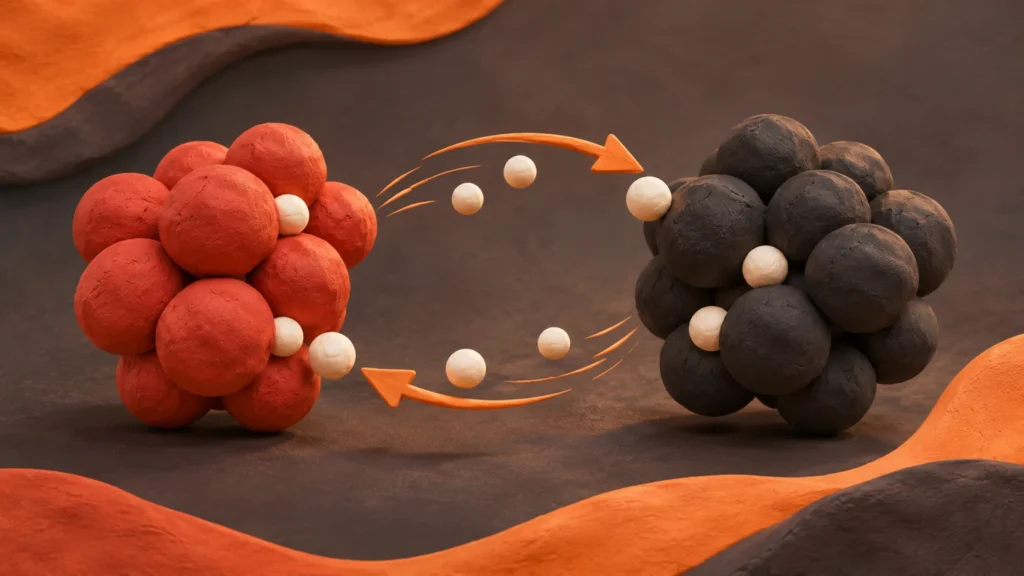
Oxidation and reduction are often introduced as a pair of definitions, then forgotten as soon as an equation contains several substances. The useful habit is to follow one substance from reactants to products. Ask whether it gains or loses oxygen or hydrogen, and then identify the other substance changing alongside it.
This approach is especially helpful for the oxygen-and-hydrogen examples used in introductory Class 10 chemistry. It does not replace the broader electron-based meaning you may study later. Here the goal is to read suitable equations carefully, distinguish a substance undergoing oxidation from an oxidising agent, and support the names with a reason.
Begin with one change at a time
In this introductory treatment, gain of oxygen or loss of hydrogen is oxidation. Loss of oxygen or gain of hydrogen is reduction. Those paired descriptions can feel confusing if you try to apply all four at once.
Instead, choose a reactant whose change is clear. If a metal oxide becomes the metal, that substance has lost oxygen and has been reduced. Then look for the substance receiving that oxygen. The two changes belong to the same overall reaction.
Always name the actual substance being followed. “Oxygen is reduced because it disappears” is usually an unreliable description of a school equation. Atoms are rearranged; the oxygen may have become part of another product rather than vanished.
Worked example: copper oxide and hydrogen
Consider the equation CuO + H₂ → Cu + H₂O. We are interpreting a reaction description, not suggesting an unsupervised practical activity. Track copper oxide first: CuO becomes Cu, so it loses oxygen.
Therefore copper oxide is reduced. Now track hydrogen: H₂ becomes H₂O, so it gains oxygen. Hydrogen is oxidised. Both statements use the same oxygen transfer viewed from different substances.
An answer that merely says “oxidation and reduction occur” is incomplete if the question asks you to identify the substances. Write “hydrogen is oxidised because it gains oxygen, while copper oxide is reduced because it loses oxygen.” Each label is tied to visible evidence in the equation.
The agent names describe their effect on something else
An oxidising agent causes another substance to undergo oxidation and is itself reduced. A reducing agent causes another substance to undergo reduction and is itself oxidised. The agent name therefore points to its effect on the reaction partner.
In the copper oxide example, CuO supplies oxygen to hydrogen. It acts as the oxidising agent and is reduced to copper. Hydrogen removes oxygen from CuO. It acts as the reducing agent and is oxidised to water.
This is why the sentence “the oxidising agent is oxidised” is not a safe memory rule. Keep two questions separate: what change happens to this substance, and what change does it cause in the other substance?
Use a two-row tracking table
On rough paper, make columns for reactant, corresponding product, oxygen change and conclusion. For CuO, the row reads CuO → Cu, loses oxygen, reduced. For H₂, it reads H₂ → H₂O, gains oxygen, oxidised.
Add the agent names only after the changes are correct. This reduces the chance of reversing them. You are building the answer from the equation rather than trying to recall which familiar substance is “usually” an agent.
The same substance can play different roles in different chemical settings. The equation determines the role. Do not identify an oxidising agent purely because its formula contains oxygen; ask whether it actually causes oxidation in the given reaction.
A second equation to read
Consider ZnO + C → Zn + CO. Zinc oxide loses oxygen as it becomes zinc, so ZnO is reduced. Carbon gains oxygen as it becomes carbon monoxide, so carbon is oxidised.
Carbon is the reducing agent because it removes oxygen from zinc oxide. Zinc oxide is the oxidising agent because it provides oxygen to carbon. Notice that the reasoning has the same structure as before even though the reactants differ.
Check atom balance separately: one zinc, one oxygen and one carbon appear on each side. Balancing ensures conservation of atoms, but balancing alone does not tell you which species is oxidised. The classification comes from following the chemical change.
Hydrogen provides another useful route
Some suitable examples are easier to interpret through hydrogen transfer. A substance that gains hydrogen is reduced, while one that loses hydrogen is oxidised. Use the definition that reveals the change clearly rather than forcing oxygen into an equation where it is not the helpful clue.
However, do not assume that every equation containing hydrogen is a simple hydrogen-transfer example. A hydrogen atom may appear in several substances, and the complete reaction needs attention. For a beginner’s answer, use the specific change established by the supplied equation and the definitions taught in the question’s context.
The Chemical Reactions and Equations textbook chapter gives the surrounding treatment of redox reactions. Read the explanation alongside the equations so that the words and formulas reinforce one another.
Oxidation is broader than burning
Burning magnesium in oxygen is oxidation because magnesium combines with oxygen to form magnesium oxide. But oxidation does not mean only a visible flame. Slower chemical changes can also involve oxidation.
Corrosion and rancidity are familiar contexts where oxidation is discussed. When explaining them, connect the change to the material involved rather than claiming that every damaged metal or unpleasant smell has the same cause. These everyday examples illustrate the concept; they do not replace a reaction-specific explanation.
Try a classification question
For Fe₂O₃ + 3CO → 2Fe + 3CO₂, identify the substance reduced and the substance oxidised. Iron oxide loses oxygen to form iron, so it is reduced. Carbon monoxide gains oxygen to become carbon dioxide, so it is oxidised.
Therefore CO acts as the reducing agent, while Fe₂O₃ acts as the oxidising agent. If your agent names disagree with your oxygen-tracking rows, check the distinction between a substance’s own change and its effect on another substance.
Turn definitions into explanations
Use the Chemical Reactions NCERT solutions after writing your own answer. Compare whether you have named both the substance and the reason. A correct definition copied at the top cannot repair an incorrect identification below.
Then practise with the Chemical Reactions chapter-wise collection. Start each redox answer by tracking one reactant into its product. Once that change is clear, its partner and the agent names usually become much easier to identify.












Comments (0)
No comments yet. Be the first to comment!
Please log in to comment
Log In