
NCERT Class 10 Hindi Book PDF (Kshitij Part 2)
Contents
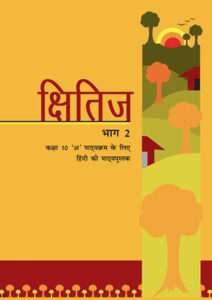
Chapter 1: Surdas Ke Pad
Chapter 2: Ram Lakshman Parshuram Samvad
Chapter 3: Aatmakathya
Chapter 4: Utsah Aur At Nahin Rahi Hai
Chapter 5: Yeh Danturit Muskan Aur Fasal
Chapter 6: Sangatkar
Chapter 7: Netaji Ka Chashma
Chapter 8: Balgobin Bhagat
Chapter 9: Lakhnavi Andaz
Chapter 10: Ek Kahani Yeh Bhi
Mastering CBSE Class 10 Hindi Course A: Official NCERT Kshitij-2 (क्षितिज भाग 2) Guide
In the academic curriculum of secondary education, CBSE Class 10 Hindi Course A (Subject Code 002) is a cornerstone discipline designed to refine literary sensibilities, linguistic accuracy, cultural heritage, and aesthetic maturity. Prescribed by the National Council of Educational Research and Training (NCERT), the core textbook Kshitij Part 2 (क्षितिज भाग – 2) provides an expansive panorama of Indian literary excellence, harmoniously uniting the devotion (भक्ति काल) and heroic grandeur (रीति/आदिकाल) of classical poets with the radical social realism, progressive humanism, and psychological depth of modern Hindi luminaries.
In the CBSE Class 10 Board Examination, Hindi Course A carries a total of 80 marks in the theoretical paper, alongside a 20-mark internal assessment component. Within the theoretical framework, Kshitij Part 2 constitutes the absolute lion’s share of the literature curriculum, directly contributing approximately 26 to 28 marks across Section B and Section C through objective extract-based questions, short conceptual inquiries (2 marks each), and analytical long-answer evaluative questions (4 marks each). Achieving a score of 95%+ requires students to master not only thematic summaries, but also the nuanced classical dialects (Braj Bhasha and Awadhi), complex rhetorical figures (अलंकार), and metric structures (छंद विधान).
CBSE Class 10 Hindi Kshitij-2: Complete Rationalised Syllabus Blueprint
Under the latest rationalised curriculum published by NCERT, discontinued chapters (such as works by Dev, Girija Kumar Mathur, Rituraj, Mahavir Prasad Dwivedi, and Sarveshwar Dayal Saxena) have been permanently removed, leaving twelve core masterworks organized into distinct Poetry and Prose sections:
| अध्याय सं. (Chapter) | पाठ का नाम (Title) | कवि / लेखक (Author) | विधा एवं मुख्य विषय (Genre & Focus) |
|---|---|---|---|
| पाठ 1 (Chapter 1) | पद (Surdas ke Pad) | सूरदास (Surdas) | भ्रमरगीत सार (Braj Bhasha): Gopi-Uddhav dialogue; triumph of love over dry yoga philosophy |
| पाठ 2 (Chapter 2) | राम-लक्ष्मण-परशुराम संवाद | तुलसीदास (Tulsidas) | रामचरितमानस बालकांड (Awadhi): Veer and Raudra rasa; wit, heroism, and chivalric honor |
| पाठ 3 (Chapter 3) | आत्मकथ्य (Aatmakathya) | जयशंकर प्रसाद (Jaishankar Prasad) | छायावादी कविता: Reluctance to write autobiography; modesty and poignant personal sorrow |
| पाठ 4 (Chapter 4) | उत्साह / अट नहीं रही है | सूर्यकांत त्रिपाठी ‘निराला’ | आह्वान गीत एवं प्रकृति वर्णन: Clouds as revolutionary catalysts; spring beauty of Phalguna |
| पाठ 5 (Chapter 5) | यह दंतुरित मुस्कान / फसल | नागार्जुन (Nagarjun) | वात्सल्य एवं कृषि-संस्कृति: Infant’s magical smile; crop as the collective sweat of mankind |
| पाठ 6 (Chapter 6) | संगतकार (Sangatkar) | मंगलेश डबराल | समकालीन कविता: Unsung accompaniment in arts and life; humanism of background support |
| पाठ 7 (Chapter 7) | नेताजी का चश्मा | स्वयं प्रकाश | देशभक्ति कहानी: Captain the spectacle-seller; true patriotism beyond military uniforms |
| पाठ 8 (Chapter 8) | बालगोबिन भगत | रामवृक्ष बेनीपुरी | रेखाचित्र (Sketched Memoir): Kabir-panthi saintliness within household life; widow remarriage |
| पाठ 9 (Chapter 9) | लखनवी अंदाज | यशपाल (Yashpal) | व्यंग्य (Satire): Feudal pretension; sniffing cucumber slices; critique of abstract fiction |
| पाठ 10 (Chapter 10) | एक कहानी यह भी | मन्नू भंडारी (Mannu Bhandari) | आत्मकथ्य: Father-daughter intellectual conflict; freedom movement participation; female agency |
| पाठ 11 (Chapter 11) | नौबतखाने में इबादत | यतीन्द्र मिश्र (Yatindra Mishra) | व्यक्ति-चित्र: Ustad Bismillah Khan; devotional Shehnai; Benaras Ganga-Jamuni syncretism |
| पाठ 12 (Chapter 12) | संस्कृति (Sanskriti) | भदंत आनंद कौसल्यायन | वैचारिक निबंध: Clear distinction between civilization (सभ्यता) and authentic culture (संस्कृति) |
CBSE Marking Scheme Rubrics & High-Scoring Examination Strategy
To secure a score of 95%+ in Class 10 Hindi Course A, students must approach Kshitij-2 with analytical rigor:
- भाव-सौंदर्य एवं शिल्प-सौंदर्य का संतुलन: In poetry questions, examiners allocate marks specifically for identifying poetic devices (उपमा, रूपक, अनुप्रास, उत्प्रेक्षा, मानवीकरण, अतिशयोक्ति), metric rhythm (चौपाई, दोहा, पद, मुक्त छंद), and dialectical nuances (मधुर ब्रजभाषा, तत्समप्रधान अवधी, खड़ीबोली).
- गद्य में सूक्ष्म व्यंग्य एवं वैचारिक बिंदु: In prose questions, avoid merely narrating the story. Clearly state the underlying social satire—such as the decay of feudal aristocracy in Lakhnavi Andaz or the distinction between invention and consumption in Sanskriti.
- CBSE Answer-Writing Discipline: Adhere strictly to word limits (25-30 words for 2-mark questions; 50-60 words for 4-mark questions). Opening sentences must directly address the central premise with correct literary diction.
CBSE Board Examination Time Management & Answer Structuring Strategy
To successfully finish the 80-mark theoretical paper within the stipulated 3-hour duration, students should adhere to the following tactical time-management blueprint:
- पठन एवं चिंतन (Initial 15 Minutes Reading Period): Dedicate this critical window entirely to reviewing the unseen passages (अपठित गद्यांश) and selecting the optimal internal choice options for long-answer writing tasks.
- खंड ‘अ’ वस्तुनिष्ठ प्रश्न (Section A MCQs – 45 Minutes): Complete all grammar and textbook extract multiple-choice questions swiftly, ensuring double-verification of option numbers and technical grammar terminology (वाच्य, पद-परिचय, रस, वाक्य भेद).
- खंड ‘ब’ वर्णनात्मक प्रश्न (Section B Descriptive – 60 Minutes): Allocate focused time to Kshitij-2 poetry and prose questions. Ensure structured paragraphs with distinct points rather than continuous unformatted text blocks.
- रचनात्मक लेखन एवं पुनरीक्षण (Writing Skills & Revision – 60 Minutes): Craft concise essays, formal letters, advertisements, and email drafts, reserving the final 15 minutes for checking spelling, matras, and numbering.
Frequently Asked Questions (FAQs) – NCERT Class 10 Hindi Kshitij-2
Q1. Which chapters were deleted from Kshitij-2 in the latest NCERT rationalised edition?
Chapters by Dev (सवैया, कवित्त), Girija Kumar Mathur (छाया मत छूना), Rituraj (कन्यादान), Mahavir Prasad Dwivedi (स्त्री शिक्षा के विरोधी कुतर्कों का खंडन), and Sarveshwar Dayal Saxena (मानवीय करुणा की दिव्य चमक) were permanently deleted.
Q2. How are poetry extracts examined in the board paper?
Poetry extracts carry multiple-choice questions (MCQs) in Section A evaluating contextual comprehension and poetic devices, followed by descriptive 2-mark and 4-mark questions in Section C.
Q3. Where can I download verified chapter PDFs for Kshitij-2?
All 12 chapter PDFs and the complete book ZIP archive are mirrored on Cloudflare R2 CDN and freely downloadable through the direct verified links provided on this page.
Classes & Batches

Class 10 English Board Express: First Flight Prose, Poetry Analysis & Core Grammar Rules | Dear Sir

Class 10 Maths Full Syllabus NCERT Masterclass: Chapter-Wise Concepts, Proofs & Shortcut Tricks | Dear Sir

Class 10 SST Complete NCERT Board Course: Animated History, Civics, Geography & Economics | Digraj Sir

Class 10 Science Full Syllabus Batch 2026-27: Complete NCERT Lectures, Concept Notes & PYQs | PW Foundation
Study Resources & Notes

NCERT Class 10 Hindi Book PDF (Sparsh Part 2)

CBSE Class 10 Hindi PYQs with Solution
CBSE Class 10 Hindi Course A Sample Paper with Solution & Marking Scheme
Class 10 Hindi Kshitij NCERT Solutions PDF – Chapter Wise
Quick Practice & Sets

CBSE Class 10 Science 30-Minute Rapid Chapter Mocks

CBSE Class 10 Science Chapter-wise Assertion & Reason Bank

CBSE Class 10 Maths Standard Timed Chapter Mocks

CBSE Class 10 Maths Standard NCERT Exemplar HOTS
Community Buzz

How to Prepare for Class 10 Maths in 30 Days Without Stress
Class 10 Economics: What Per Capita Income Hides
Class 10 English Literature: Build an Evidence-Based Answer
Class 10 Refractive Index: Connect Speed and Bending of Light
Comments (0)
No comments yet. Be the first to comment!
Please log in to comment
Log In