
NCERT Class 10 Maths Book PDF
Contents
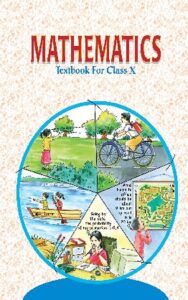
Chapter 1: Real Numbers
Chapter 2: Polynomials
Chapter 3: Pair of Linear Equations in Two Variables
Chapter 4: Quadratic Equations
Chapter 5: Arithmetic Progressions
Chapter 6: Triangles
Chapter 7: Coordinate Geometry
Chapter 8: Introduction to Trigonometry
Chapter 9: Some Applications of Trigonometry
Chapter 10: Circles
Complete Guide to NCERT Class 10 Mathematics: Latest Rationalised Edition (2026–27)
Mathematics in Class 10 is often perceived as a daunting hurdle by many students, but when approached with the right resource and a clear conceptual framework, it turns into the highest-scoring subject in the entire CBSE board examination. The official NCERT Class 10 Maths Textbook serves as the definitive curriculum blueprint set by the National Council of Educational Research and Training (NCERT) and followed strictly by the Central Board of Secondary Education (CBSE) and multiple State Boards across India.
Whether your goal is to secure a perfect centum (100/100) to keep the doors open for competitive science streams (PCM/PCB) or to ensure high overall grades for commerce and humanities, your preparation must center completely around this book. Over 85% to 90% of all questions appearing in the CBSE Class 10 Mathematics board examination—including Section A multiple-choice questions, Section B short-answer proofs, Section C conceptual problems, Section D long-form questions, and Section E real-world Case Study questions—are either drawn directly from this textbook or modeled closely on its solved examples and exercise problems.
Understanding the Rationalised CBSE Syllabus (2026–27 Academic Cycle)
In accordance with the National Education Policy (NEP) guidelines, NCERT undertook a comprehensive syllabus rationalisation exercise to reduce academic stress and eliminate redundant content without diluting foundational rigor. For students appearing in the 2026–27 academic year, it is vital to know exactly which portions were deleted so you do not waste valuable study hours on obsolete exercises:
- Unit I (Number Systems): Euclid’s Division Lemma and non-terminating decimal representations have been pruned. The focus is strictly on the Fundamental Theorem of Arithmetic and irrationality proofs.
- Unit II (Algebra): The division algorithm for polynomials and the cross-multiplication method for solving linear equations have been eliminated. In Quadratic Equations, solving by completing the square is gone, leaving middle-term splitting and the quadratic formula.
- Unit IV (Geometry): The lengthy proofs for the Area of Similar Triangles Theorem and the Pythagoras Theorem have been omitted from the exam syllabus. Similarity criteria (AA, SAS, SSS) and the Basic Proportionality Theorem (Thales’s Theorem) are now paramount. In Coordinate Geometry, the area of a triangle formula has been deleted.
- Unit V (Trigonometry): Trigonometric ratios of complementary angles (such as (sin(90^circ – heta) = cos heta)) have been completely removed.
- Unit VI (Mensuration): Frustum of a cone has been omitted. The focus is solely on combinations of standard 3D solids.
- Unit VII (Statistics): Graphical representation of cumulative frequency distributions (ogive curves) has been removed.
CBSE Class 10 Mathematics: Official Unit-Wise Marks Blueprint
The theory paper comprises 80 marks distributed across seven foundational units, with an internal assessment of 20 marks conducted by schools:
| Unit No. | Unit Name | Chapters Covered | Board Exam Weightage |
|---|---|---|---|
| I | Number Systems | Chapter 1: Real Numbers | 06 Marks |
| II | Algebra | Polynomials, Linear Equations, Quadratic Equations, Arithmetic Progressions | 20 Marks |
| III | Coordinate Geometry | Chapter 7: Coordinate Geometry | 06 Marks |
| IV | Geometry | Chapter 6: Triangles, Chapter 10: Circles | 15 Marks |
| V | Trigonometry | Intro to Trigonometry, Heights & Distances | 12 Marks |
| VI | Mensuration | Areas Related to Circles, Surface Areas & Volumes | 10 Marks |
| VII | Statistics & Probability | Chapter 13: Statistics, Chapter 14: Probability | 11 Marks |
| Total Written Board Paper | 80 Marks | ||
5 Proven Strategies for Securing Full Marks in Class 10 Maths
- Master Solved Examples First: A common mistake students make is diving straight into the end-of-chapter exercises while ignoring the solved examples. CBSE board question setters frequently pick examples verbatim for 3-mark and 5-mark questions. Solve every single example on paper before touching exercise questions.
- Step Marking is Your Secret Weapon: In the CBSE evaluation system, an incorrect final numerical answer does not mean zero marks. If an answer carries 4 marks and your final calculation has a minor arithmetic slip, you will still be awarded 3 or 3.5 marks provided your formula, substitution, and initial logical steps are correct. Always write down the standard formula first, specify what each variable represents, and box your final answer clearly with units (such as ( ext{cm}^2), ( ext{m}^3), or ( ext{km/h})).
- Geometry Proof Protocol: When proving theorems or geometric questions in Triangles and Circles, structure your answer strictly into four dedicated headings: Given, To Prove, Construction (drawn with a sharp pencil and ruler), and Proof. In the proof, write the exact reason or theorem name in brackets after every single claim.
- Maintain a Weekly Error Log: Whenever you make a calculation mistake during self-study or practice tests, do not simply erase it. Write down why you made that mistake in a dedicated notebook (e.g., “Forgot to change the sign when multiplying through by a negative number” or “Misread diameter 14 cm as radius 14 cm”). Reviewing this error log every Sunday will eliminate 90% of your habitual blunders.
- Time Management in Mock Papers: Allocate 30 minutes for Section A (20 MCQs), 30 minutes for Section B (5 short questions), 45 minutes for Section C (6 conceptual problems), 45 minutes for Section D (4 long questions), and 20 minutes for Section E (3 Case Studies). This leaves a solid 10 minutes at the end to re-verify calculations and ensure all sub-parts are answered.
Frequently Asked Questions (FAQs) Regarding NCERT Class 10 Maths
Q1: Is solving only the NCERT book enough to score 95+ in Class 10 Maths?
Yes. For CBSE Class 10 (both Standard and Basic Mathematics), thoroughly solving all solved examples, exercise questions, and understanding every theorem in NCERT is sufficient to score above 90–95 marks. Supplementing it with the last 5 years of CBSE Previous Year Question Papers (PYQs) and official sample papers will seal a perfect 100.
Q2: What is the primary difference between Basic and Standard Mathematics?
The syllabus, textbook, and internal assessment are 100% identical. The difference lies purely in the difficulty of questions asked in the board paper. Basic Mathematics features direct, formula-based questions directly from textbook exercises, while Standard Mathematics includes more conceptual, analytical, and higher-order thinking skill (HOTS) questions.
Q3: How should I download and read these digital chapters?
Below you will find the complete chapter list. You can read any chapter online through our interactive Scribd-style reader or download high-resolution chapter PDFs hosted directly on our ultra-fast Cloudflare CDN for offline practice.
Classes & Batches

Class 10 Maths Full Syllabus NCERT Masterclass: Chapter-Wise Concepts, Proofs & Shortcut Tricks | Dear Sir

Class 10 English Board Express: First Flight Prose, Poetry Analysis & Core Grammar Rules | Dear Sir

Class 10 SST Complete NCERT Board Course: Animated History, Civics, Geography & Economics | Digraj Sir

Class 10 Science Full Syllabus Batch 2026-27: Complete NCERT Lectures, Concept Notes & PYQs | PW Foundation
Study Resources & Notes
Class 10 Maths Formula & Methods Revision: PDFs, Examples and Practice
CBSE Class 10 Maths Basic PYQs with Solution
CBSE Class 10 Maths Basic Sample Paper with Solution & Marking Scheme
Class 10 Maths Flashcards | Chapter Wise
Quick Practice & Sets


Community Buzz

How to Prepare for Class 10 Maths in 30 Days Without Stress
Class 10 Economics: What Per Capita Income Hides
Class 10 English Literature: Build an Evidence-Based Answer
Class 10 Refractive Index: Connect Speed and Bending of Light
Comments (0)
No comments yet. Be the first to comment!
Please log in to comment
Log In