
CBSE Class 10 Maths Basic PYQs with Solution
Contents
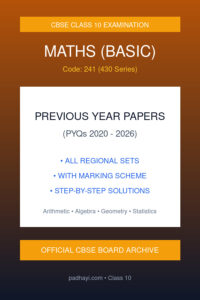
430/7/1 Set-1 Compartment (2026)
430/7/2 Set-2 Compartment (2026)
430/7/3 Set-3 Compartment (2026)
430/8/1 Set-1 Compartment (2026)
430/8/2 Set-2 Compartment (2026)
430/8/3 Set-3 Compartment (2026)
430/1/1 Set-1 (2026)
430/1/2 Set-2 (2026)
430/1/3 Set-3 (2026)
430/2/1 Set-1 (2026)
CBSE Class 10 Maths Basic Previous Year Question Papers (PYQs) with Solutions Archive
Welcome to the dedicated archive of official CBSE Class 10 Mathematics Basic (Subject Code: 241) Previous Year Question Papers with Step-by-Step Marking Scheme Solutions. Introduced by CBSE to cater to students prioritizing core foundational mathematical understanding, Mathematics Basic rigorously tests conceptual clarity, standard arithmetic, essential algebraic operations, and everyday geometric applications.
Every single authentic board examination set from 2026, 2025, 2024, 2023, 2022, and 2020 is cataloged in the Year Tabs below. Each paper contains the complete board question paper paired directly with the official CBSE Marking Scheme containing step-wise value points used by evaluators.
1. CBSE Class 10 Maths Basic Unit-Wise Weightage & Syllabus Blueprint
The annual board theory paper carries 80 marks (with 20 marks allocated to internal continuous assessment). The questions are distributed across the seven foundational units:
| Unit No. | Unit Name | Key Chapters | Marks Weightage |
|---|---|---|---|
| I | Number Systems | Real Numbers (Fundamental Theorem of Arithmetic, Irrational Proofs) | 06 Marks |
| II | Algebra | Polynomials, Linear Equations in Two Variables, Quadratic Equations, Arithmetic Progressions | 20 Marks |
| III | Coordinate Geometry | Lines (Distance Formula, Section Formula) | 06 Marks |
| IV | Geometry | Triangles (BPT), Circles (Tangents from External Points) | 15 Marks |
| V | Trigonometry | Introduction to Trigonometry, Trigonometric Identities, Heights & Distances | 12 Marks |
| VI | Mensuration | Areas Related to Circles, Surface Areas and Volumes | 10 Marks |
| VII | Statistics & Probability | Mean, Median, Mode of Grouped Data, Classical Theoretical Probability | 11 Marks |
| Total Board Theory Examination | 80 Marks | ||
2. Examination Format & Five-Section Architectural Structure
The question paper comprises 38 compulsory questions divided into five clearly delineated sections:
- Section A (Questions 1 to 20 — 20 Marks): 20 Multiple Choice Questions (including 2 Assertion-Reason questions) testing fundamental recall, zero-finding, discriminant check, and single-step geometric angle evaluations.
- Section B (Questions 21 to 25 — 10 Marks): 5 Very Short Answer (VSA) questions carrying 2 marks each, focusing on straight procedural solutions like BPT proofs, finding roots via factorization, or direct distance calculations.
- Section C (Questions 26 to 31 — 18 Marks): 6 Short Answer (SA) questions carrying 3 marks each, covering irrationality proofs (e.g. prove √3 is irrational), AP nth term and sum, and tangents from external point theorems.
- Section D (Questions 32 to 35 — 20 Marks): 4 Long Answer (LA) questions carrying 5 marks each, evaluating multi-step word problems involving speed, work, heights and distances, and solid conversions (surface area & volume).
- Section E (Questions 36 to 38 — 12 Marks): 3 Case-Based integrated assessment units carrying 4 marks each, contextualizing mathematical applications in sports, architecture, and business scenarios.
3. Step-by-Step Scoring & Presentation Strategy for Maths Basic
- Always Write the Generalized Formula: Never start calculations directly with numbers. Write down the quadratic formula, section formula, distance formula, or median formula first. Even if an arithmetic slip occurs later, writing the formula guarantees 0.5 to 1 method mark.
- Mention Units Explicitly: Append units (cm, m, cm², m³, km/h) to all calculated quantities in Mensuration, Trigonometry, and Coordinate Geometry.
- Provide Reason Codes in Geometry: Every geometric statement must cite the governing theorem in parentheses (e.g., “radius perpendicular to tangent at point of contact”).
- Reject Inadmissible Roots Explicitly: When solving real-world quadratic equations (e.g., speed, dimensions, time), write: “Rejecting negative value since speed/length cannot be negative.”
4. Frequently Asked Questions (FAQs)
Q1. How is Maths Basic different from Maths Standard in Class 10?
Maths Basic tests the exact same syllabus and NCERT textbook content as Maths Standard, but emphasizes direct conceptual applications and simpler arithmetic calculations rather than intricate multi-concept derivations and complex proofs.
Q2. Does this archive include the official CBSE solutions?
Yes. Every PDF in this repository contains the complete original question paper followed directly by the official CBSE Marking Scheme with evaluator value points and step-by-step scoring rules.
Q3. Are all regional sets and compartment exams available?
Yes. All regional sets (430/1, 430/2, 430/3, etc.) and compartment / supplementary papers are organized systematically by year.
Q4. Can I preview these papers online and download them for free?
Yes. You can read every question paper online in our fast reader and download the original high-resolution PDFs permanently free of charge.
Classes & Batches

Class 10 Maths Full Syllabus NCERT Masterclass: Chapter-Wise Concepts, Proofs & Shortcut Tricks | Dear Sir

Class 10 English Board Express: First Flight Prose, Poetry Analysis & Core Grammar Rules | Dear Sir

Class 10 SST Complete NCERT Board Course: Animated History, Civics, Geography & Economics | Digraj Sir

Class 10 Science Full Syllabus Batch 2026-27: Complete NCERT Lectures, Concept Notes & PYQs | PW Foundation
Study Resources & Notes
Class 10 Maths Formula & Methods Revision: PDFs, Examples and Practice
NCERT Class 10 Maths Book PDF
CBSE Class 10 Maths Basic Sample Paper with Solution & Marking Scheme
Class 10 Maths Flashcards | Chapter Wise
Quick Practice & Sets


Community Buzz

How to Prepare for Class 10 Maths in 30 Days Without Stress
Class 10 Economics: What Per Capita Income Hides
Class 10 English Literature: Build an Evidence-Based Answer
Class 10 Refractive Index: Connect Speed and Bending of Light
Comments (0)
No comments yet. Be the first to comment!
Please log in to comment
Log In