
CBSE Class 10 Science PYQs with Solution
Contents
31/7/1 Set-1 Compartment (2026)
31/7/2 Set-2 Compartment (2026)
31/7/3 Set-3 Compartment (2026)
31/8/1 Set-1 Compartment (2026)
31/1/1 Set-1 (2026)
31/1/2 Set-2 (2026)
31/1/3 Set-3 (2026)
31/2/1 Set-1 (2026)
31/2/2 Set-2 (2026)
31/2/3 Set-3 (2026)
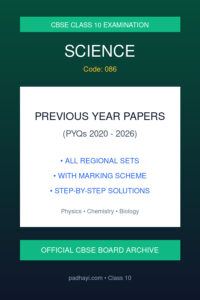
CBSE Class 10 Science Previous Year Question Papers (PYQs) with Solutions Archive
Welcome to the official repository of CBSE Class 10 Science (Subject Code: 086) Previous Year Question Papers with Attached Marking Scheme Solutions. Excelling in CBSE Class 10 Science requires more than rote memorization; it demands a deep grasp of chemical principles, biological pathways, physical laws, and experimental reasoning. Practicing authentic past board papers under real examination conditions is the proven method to achieve 95%+ marks.
In this digital catalog, every single question paper published across recent examination cycles (including 2026, 2025, 2024, 2023, 2022, and 2020) is organized by year in the Year Tabs below. Each post includes the complete, unabridged Question Paper along with the official CBSE Marking Scheme containing step-by-step evaluator value points.
1. CBSE Class 10 Science Unit-Wise Weightage & Syllabus Blueprint
The annual board theory paper carries 80 marks (supplemented by 20 marks of practical and internal assessment). The questions evaluate five core thematic units:
| Unit No. | Unit Name | Key Chapters | Marks Weightage |
|---|---|---|---|
| I | Chemical Substances – Nature & Behaviour | Chemical Reactions, Acids & Bases, Metals & Non-metals, Carbon & Its Compounds | 25 Marks |
| II | World of Living | Life Processes, Control & Coordination, How Do Organisms Reproduce?, Heredity | 25 Marks |
| III | Natural Phenomena | Light – Reflection & Refraction, Human Eye & Colorful World | 12 Marks |
| IV | Effects of Current | Electricity, Magnetic Effects of Electric Current | 13 Marks |
| V | Natural Resources | Our Environment (Ecosystems, Trophic Levels, Waste Management) | 05 Marks |
| Total Theory Examination | 80 Marks | ||
2. Examination Format & Five-Section Structure
The standard CBSE Class 10 Science question paper consists of 39 mandatory questions partitioned into five sections:
- Section A (Questions 1 to 20 — 20 Marks): 20 objective type questions carrying 1 mark each. Questions 1 to 16 are multiple-choice questions assessing conceptual clarity and direct recall. Questions 17 to 20 are Assertion-Reasoning questions testing the causal connection between biological, chemical, or physical assertions and their stated scientific justifications.
- Section B (Questions 21 to 26 — 12 Marks): 6 Very Short Answer (VSA) questions carrying 2 marks each. Expected answer length is 30 to 50 words. Focuses on writing balanced chemical equations, fundamental definitions (e.g., Ohm’s law statement, refraction index), and direct biological observations. Internal choice is provided in 2 questions.
- Section C (Questions 27 to 33 — 21 Marks): 7 Short Answer (SA) questions carrying 3 marks each. Expected answer length is 50 to 80 words. Tests reaction mechanisms (e.g., esterification, saponification), circuit resistance derivations, ray diagrams with ray directions, and genetic crosses (monohybrid ratios). Internal choice is provided in 2 questions.
- Section D (Questions 34 to 36 — 15 Marks): 3 Long Answer (LA) questions carrying 5 marks each. Expected answer length is 80 to 120 words. Features structured multi-part questions (e.g., (a), (b), (c)) combining circuit analysis, organic functional groups, human digestive or nephron schematics, and numerical calculations in optics. Internal choice is provided in all 3 questions.
- Section E (Questions 37 to 39 — 12 Marks): 3 Case-Based / Data-Based integrated competency assessment units carrying 4 marks each. Evaluates practical lab-based data, real-world technological scenarios, and experimental setups with sub-parts carrying 1 mark, 1 mark, and 2 marks (with internal choice in the 2-mark part).
3. Essential Exam Preparation & Presentation Principles for Science
- Balanced Equations with Physical States: In Chemistry, never write an unbalanced reaction. Always specify physical state symbols—(s) for solid, (l) for liquid, (g) for gas, and (aq) for aqueous—along with reaction conditions (catalysts, heat symbol Δ, pressure) over the reaction arrow to earn complete value-point credit.
- Arrowheads on Optical Ray Diagrams: In Physics, ray diagrams for spherical mirrors and lenses require clear directional arrows on incident, reflected, and refracted rays. A diagram without ray directions forfeits 50% of the allocated diagram mark.
- Neat Biological Diagrams with Unambiguous Labeling: In Biology, schematics of the human heart, excretory nephron, female reproductive system, or reflex arc must be drawn with a sharp pencil. Keep label guide lines parallel and write labels on one side of the diagram.
- Sign Convention in Optics & Units in Electricity: In numerical problems, apply the Cartesian Sign Convention meticulously: object distance u is always negative, focal length f is positive for convex and negative for concave mirrors/lenses. Always conclude numerical calculations with standard SI units (Ω, W, J, A, V, diopters D).
4. Frequently Asked Questions (FAQs)
Q1. Are these official CBSE Class 10 Science question papers?
Yes. All sets across all years in this repository are authentic, official CBSE board examination question papers with their verified official marking schemes issued for evaluation centers.
Q2. Why is it important to solve all regional sets (31/1, 31/2, 31/3, etc.)?
CBSE develops distinct regional sets for Delhi, Outside Delhi (All India), and Foreign examination zones. Practicing all sets guarantees exposure to varied numerical permutations, distinct experimental setups, and alternative case studies.
Q3. Does the attached PDF include step-by-step solutions?
Yes. Every PDF contains the complete Question Paper followed by the official CBSE Marking Scheme with step-wise marks distribution and value points.
Q4. Can I preview and download all Science PYQs for free?
Yes. All Science PYQs are permanently free to preview inline in our continuous reader and download via Cloudflare R2 CDN links.
Classes & Batches

Class 10 Science Full Syllabus Batch 2026-27: Complete NCERT Lectures, Concept Notes & PYQs | PW Foundation

Class 10 English Board Express: First Flight Prose, Poetry Analysis & Core Grammar Rules | Dear Sir

Class 10 Maths Full Syllabus NCERT Masterclass: Chapter-Wise Concepts, Proofs & Shortcut Tricks | Dear Sir

Class 10 SST Complete NCERT Board Course: Animated History, Civics, Geography & Economics | Digraj Sir
Study Resources & Notes


Quick Practice & Sets

CBSE Class 10 Science 30-Minute Rapid Chapter Mocks

CBSE Class 10 Science Chapter-wise Assertion & Reason Bank
CBSE Class 10 Science NCERT Exemplar Problems & Solutions

CBSE Class 10 Science Competency & Case Study Bank
Community Buzz

How to Prepare for Class 10 Maths in 30 Days Without Stress
Class 10 Economics: What Per Capita Income Hides
Class 10 English Literature: Build an Evidence-Based Answer
Class 10 Refractive Index: Connect Speed and Bending of Light
Comments (0)
No comments yet. Be the first to comment!
Please log in to comment
Log In