
Electrolysis of water is a decomposition reaction. The mass ratio $(M_{H}:M_{O})$ of hydrogen and oxygen gases liberated at the electrodes during electrolysis of water is :
[1 marks]
Assertion (A): Decomposition reactions are generally endothermic reactions.
Reason (R): Decomposition of organic matter into compost is an exothermic process.
[1 marks]
A student performs the following experiment in his school laboratory.
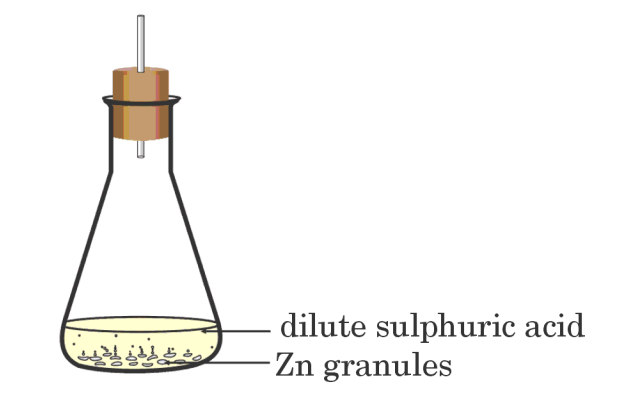
List two observations to justify that in this experiment a chemical change has taken place.
[2 marks]
Select from the following a decomposition reaction in which source of energy for decomposition is light :
[1 marks]
$\ce{MnO2 + 4HCl \rightarrow MnCl2 + 2H2O + Cl2}$
The reaction given above is a redox reaction because in this case :
[1 marks]
Name the type of chemical reaction in which calcium oxide reacts with water. Justify your answer by giving balanced chemical equation for the chemical reaction.
[2 marks]
Write one chemical equation each for the chemical reaction in which the following have taken place :
(i) Change in colour
(ii) Change in temperature
(iii) Formation of precipitate
Mention colour change/temperature change (rise/fall)/compound precipitated along with equation.
[3 marks]
SECTION - A
Select and write one most appropriate option out of the four options given for each of the questions 1 - 20:
The emission of brown fumes in the given experimental set-up is due to
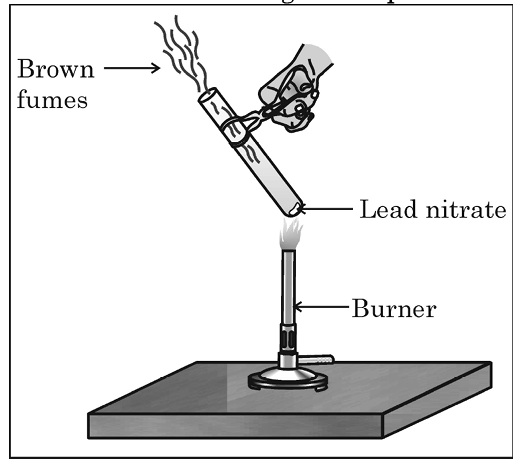
[1 mark]
SECTION - A
Select and write one most appropriate option out of the four options given for each of the questions 1 - 20:
\( \ce{MnO2 + x HCl -> MnCl2 + y H2O + z Cl2} \)
In order to balance the above chemical equation, the values of x, y and z respectively are:
[1 mark]
Q. Nos. 17 to 20 are Assertion - Reason based questions.
These consist of two statements Assertion (A) and Reason (R). Answer these questions selecting the appropriate option given below:
(a) Both (A) and (R) are true and (R) is the correct explanation of (A).
(b) Both (A) and (R) are true, but (R) is not the correct explanation of (A).
(c) (A) is true, but (R) is false.
(d) (A) is false, but (R) is true.
Assertion (A): The colour of aqueous solution of copper sulphate turns colourless when a piece of lead is added to it.
Reason (R): Lead is more reactive than copper, and hence displaces copper from its salt solution.
[1 mark]
SECTION - C
Q. No. 27 to 33 are short answer questions.
(a) Identify the reducing agent in the following reactions:
(i) \( \ce{4NH3 + 5O2 -> 4NO + 6H2O} \)
(ii) \( \ce{H2O + F2 -> HF + HOF} \)
(iii) \( \ce{Fe2O3 + 3CO -> 2Fe + 3CO2} \)
(iv) \( \ce{2H2 + O2 -> 2H2O} \)
(b) Define a redox reaction in terms of gain or loss of oxygen.
[3 marks]
Consider the two reactions :
(i) $BaCl_2(aq) + Na_2SO_4(aq) \rightarrow BaSO_4(s) + 2NaCl(aq)$
(ii) $Pb(NO_3)_2(aq) + 2KI(aq) \rightarrow PbI_2(s) + 2KNO_3(aq)$
Both reactions can be classified as :
When dry lead nitrate crystals are heated strongly in a dry test tube, the gases evolved are :
(a) In the reaction $ZnO + C \rightarrow Zn + CO$, identify the substance oxidised and the substance reduced.
(b) Write a balanced chemical equation for the precipitation reaction between lead nitrate and potassium iodide solutions.
[2 marks]