
| (a) | A wire of resistance R is cut into three equal parts. If these three parts are then joined in parallel, calculate the total resistance of the combination so formed. |
| OR | |
| (b) | Define electric power. When do we say that the power consumed in an electric circuit is 1 watt? |
[2 marks]
Consider the following electric circuit :
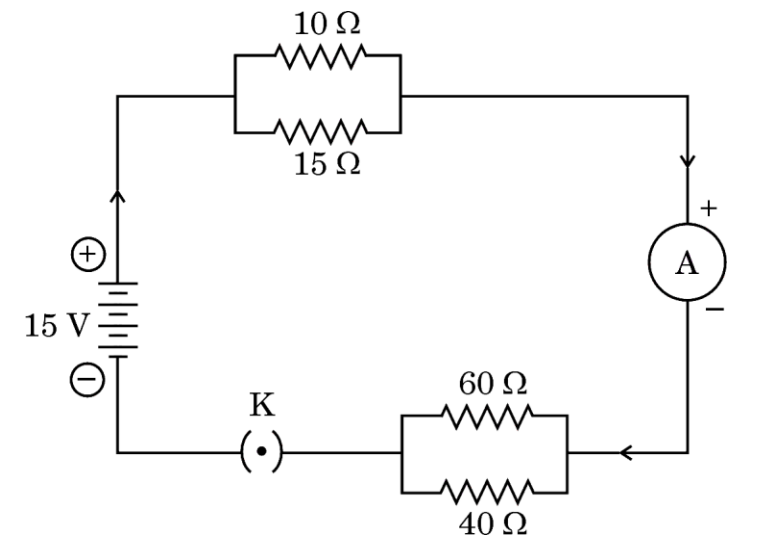
Calculate the values of the following:
(a) The total resistance of the circuit
(b) The total current drawn from the source
(c) Potential difference across the parallel combination of 10 $\Omega$ and 15 $\Omega$ resistors
[3 marks]
|
(a) |
Write the relationship between resistivity and resistance of a cylindrical conductor of length $l$ and area of cross-section $A$. Hence derive the SI unit of resistivity. |
| (b) | Why are alloys used in electrical heating devices? |
[3 marks]
(A) Show how you would connect three resistors each of resistance 6 $\Omega$, so that the combination has a resistance of 9 $\Omega$. Also justify your answer.
OR
(B) In the given circuit calculate the power consumed in watts in the resistor of 2 $\Omega$:
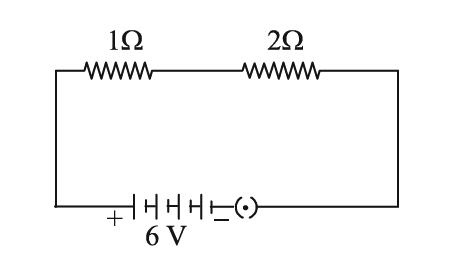
[2 marks]
| (A) |
|
||||||
| OR | |||||||
| (B) |
|
[5 marks]
SECTION - A
Select and write one most appropriate option out of the four options given for each of the questions 1 - 20:
If four identical resistors, of resistance 8 ohm, are first connected in series so as to give an effective resistance \( R_{s} \) and then connected in parallel so as to give an effective resistance \( R_{p} \) then the ratio \( \frac{R_{s}}{R_{p}} \) is
[1 mark]
SECTION - A
Select and write one most appropriate option out of the four options given for each of the questions 1 - 20:
In the following diagram, the position of the needle is shown on the scale of a voltmeter. The least count of the voltmeter and the reading shown by it respectively are:
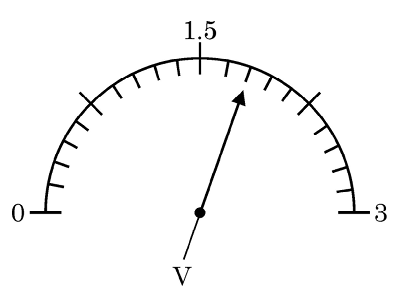
[1 mark]
SECTION - D
Q. No. 34 to 36 are long answer questions.
(a) An electric iron consumes energy at a rate of 880 W when heating is at the maximum rate and 330 W when the heating is at the minimum. If the source voltage is 220 V, calculate the current and resistance in each case.
(b) What is heating effect of electric current?
(c) Find an expression for the amount of heat produced when a current passes through a resistor for some time.
[5 marks]
| (a) |
Three resistors $R_{1}$, $R_{2}$ and $R_{3}$ are connected in parallel and the combination is connected to a battery, an ammeter, a voltmeter and a key. Draw suitable circuit diagram to show the arrangement of these circuit components along with the direction of current flowing. |
| (b) |
Calculate the equivalent resistance of the following network:
|
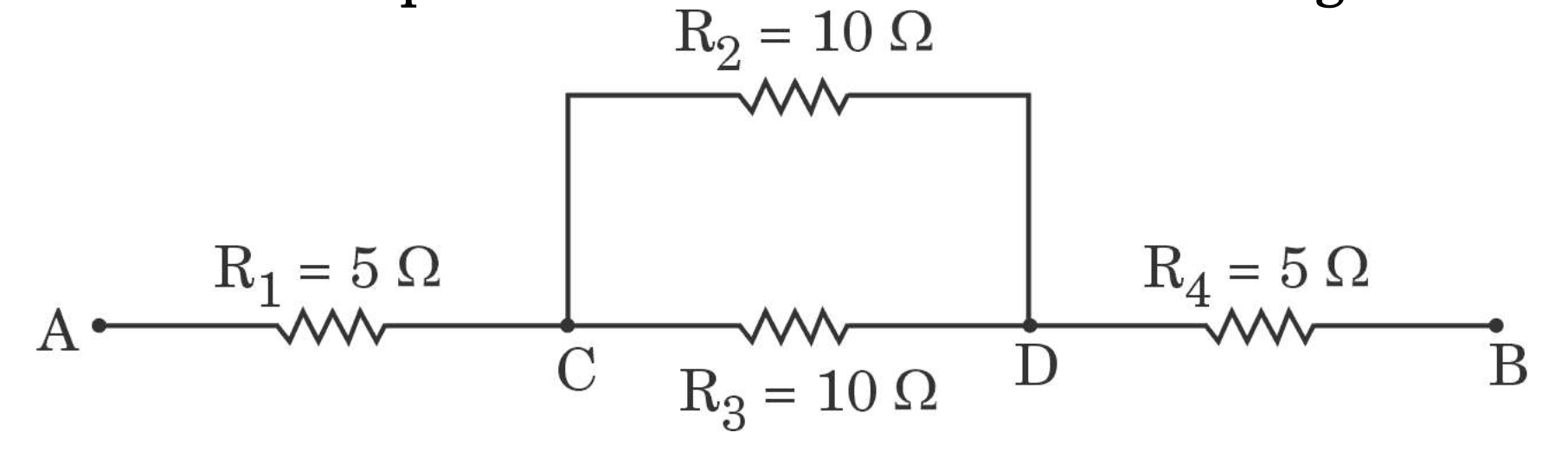
[3 marks]
| (a) |
|
||||
| OR | |||||
| (b) |
|
[3 marks]
(A) A cylindrical metal wire of length $1\text{ cm}$ and circular radius $0.01\text{ cm}$ has a resistance of $7\,\Omega$. Calculate the resistivity of the material of the wire.
OR
(B) An electric heater draws a current of $11\text{ A}$ from a $220\text{ V}$ power source. Calculate its electrical resistance and power rating.
[2 marks]
CASE STUDY 3
Study the following circuit diagram showing resistors and electrical heating elements connected across an electric source :
An electric heating device has two resistance coils that can be used separately, in series, or in parallel.
(i) Calculate the total equivalent resistance when the resistors are connected in parallel. [1 mark]
(ii) Find the current drawn when connected to a $220\text{ V}$ power supply. [1 mark]
(iii) (a) Calculate the heat energy produced per minute in parallel combination compared to series combination. [2 marks]
OR
(iii) (b) Explain why alloy coils are preferred over pure metals for the heating elements in domestic appliances. [2 marks]