
Mirror 'X' is used to concentrate sunlight in solar furnace and Mirror 'Y' is fitted on the side of the vehicle to see the traffic behind the driver. Which of the following statements are true for the two mirrors?
(i) The image formed by mirror 'X' is real, diminished and at its focus.
(ii) The image formed by mirror 'Y' is virtual, diminished and erect.
(iii) The image formed by mirror 'X' is virtual, diminished and erect.
(iv) The image formed by mirror 'Y' is real, diminished and at its focus.
[1 marks]
An object is placed at a distance of 60 cm from a concave lens of focal length 30 cm. Use lens formula to find the position of the image formed in this case.
[2 marks]
Draw ray diagrams to show the nature, position and relative size of the image formed by a convex mirror when the object is placed (i) at infinity and (ii) between infinity and pole P of the mirror.
[3 marks]
| (a) |
|
||||||||||||||
| OR | |||||||||||||||
| (b) |
|
[5 marks]
At what distance from a convex lens should an object be placed to get an image of the same size as that of the object on a screen ?
[1 marks]
An object is placed at a distance of 10 cm from a convex mirror of focal length 15 cm. Find the position of the image formed by the mirror.
[2 marks]
Q. Nos. are source-based/case-based questions with 2 to 3 short sub-parts. Internal choice is provided in one of these sub-parts :
Study the data given below showing the focal length of three concave mirrors A, B and C and the respective distances of objects placed in front of the mirrors:
| Case | Mirror | Focal Length (cm) | Object Distance (cm) |
| 1 | A | 20 | 45 |
| 2 | B | 15 | 30 |
| 3 | C | 30 | 20 |
(i) In which one of the above cases the mirror will form a diminished image of the object? Justify your answer.
(ii) List two properties of the image formed in case 2.
(iii) (A) What is the nature and size of the image formed by mirror C? Draw ray diagram to justify your answer.
OR
(iii) (B) An object is placed at a distance of 18 cm from the pole of a concave mirror of focal length 12 cm. Find the position of the image formed in this case.
[4 marks]
SECTION - C
Q. No. 27 to 33 are short answer questions.
(a) Complete the following ray diagram to show the formation of image:
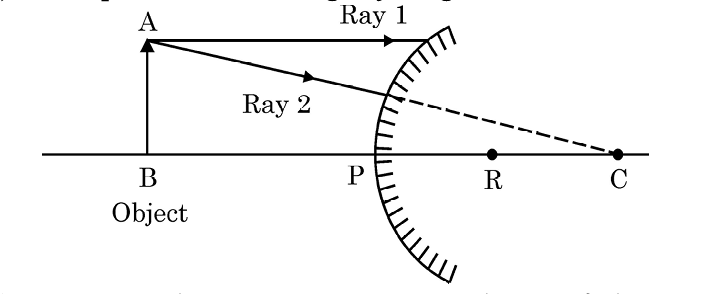
(b) Mention the nature, position and size of the image formed in this case.
(c) State the sign of the image distance in this case using the Cartesian sign convention.
[3 marks]
Q. No. 37 to 39 are case based/data based questions with 2 to 3 short sub-parts. Internal choice is provided in one of these sub-parts.
Hold a concave mirror in your hand and direct its reflecting surface towards the sun. Direct the light reflected by the mirror on to a white card-board held close to the mirror. Move the card-board back and forth gradually until you find a bright, sharp spot of light on the board. This spot of light is the image of the sun on the sheet of paper; which is also termed as "Principal Focus" of the concave mirror.
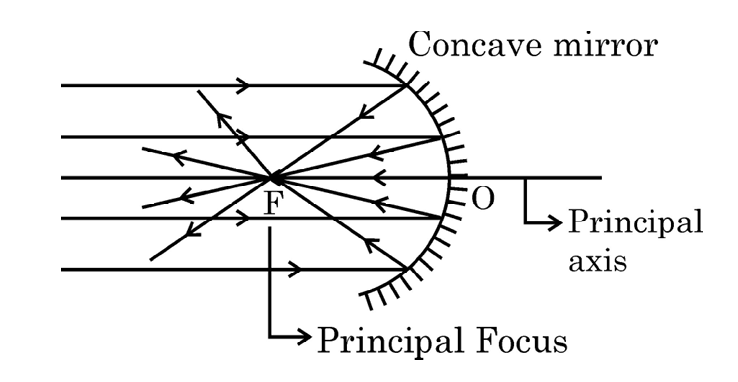
(a) List two applications of concave mirror.
(b) If the distance between the mirror and the principal focus is 15 cm, find the radius of curvature of the mirror.
(c) Draw a ray diagram to show the type of image formed when an object is placed between pole and focus of a concave mirror.
OR
(c) An object 10 cm in size is placed at 100 cm in front of a concave mirror. If its image is formed at the same point where the object is located, find:
(i) focal length of the mirror, and
(ii) magnification of the image formed with sign as per Cartesian sign convention.
[4 marks]
An object is placed in front of a thin convex lens of focal length $15\text{ cm}$ such that a real, inverted image of the same size as the object is formed on the other side. The positions of the object and the image from the optical centre of the lens are :
Assertion (A): The emergent ray from a rectangular glass slab is parallel to the incident ray but displaced laterally.
Reason (R): The extent of bending of the ray of light at the opposite parallel surfaces of the rectangular glass slab is equal and opposite.
A real and inverted image of an illuminated needle is formed by a convex lens at a distance of $30\text{ cm}$ from the lens. If the image formed is twice the size of the needle, determine the focal length of the lens and the position of the object.
[2 marks]
(a) Two thin lenses of focal lengths $+20\text{ cm}$ and $-50\text{ cm}$ are placed in co-axial contact. Calculate the power and focal length of the combination.
(b) Two incandescent lamps rated $100\text{ W}, 220\text{ V}$ and $60\text{ W}, 220\text{ V}$ are connected in parallel to an electric mains supply of $220\text{ V}$. Find the total current drawn from the line.
[5 marks]