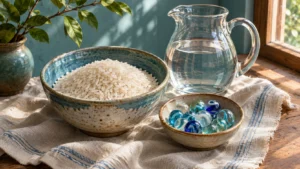
A place may contain useful minerals, fertile land or abundant sunlight and still struggle to meet people's needs. Having a resource is not the same as being able to use…

A chapter can feel familiar while the book is open. You recognise the headings, remember the diagrams and follow the worked examples. Then someone asks a short question without showing…
My list had “science” on it and I kept avoiding it. Changed it to “draw one nephron from memory” and actually did it before lunch. The list is shorter now…
A page of similar questions can make a method feel obvious. After solving four equations by elimination, you know what the fifth one is likely to require. A mixed set…
You recognise that two triangles have the same shape, write a proportion, and then get a length that does not fit the diagram. Often the theorem is not the problem.…
A box of numbered tickets looks like one of the simplest probability settings. Every ticket has a label, and one is drawn at random. Yet a single missed endpoint or…
A country holds elections. Does that one fact tell us everything about the quality of its democracy? Elections matter, but judging democratic outcomes requires more than checking a single feature.…
Choosing between many and much becomes easier once you know whether the noun is countable in that sentence. Choosing between few and a few needs an additional question: does the…
If the kidneys filter blood, why do useful substances such as glucose not simply leave the body with the urine? The answer is that urine formation involves more than one…
Adding water to an acidic solution sounds as though it should simply make “more acid”. The volume does increase, but the concentration of acid-related ions decreases. That difference between amount…