

Can You Improve Your Marks in CBSE Class 10 Second Board Exam 2027 After Passing?
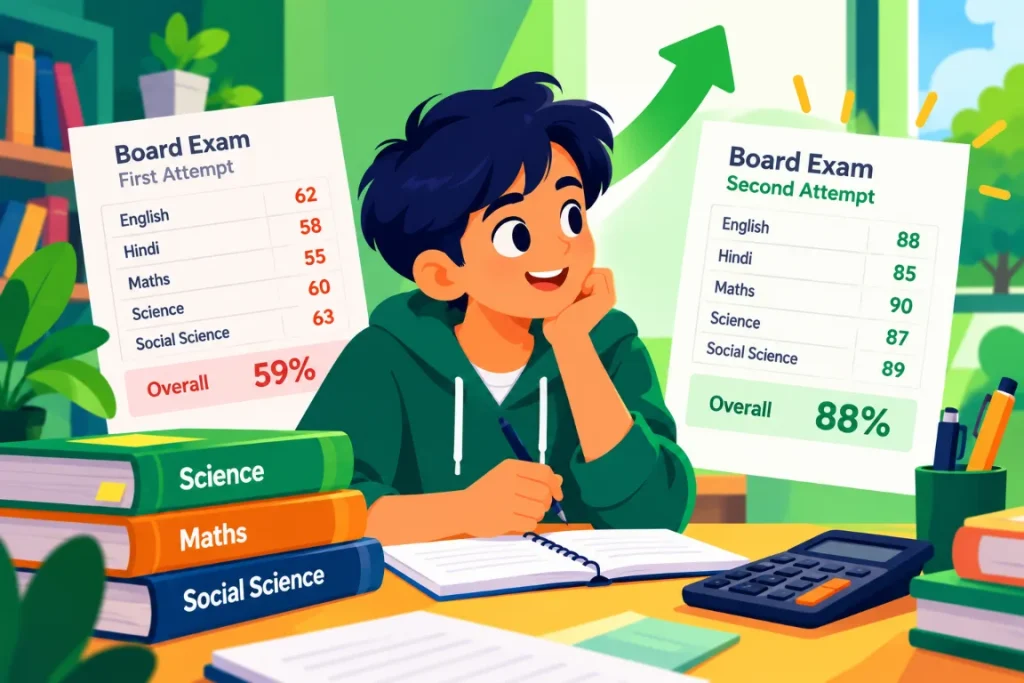
Yes, students who pass the first CBSE Class 10 board examination may have an opportunity to improve their marks in the second board examination, subject to the eligibility conditions and rules prescribed by CBSE for the 2026-27 session.
This is an important question for students who pass their first examination but are unhappy with their marks in Mathematics, Science, Social Science, English or another eligible subject. A student might qualify for Class 11 but still want a better result for school admission or personal academic goals.
The two-board-examination system makes it important to understand the difference between improving marks and clearing a subject in which you did not pass.
Before making a decision, students should check the latest official CBSE instructions for the 2027 examinations. Eligibility, the number of subjects permitted for improvement, registration procedures and the treatment of results must follow the rules applicable to their examination session.
Can you appear for the second board exam after passing Class 10?
Passing the first examination does not necessarily mean you have lost the opportunity to improve your marks.
Under the two-board-examination framework for CBSE Class 10, the second examination provides an additional opportunity for eligible students, including students seeking improvement, according to the notified scheme.
For example, imagine a student receives these marks in the first examination:
| Subject | First exam marks |
|---|---|
| English | 84 |
| Mathematics | 68 |
| Science | 76 |
| Social Science | 88 |
| Hindi | 81 |
The student has passed all five subjects but wants to improve Mathematics from 68 to a higher score.
If the student meets the eligibility conditions for the second examination, they may be able to use that opportunity to improve their Mathematics result.
The important distinction is that the student is not appearing because they failed the subject. They are seeking to improve a result in which they have already qualified.
Do not assume that every subject, result category or student is automatically eligible. Confirm the permitted subjects and conditions in the official CBSE instructions for the 2026-27 session.
You can read Padhai’s existing guide to the CBSE Class 10 two-board examination rules for 2026-27 for the broader examination framework.
How many subjects can you improve in the second board exam?
The number of subjects permitted for improvement depends on the official scheme applicable to the examination year.
Students should not assume they can retake all five subjects simply because a second examination is being conducted.
Before choosing subjects, check the current CBSE instructions for:
- The maximum number of subjects permitted for improvement.
- Which subjects are eligible.
- Whether the student must have appeared in the first examination.
- How the second examination result will be considered.
- The registration process and deadline.
These details matter because a student may want to improve two or three subjects, while another may only need to focus on one.
For instance, if Mathematics is your weakest subject but you are satisfied with your Science and English marks, you should first establish whether Mathematics alone can be selected under the applicable rules.
Do not register based only on advice from classmates, social media posts or older examination policies. Use the instructions issued for your own batch.
What is the difference between improvement and compartment?
Improvement and compartment are related to different result situations. Understanding the difference can help you choose the correct next step.
| Situation | What it means |
|---|---|
| You passed a subject but want higher marks | You may qualify for the applicable improvement opportunity. |
| You did not qualify in a subject | You need to check the applicable compartment or other examination route. |
| You passed all subjects and are satisfied with your marks | You may not need to appear again. |
| You did not appear in the required examination | Your eligibility depends on the rules for that situation. |
Improvement is for better performance, while compartment is associated with a subject that has not been cleared. The exact categories and available opportunities must be checked against the current CBSE scheme.
For students who have failed one subject, Padhai’s guide to CBSE Class 10 internal assessment marks may help explain how subject assessment is structured, but it does not replace the official rules governing examination eligibility.
Will CBSE consider the better marks from the two examinations?
This is one of the most important questions to verify before deciding whether to sit for the second examination.
Students should not automatically assume that CBSE will always take the higher score, combine marks from both attempts, or use the same method for every situation.
The way the result is determined must follow the official rules for the 2026-27 examination session.
Before registering, check the instructions covering how marks from the first and second examinations are treated, including any conditions that apply when a student improves one subject but not another.
This is particularly important if you are trying to achieve a specific percentage for admission to Class 11.
For example, a student targeting 90% should calculate their current percentage first and identify which subject improvement would make the biggest difference. You can use Padhai’s guide to CBSE Class 10 exam pattern and subject-wise marks distribution to understand the assessment structure before planning your preparation.
Should you take the second exam if you have already passed?
Not every student needs to appear for the second examination.
The decision depends on your existing marks, your academic goals, the subjects in which improvement is permitted and how much preparation time you have.
Consider these three situations.
You passed comfortably in every subject.
If your marks already meet your goals and your preferred school does not require a higher score, another examination may not be necessary.
You passed but have one unusually low score.
Improving that subject may be worth considering if the current rules permit it and a better result would help you meet an admission requirement.
You want a much higher overall percentage.
Calculate how much improvement you would realistically need. A small increase in one subject may not change your overall percentage as much as you expect, especially if you are already scoring well in the others.
Before making the decision, understand the requirements of the school or stream you want to join. A higher overall percentage is not always the only admission criterion.
How should you choose the subject for improvement?
Start with your marksheet rather than choosing a subject simply because other students are retaking it.
Look at your subject-wise scores and ask yourself three questions:
- Which subject has the greatest scope for improvement?
- Which subject can I realistically prepare for in the available time?
- Will improving this subject help me meet a particular academic or admission goal?
Suppose you scored 91 in English, 89 in Social Science, 85 in Hindi, 72 in Science and 65 in Mathematics. If Mathematics is eligible for improvement, it may be a more practical priority than spending weeks trying to increase English by two or three marks.
However, a low score does not automatically mean that a subject is the easiest to improve. Your understanding of the syllabus and the type of mistakes you made also matter.
Use the official CBSE Class 10 syllabus for 2026-27 to identify the topics you need to revise.
For Mathematics, you can practise with Class 10 Maths previous-year questions. For Science, use Class 10 Science previous-year questions. Practising actual board questions helps you identify whether your lost marks came from weak concepts, calculation errors, incomplete answers or poor time management.
How to prepare for a subject improvement exam
Preparing for an improvement examination is not exactly the same as starting board preparation from scratch. You have already taken the examination once, so you can use your previous performance to make a more focused plan.
1. Analyse your first result.
Identify the chapters and question types where you lost marks. If you have access to your evaluated answer sheet or useful teacher feedback, use it to understand your mistakes.
2. Revise the weak areas first.
Do not spend equal time on every chapter if your main weaknesses are concentrated in a few topics. Revise those topics before moving to full-length practice papers.
3. Solve previous-year questions.
Work through questions from recent examinations to understand how concepts are tested. Padhai has a collection of CBSE Class 10 papers from 2025 and 2024.
4. Practise under timed conditions.
A student may understand a chapter but still lose marks because they cannot finish the paper. Complete timed practice papers and review the answers afterwards.
5. Review mistakes instead of only counting scores.
Every practice test should show you what needs to change. Keep a list of recurring errors and revisit it regularly.
6. Confirm the examination details.
Check the current date sheet, registration instructions, eligibility conditions and permitted subjects through CBSE and your school. Do not rely on an old date sheet or assume that last year’s deadlines still apply.
You can also use Padhai’s Class 10 practice section to supplement your revision.
Will improving your marks affect Class 11 admission?
It can matter if your preferred school uses Class 10 marks as part of its admission criteria, but the effect depends on that school’s policy and the applicable CBSE rules.
Some schools set minimum marks for particular streams or subjects. Others consider several factors when allocating seats.
If you are considering Science, Commerce or Humanities, contact the school to understand its requirements before deciding whether to appear for the second examination.
Also ask how the school handles admission while a student’s second examination result is pending, if that situation applies to you. Do not assume that every school follows the same procedure.
The goal is to make a decision based on your actual admission requirements rather than retaking a subject simply because you feel your marks should be higher.
Where can you check the official CBSE rules for 2027?
The safest source is the official CBSE website and the circulars or examination instructions published for the 2026-27 session.
Start with the CBSE official website and look for the latest instructions relating to the Class 10 two-board examination scheme.
You can also follow Padhai’s CBSE Class 10 notifications page for explanations of important updates.
Before acting, confirm the following details in the relevant official notice:
- Who can appear in the second examination.
- How many subjects can be selected for improvement.
- How marks from the two examinations will be treated.
- The registration process and deadline.
- The examination dates and applicable result rules.
This is especially important because old articles may describe a different examination system. A rule that applied to an earlier batch should not automatically be applied to students appearing in 2027.
Frequently asked questions
Can I improve my CBSE Class 10 marks after passing in 2027?
Eligible students may have an opportunity to improve marks through the second board examination under the 2026-27 framework. Confirm the current CBSE eligibility conditions and permitted subjects before registering.
Can I appear for the second exam if I scored 90% in the first exam?
Your percentage alone does not establish whether you are eligible or ineligible. Check the current rules and decide whether improving a permitted subject would help you meet your goals.
Can I retake only Mathematics in the second board exam?
Whether you can select Mathematics alone depends on the applicable improvement rules and your eligibility. Verify the permitted subject choices in the official instructions.
Is the second board exam compulsory for students who passed?
Do not assume that every student who passed must appear again. Check the official scheme to understand who is required to appear and who may use the second examination as an additional opportunity.
Is the second board exam the same as a compartment exam?
No. Improvement and compartment address different result situations, although the examination framework may provide opportunities for different categories of students. Follow the current CBSE rules for your result status.
Will my percentage increase if I score better in the second exam?
That depends on the official result-calculation rules and how marks from the examinations are treated. Confirm the applicable policy before calculating your expected final percentage.
Final advice
If you have passed CBSE Class 10 but are unhappy with your marks, do not immediately assume that you must accept the first result or that you can freely retake every subject.
The second board examination may provide an opportunity to improve your performance, but the decision should be based on the official eligibility rules, the subjects permitted for improvement and your academic goals.
Check the current CBSE instructions, calculate where improvement would matter most, and prepare using the syllabus and actual board questions. A targeted plan is more useful than trying to revise every subject again without a clear reason.













Comments (0)
No comments yet. Be the first to comment!
Please log in to comment
Log In