Complete Conceptual Breakdown: Chemical Reactions and Equations
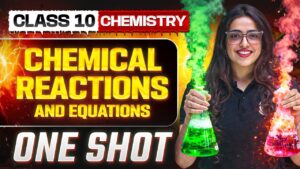
Chemical reactions represent the fundamental atomic rearrangements through which substances transform into entirely new entities possessing distinct chemical identities and physical characteristics. In Class 10 Science, Chapter 1 establishes the bedrock of inorganic chemistry by exploring chemical transformation evidence, standard symbolic notations, stoichiometric balancing techniques, and diverse reaction typologies. Understanding these concepts enables students to interpret chemical phenomena in laboratory settings and daily life, such as rusting, food spoilage, effervescence, and metabolic respiration.
Observable Indicators of a Chemical Transformation
A chemical reaction occurs when chemical bonds between reactant atoms break and new bonds form to produce products with different chemical properties. Chemists identify chemical changes through distinct experimental indicators:
- Evolution of a Gas: When granulated zinc reacts with dilute sulfuric acid inside a conical flask, hydrogen gas bubbles evolve vigorously ($Zn + H_2SO_4 rightarrow ZnSO_4 + H_2 uparrow$), which burns with a characteristic pop sound when exposed to a burning wooden splinter.
- Formation of a Precipitate: Mixing colorless aqueous solutions of lead(II) nitrate and potassium iodide immediately yields a bright yellow precipitate of insoluble lead iodide ($Pb(NO_3)_2 + 2KI rightarrow PbI_2 downarrow + 2KNO_3$).
- Change in Color: Heating green ferrous sulfate crystals ($FeSO_4 cdot 7H_2O$) results in water loss followed by thermal decomposition into reddish-brown ferric oxide ($Fe_2O_3$) accompanied by pungent suffocating fumes of sulfur dioxide and sulfur trioxide gases.
- Change in Temperature: Adding quicklime (calcium oxide, $CaO$) to water in a beaker triggers a highly exothermic combination reaction forming slaked lime ($Ca(OH)_2$) and releasing intense thermal energy that can boil the surrounding water.
- Change in Physical State: Burning hydrogen gas in the presence of atmospheric oxygen produces liquid water ($2H_2(g) + O_2(g) rightarrow 2H_2O(l)$), illustrating a phase transformation from gas to liquid.
The Law of Conservation of Mass and Stoichiometric Balancing
Antoine Lavoisier’s foundational Law of Conservation of Mass dictates that mass can neither be created nor destroyed in any closed chemical reaction. Consequently, the total number of atoms of each individual element present in the reactants must precisely equal the total number of atoms of that same element present in the products. An unbalanced chemical representation is termed a skeletal chemical equation.
To balance a skeletal equation accurately using the systematic algebraic hit-and-trial inspection method:
- Construct a stoichiometric tally box listing each element alongside its reactant and product atom count.
- Begin balancing with the chemical compound possessing the greatest number of atoms, regardless of whether it is a reactant or product. Within that compound, prioritize elements with the largest atomic imbalance, typically balancing oxygen and hydrogen last.
- Never modify chemical subscripts within molecular formulas; adjust only the whole-number stoichiometric coefficients preceding the chemical symbols.
- Always indicate state symbols: solid $(s)$, liquid $(l)$, gaseous $(g)$, and aqueous solution $(aq)$. For instance: $3Fe(s) + 4H_2O(g) rightarrow Fe_3O_4(s) + 4H_2(g)$.
Core Classifications of Chemical Reactions
Chemical reactions are classified into several primary categories based on atomic interaction patterns:
| Reaction Type | General Formula | Representative Example | Key Visual Observation |
|---|---|---|---|
| Combination | $A + B rightarrow AB$ | $2Mg(s) + O_2(g) rightarrow 2MgO(s)$ | Dazzling white flame, white powder residue |
| Decomposition | $AB rightarrow A + B$ | $2Pb(NO_3)_2(s) rightarrow 2PbO(s) + 4NO_2(g) + O_2(g)$ | Brown nitrogen dioxide fumes, yellow residue |
| Displacement | $A + BC rightarrow AC + B$ | $Fe(s) + CuSO_4(aq) rightarrow FeSO_4(aq) + Cu(s)$ | Blue copper sulfate turns light green, red-brown copper deposit |
| Double Displacement | $AB + CD rightarrow AD + CB$ | $Na_2SO_4(aq) + BaCl_2(aq) rightarrow BaSO_4(s) + 2NaCl(aq)$ | White insoluble barium sulfate precipitate |
Photochemical and Electrolytic Decomposition Mechanisms
Decomposition reactions require external energy input in the form of heat (thermal decomposition), light (photochemical decomposition), or electrical energy (electrolytic decomposition) to sever chemical bonds:
- Photochemical Decomposition of Silver Halides: When white silver chloride ($AgCl$) powder is placed on a watch glass in ambient sunlight, it gradually transforms into an ash-grey solid due to photon-induced atomic fission:
$$2AgCl(s) xrightarrow{text{Sunlight}} 2Ag(s) + Cl_2(g) uparrow$$
Similarly, pale yellow silver bromide undergoes analogous photochemical photolysis:
$$2AgBr(s) xrightarrow{text{Sunlight}} 2Ag(s) + Br_2(g) uparrow$$
These two light-sensitive chemical transformations formed the historical technological foundation of black-and-white analog photography. Because silver halides decompose rapidly when exposed to ambient light, they are always stored in dark amber-colored glass reagent bottles in laboratories. - Exothermic Respiration vs. Endothermic Photosynthesis: Students frequently confuse the thermodynamic classification of metabolic reactions. Cellular respiration is strictly an exothermic reaction because glucose molecules undergo catalytic oxidation with oxygen to release chemical bond energy stored as ATP ($C_6H_{12}O_6 + 6O_2 rightarrow 6CO_2 + 6H_2O + text{Energy}$). Conversely, photosynthesis is an endothermic reaction because green plants continuously absorb radiant solar photon energy to assemble complex organic carbohydrates from simple inorganic precursors.
Redox Reactions, Corrosion, and Rancidity in Daily Life
Redox (Reduction-Oxidation) reactions involve simultaneous electron transfer. Oxidation is defined as the addition of oxygen, the removal of hydrogen, or the loss of electrons. Reduction is defined as the addition of hydrogen, the removal of oxygen, or the gain of electrons. In the classic reaction $CuO + H_2 rightarrow Cu + H_2O$, copper(II) oxide loses oxygen to form elemental copper (it is reduced; acting as the oxidizing agent), while molecular hydrogen gains oxygen to form water (it is oxidized; acting as the reducing agent).
In everyday environments, redox reactions cause undesirable deterioration. Corrosion refers to the gradual degradation of metals exposed to atmospheric oxygen, moisture, and acidic vapors. Iron corrosion (rusting) produces hydrated ferric oxide ($Fe_2O_3 cdot xH_2O$), which flakes away and weakens structural integrity. Prevention techniques include galvanization (coating iron with protective zinc), electroplating, anodizing, and painting. Rancidity occurs when fats and edible oils undergo slow aerial oxidation, generating foul odors and unpleasant flavors. Commercial food packaging mitigates rancidity by flushing sealed bags with inert nitrogen gas ($N_2$) and incorporating food-grade antioxidants such as BHA and BHT.
Classes & Batches

Class 10 English Board Express: First Flight Prose, Poetry Analysis & Core Grammar Rules | Dear Sir

Class 10 Maths Full Syllabus NCERT Masterclass: Chapter-Wise Concepts, Proofs & Shortcut Tricks | Dear Sir

Class 10 SST Complete NCERT Board Course: Animated History, Civics, Geography & Economics | Digraj Sir
Study Resources & Notes

NCERT Class 10 Hindi Book PDF (Sparsh Part 2)

CBSE Class 10 Hindi PYQs with Solution

CBSE Class 10 Information Technology PYQs with Solution

NCERT Class 10 Economics Book PDF (Understanding Economic Development)
Quick Practice & Sets

CBSE Class 10 Science 30-Minute Rapid Chapter Mocks

CBSE Class 10 Science Chapter-wise Assertion & Reason Bank

CBSE Class 10 Maths Standard Timed Chapter Mocks