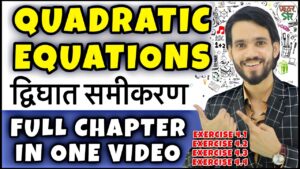
Chapter 4: Quadratic Equations: Factorization, Formula & Discriminant Analysis
Quadratic equations are second-degree polynomial equations that describe accelerated motion under gravity, projectile curves, structural parabolic arches, and economic revenue optimization. In CBSE Class 10 Mathematics, Chapter 4 develops analytical proficiency in recognizing standard quadratic forms, solving equations via middle-term factorization and the quadratic formula, and classifying the nature of roots using the discriminant.
Standard Form and Definitions
A quadratic equation in the variable $x$ is an equation that can be arranged into the canonical form:
$$ax^2 + bx + c = 0$$
where $a, b, c$ are real numbers and the leading coefficient $a neq 0$. If $a = 0$, the second-degree term vanishes, reducing the expression to a linear equation. The values of $x$ that satisfy this equation are termed the roots of the quadratic equation, which are identical to the zeroes of the corresponding quadratic polynomial $P(x) = ax^2 + bx + c$. Every quadratic equation possesses exactly two roots (which may be real and distinct, real and coincident, or complex conjugates).
Solving by Factorization (Splitting the Middle Term)
To solve $ax^2 + bx + c = 0$ by factorization:
- Compute the product of the leading coefficient and the constant term: $ac$.
- Find two numbers $p$ and $q$ such that their sum equals the middle-term coefficient ($p + q = b$) and their product equals $ac$ ($p cdot q = ac$).
- Rewrite the linear middle term $bx$ as $px + qx$, group terms in pairs, and factor out common binomial factors:
$$ax^2 + px + qx + c = 0 implies (mx + n)(rx + s) = 0$$ - Apply the Zero Product Property: if $A cdot B = 0$, then either $A = 0$ or $B = 0$, yielding the two roots.
The Quadratic Formula (Sridharacharya’s Theorem)
When coefficients are large or involve radical values, factoring by inspection becomes difficult. In the 9th century CE, the ancient Indian mathematician Sridharacharya developed the universal algorithmic solution derived via completing the square:
$$x = frac{-b pm sqrt{b^2 – 4ac}}{2a}$$
Derivation via Completing the Square:
- Start with $ax^2 + bx + c = 0$. Since $a neq 0$, divide the entire equation by $a$:
$$x^2 + frac{b}{a}x + frac{c}{a} = 0 implies x^2 + frac{b}{a}x = -frac{c}{a}$$ - To complete the square on the left-hand side, add $left(frac{b}{2a}right)^2 = frac{b^2}{4a^2}$ to both sides:
$$x^2 + 2left(frac{b}{2a}right)x + left(frac{b}{2a}right)^2 = frac{b^2}{4a^2} – frac{c}{a}$$ - Recognize the perfect square binomial identity on the left:
$$left(x + frac{b}{2a}right)^2 = frac{b^2 – 4ac}{4a^2}$$ - Taking square roots on both sides yields:
$$x + frac{b}{2a} = pm frac{sqrt{b^2 – 4ac}}{2a} implies x = -frac{b}{2a} pm frac{sqrt{b^2 – 4ac}}{2a} = frac{-b pm sqrt{b^2 – 4ac}}{2a}$$
Discriminant and Nature of Roots
The algebraic quantity under the square root in the quadratic formula, $b^2 – 4ac$, is termed the discriminant, denoted by $D$:
$$D = b^2 – 4ac$$
The numerical sign of the discriminant completely dictates the nature of the roots without requiring explicit computation of their numerical values:
| Discriminant Value | Nature of Roots | Graphical Behavior | Formula for Roots |
|---|---|---|---|
| $D > 0$ | Two distinct, real roots ($alpha neq beta$) | Parabola intersects x-axis at two distinct points | $x = frac{-b + sqrt{D}}{2a}, frac{-b – sqrt{D}}{2a}$ |
| $D = 0$ | Two equal, coincident real roots ($alpha = beta$) | Parabola touches x-axis at exactly one point | $x = -frac{b}{2a}, -frac{b}{2a}$ |
| $D < 0$ | No real roots (roots are complex/imaginary) | Parabola does not touch or intersect x-axis | No real solutions exist |
High-Yield Water Taps and Cistern Problems
A classic high-weightage 4-mark board application involves two water pipes filling a common reservoir. If a smaller tap takes $x$ hours to fill the tank alone, its filling rate is $frac{1}{x}$ of the tank per hour. If a larger tap takes $(x – 10)$ hours, its rate is $frac{1}{x – 10}$ tank per hour. Running together, their combined rate satisfies:
$$frac{1}{x} + frac{1}{x – 10} = frac{1}{T_{text{total}}}$$
Multiplying across by the common denominator $x(x – 10)T_{text{total}}$ produces a standard quadratic equation in $x$. After solving via the quadratic formula, any negative root or root smaller than 10 must be discarded because physical duration cannot be negative.
High-Yield Board Question Archetype: Equal Roots
Examiners routinely present quadratic equations containing an unknown parameter $k$ and state that the equation has real and equal roots. Students must set $D = 0$ to solve for $k$:
Problem: Find the value(s) of $k$ for which the quadratic equation $(k – 12)x^2 + 2(k – 12)x + 2 = 0$ has real and equal roots.
Step-by-Step Solution:
- Comparing with $Ax^2 + Bx + C = 0$, we have $A = (k – 12)$, $B = 2(k – 12)$, and $C = 2$. Note the restriction: for the equation to remain quadratic, $A neq 0 implies k – 12 neq 0 implies k neq 12$.
- For real and equal roots, the discriminant must vanish: $D = B^2 – 4AC = 0$.
$$[2(k – 12)]^2 – 4(k – 12)(2) = 0$$
$$4(k – 12)^2 – 8(k – 12) = 0$$ - Factor out common term $4(k – 12)$:
$$4(k – 12)[(k – 12) – 2] = 0 implies 4(k – 12)(k – 14) = 0$$ - This yields two potential values: $k = 12$ or $k = 14$.
- Crucial step: If $k = 12$, the coefficient of $x^2$ becomes $(12 – 12) = 0$, meaning the equation ceases to be quadratic. Therefore, $k = 12$ must be rejected.
- Conclusion: The only valid value of $k$ is $k = 14$.
Classes & Batches

Class 10 English Board Express: First Flight Prose, Poetry Analysis & Core Grammar Rules | Dear Sir

Class 10 SST Complete NCERT Board Course: Animated History, Civics, Geography & Economics | Digraj Sir

Class 10 Science Full Syllabus Batch 2026-27: Complete NCERT Lectures, Concept Notes & PYQs | PW Foundation
Study Resources & Notes

NCERT Class 10 Hindi Book PDF (Sparsh Part 2)

CBSE Class 10 Hindi PYQs with Solution

CBSE Class 10 Information Technology PYQs with Solution

NCERT Class 10 Economics Book PDF (Understanding Economic Development)
Quick Practice & Sets

CBSE Class 10 Science 30-Minute Rapid Chapter Mocks

CBSE Class 10 Science Chapter-wise Assertion & Reason Bank

CBSE Class 10 Maths Standard Timed Chapter Mocks