

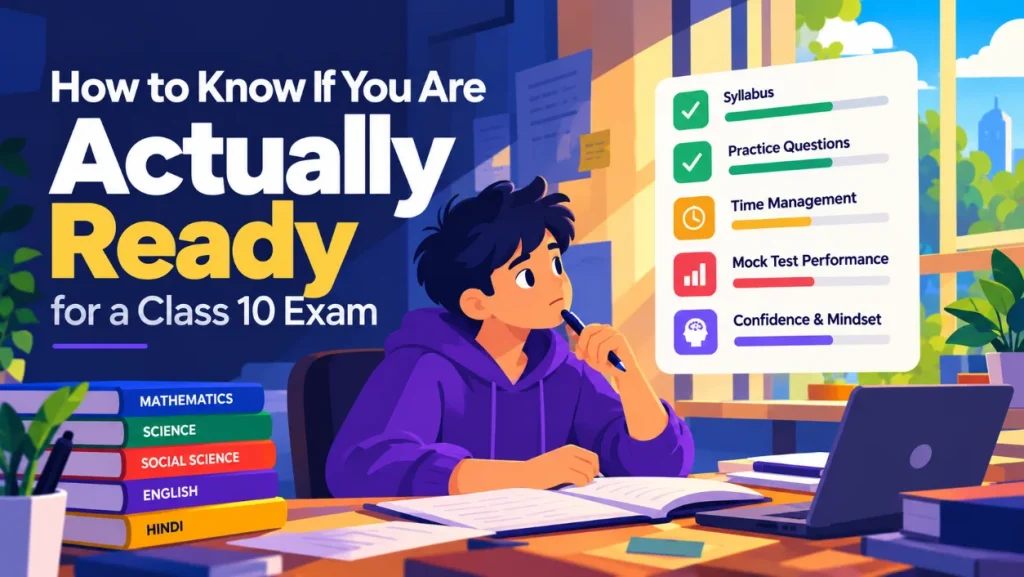
Finishing the Class 10 syllabus feels like a big achievement. And it is.
But here is the slightly uncomfortable question: does finishing the syllabus mean you are ready for the exam?
Not necessarily.
You can finish every chapter and still struggle to solve a question without help. You can revise your notes several times and forget the same topic a week later. You can score well in chapter tests but get stuck when an entire syllabus is mixed together in one paper.
That is why being exam-ready is different from simply being syllabus-complete.
A Class 10 student is genuinely ready when they can recall important concepts without constantly looking at notes, solve unfamiliar questions, write answers within the required time, identify their weak areas and perform reasonably well in a full-length test.
The good news is that you don’t have to guess whether you are ready.
You can test yourself.
The 7 Signs That You Are Actually Ready for a Class 10 Exam
Before getting into the details, here is the quick version.
You are probably in a good position if you can:
- Recall important concepts without opening your book.
- Solve questions you have not seen before.
- Complete a chapter without depending on solutions.
- Explain difficult topics in your own words.
- Score consistently in full-length practice papers.
- Finish papers within the given time.
- Clearly identify and fix your recurring mistakes.
If several of these are missing, don’t panic. It simply means you still have some work to do.
And honestly, discovering that before the board exam is exactly what practice is for.
1. Can You Recall the Chapter Without Looking at Your Notes?
This is one of the easiest ways to check your preparation.
Close the textbook.
Put your notes aside.
Take a blank sheet of paper and write down everything you can remember about the chapter.
You don’t need to reproduce the textbook. Instead, try to recall:
- Main concepts
- Important formulas
- Definitions or terms
- Important examples
- Diagrams or processes
- Key dates or events where relevant
- Common question types
- Relationships between different concepts
Now compare your sheet with your notes.
If you remember most of the important ideas, that’s a good sign.
If you look at your notes and repeatedly think, “Wait, I studied this. How did I forget it?”, the chapter probably needs another round of active revision.
This is an important distinction.
Recognising information is not the same as recalling it.
When you read a familiar answer in your notebook, it can feel as though you know it. The real test comes when the notebook disappears.
Try the blank-page test
Pick a chapter and give yourself 10 minutes.
Write what you remember without checking anything.
Then use your notes to find the gaps.
This gives you a much more honest picture of your preparation than simply reading the chapter again.
2. Can You Solve Questions Without Looking at the Solution?
This is particularly important for Mathematics and Science, but it applies to other subjects too.
Take a set of questions from a chapter you have already studied.
Don’t read the solutions first.
Try solving them independently.
If you get stuck, give yourself some time before checking the answer. Don’t immediately reach for the solution after 30 seconds.
For Mathematics, ask yourself:
- Do I know which concept is being tested?
- Can I choose the correct formula or method?
- Can I complete the calculation without help?
- Can I check whether my final answer makes sense?
For Science:
- Can I identify what the question is actually asking?
- Can I explain the concept instead of copying a memorised sentence?
- Can I handle a question where the situation is slightly different?
- Can I draw or interpret the relevant diagram where necessary?
For Social Science and languages:
- Can I structure an answer without looking at a model answer?
- Am I answering the question or simply writing everything I remember?
- Can I support my answer with relevant details?
If you regularly need to look at solutions before completing questions, you may understand the chapter but are not yet fully exam-ready.
You need more independent practice.
You can use Padhai’s Class 10 practice section to add question-solving to your revision routine.
3. Can You Handle a Question You Have Never Seen Before?
This is where preparation gets real.
A student may solve 20 questions from a chapter and feel completely prepared. Then a question appears with different wording and suddenly the chapter looks unfamiliar.
That doesn’t always mean the student didn’t study.
It often means they learned the pattern of the question, rather than the underlying concept.
Try this test.
Take a concept you have already prepared and find questions that use it in different ways.
For example, in Mathematics, don’t only practise questions that look like the examples you have already solved.
In Science, try questions where the same concept is presented through a situation or application.
In Social Science, practise questions that require you to connect information rather than simply reproduce a memorised point.
Ask yourself:
“If the examiner changes the wording, can I still figure out what to do?”
If the answer is yes, your preparation is becoming stronger.
If your mind goes blank whenever a question looks unfamiliar, spend more time understanding concepts and less time memorising answer patterns.
4. Can You Explain the Topic in Your Own Words?
Here is a surprisingly good test.
Pretend that a younger student has asked you to explain the topic.
Now explain it without opening the book.
You don’t need complicated language. In fact, simple language is better.
If you can explain:
- what the concept means,
- why it works,
- how it is connected to other ideas,
- and where it can be applied,
you probably understand it.
If you find yourself repeating textbook phrases without really knowing what they mean, there is probably a gap in your understanding.
This technique works especially well for Science, Mathematics and Social Science.
For example, instead of merely remembering a definition, ask:
“What does this actually mean in normal language?”
That small change can make revision much more useful.
5. Can You Complete a Full-Length Paper Without Falling Apart?
This is probably the biggest test of exam readiness.
Chapter-wise tests are useful, but the actual examination does not politely tell you which chapter each question belongs to.
A board-style paper can move from one topic to another, and you have to keep switching gears.
Try a full-length paper under proper exam conditions.
That means:
- Set the actual time limit.
- Keep your phone away.
- Don’t use your notes.
- Don’t pause the test every time you get stuck.
- Attempt the paper in one sitting.
- Follow the instructions given with the paper.
Once you finish, don’t look only at the final score.
Analyse the paper.
Your score is only one part of the result
Suppose you score 62 out of 80.
That number tells you something.
But the mistakes tell you much more.
Maybe:
- 5 marks were lost because of calculation errors.
- 4 marks were lost because you forgot concepts.
- 3 marks were lost because you misunderstood questions.
- 2 marks were left because you ran out of time.
- 4 marks were lost in questions you actually knew but answered poorly.
Those are five different problems.
And each needs a different solution.
You can also use Padhai’s CBSE Class 10 previous-year questions to practise working through complete exam-style questions.
6. Are Your Scores Consistent?
One good test score doesn’t automatically mean you’re ready.
Maybe you got 88% once because the questions happened to match the topics you had revised.
What happens the next time?
And the time after that?
Instead of asking:
“What is my highest score?”
ask:
“What is my usual score?”
Consistency gives you a better idea of where you actually stand.
For example:
| Practice Test | Score |
|---|---|
| Test 1 | 62% |
| Test 2 | 68% |
| Test 3 | 71% |
| Test 4 | 73% |
This is a much more encouraging situation than:
| Practice Test | Score |
|---|---|
| Test 1 | 84% |
| Test 2 | 59% |
| Test 3 | 67% |
| Test 4 | 55% |
The second student may have some strong areas, but the performance is less predictable.
Your goal isn’t to get a perfect score in every practice test.
Your goal is to gradually make your performance more stable.
7. Do You Know Why You Lose Marks?
This is one of the most important signs of genuine preparation.
After a test, classify every mistake.
A simple system is enough.
| Type of mistake | Example |
|---|---|
| Concept gap | You didn’t understand the topic |
| Memory gap | You knew it earlier but couldn’t recall it |
| Application problem | You knew the concept but couldn’t use it |
| Careless mistake | Calculation, sign or reading error |
| Time problem | You couldn’t finish the paper |
| Answer-writing problem | You knew the answer but didn’t present it properly |
This helps you avoid a very common mistake: studying everything again when you actually need to fix one specific weakness.
If your concepts are strong but you keep losing marks through calculation mistakes, reading another chapter isn’t going to solve the problem.
You need targeted practice.
A Simple Class 10 Readiness Test
If you want a quick reality check, try this.
Choose one subject.
Then complete the following five tasks.
Test 1: Recall
Take a blank page and write the main concepts from one chapter without opening your notes.
Test 2: Questions
Solve 10 to 20 questions without looking at solutions.
Test 3: Unfamiliar Questions
Attempt a few questions that you haven’t previously practised.
Test 4: Explanation
Explain one difficult concept in your own words.
Test 5: Timed Paper
Attempt a complete practice paper within the prescribed time.
Now review the results.
If you struggled with all five, you probably need more preparation.
If you did well with recall and chapter questions but struggled with unfamiliar questions, focus on application.
If you solved the questions but couldn’t finish the paper, work on time management.
If you completed everything but made many avoidable mistakes, your next target should be accuracy.
This is much more useful than simply asking, “How many chapters have I completed?”
The Difference Between Syllabus Completion and Exam Readiness
These two things are often confused.
| Syllabus Complete | Exam Ready |
|---|---|
| You have read every chapter | You can recall important concepts |
| You have watched lectures | You can solve questions independently |
| You have made notes | You can revise from them efficiently |
| You have seen sample questions | You can handle unfamiliar questions |
| You have taken chapter tests | You can handle a full-length paper |
| You know the topics | You know where you make mistakes |
| You studied everything once | You have revised and tested yourself |
Think of syllabus completion as finishing the first major part of preparation.
Exam readiness comes later.
You need practice, revision, testing and correction before you can confidently say you’re ready.
If you want to check whether you are working from the right syllabus for the current session, see the CBSE Class 10 syllabus for 2026-27 on Padhai.
You can also review the CBSE Class 10 exam pattern and subject-wise marks distribution so your practice matches the assessment structure.
What If You Are Not Ready Yet?
First, don’t panic.
Finding out that you’re not ready is useful information.
It would be much worse to discover it for the first time on exam day.
Instead, identify the exact problem.
If you keep forgetting things
Use active recall and spaced revision.
Don’t simply read the chapter again. Close the book and try to retrieve the information yourself.
If you can’t solve questions
Go back to the concept and then practise simpler questions before moving towards harder ones.
If you know the concepts but score poorly
Analyse your answer-writing, accuracy and time management.
If you can’t finish papers
Start practising under timed conditions.
If one subject is much weaker
Don’t ignore it because you enjoy studying another subject more.
Give the weak subject regular, smaller study sessions rather than waiting for a giant revision day.
How to Check Your Readiness Every Week
You don’t need to take a full mock test every single day.
A simple weekly check can work well.
During the week
Study new or weak topics.
At the end of the week
Spend some time revising older topics.
Then test yourself
Take a short mixed test without looking at your notes.
Review your mistakes
Write down the topics or skills that caused problems.
Plan the next week
Use those mistakes to decide what needs attention.
This creates a useful loop:
Study → Recall → Practise → Test → Analyse → Revise
The important part is the analysis.
Without it, you are just collecting test scores.
Don’t Wait Until the Last Month to Find Out
One of the biggest advantages of checking your readiness early is that you still have time to fix problems.
If you discover in September that you struggle with a particular subject, you have room to work on it.
If you discover it immediately before the board examination, the same problem becomes much harder to manage.
For the 2026-27 academic session, Class 10 students should keep their preparation aligned with the syllabus, assessment information and official CBSE updates applicable to their batch. Padhai also maintains a Class 10 notifications section where students can follow relevant updates.
Don’t build your entire preparation around rumours about “important questions” or predictions about exactly what will appear.
Learn the syllabus.
Understand the concepts.
Practise different types of questions.
Use official sample papers and previous papers appropriately.
Then test yourself.
A 10-Minute Readiness Checklist
Before your next exam, ask yourself these questions:
- Can I explain the major topics without looking at my notes?
- Can I recall important formulas, terms and concepts?
- Can I solve questions without checking solutions?
- Can I handle a question I’ve never seen before?
- Can I write answers clearly and directly?
- Can I complete a paper within the time limit?
- Do I know my three biggest recurring mistakes?
- Have I revised topics I previously got wrong?
- Have I attempted full-length papers?
- Are my scores becoming more consistent?
If you can confidently tick most of these boxes, you’re moving in the right direction.
If several boxes are still empty, that’s not a failure.
It’s your study plan telling you where the work is.
Final Answer: Are You Actually Ready?
You are not exam-ready simply because you have completed the Class 10 syllabus.
You are ready when you can remember what you studied, use it without help, handle unfamiliar questions, write answers clearly, manage your time and learn from your mistakes.
That’s the real test.
So instead of asking yourself every few days, “Have I studied enough?”, ask better questions:
Can I solve this without looking?
Can I explain it without memorising the textbook?
Can I handle a new question?
Can I finish the paper on time?
Do I know why I lost my last mark?
Those answers will tell you far more about your preparation than the number of chapters you’ve checked off a timetable.
And if you’re not quite there yet, don’t wait for motivation to magically appear. Pick the weakest area, work on it, test yourself again and keep moving.
Being ready isn’t a feeling.
It’s something you can test.
Frequently Asked Questions
How do I know if I am ready for my Class 10 board exam?
Try a combination of recall, independent question-solving and full-length timed papers. If you can consistently solve questions without help, handle unfamiliar problems and complete papers within the required time, you are likely in a much stronger position.
Is finishing the Class 10 syllabus enough for board exams?
No. Completing the syllabus is an important milestone, but you still need revision, question practice, mock tests and mistake analysis. Knowing the material and being able to use it under exam conditions are different skills.
How many mock tests should I take before Class 10 boards?
There is no universal number that guarantees readiness. The quality of your analysis matters more than simply counting papers. After each test, identify your mistakes and use them to guide your revision.
What should I do if my practice-test marks are low?
Don’t immediately restart the entire syllabus. First identify why you lost marks. Separate concept gaps from memory problems, careless mistakes, time-management issues and answer-writing problems. Then work on the specific weakness.
Should I revise everything again after finishing the syllabus?
Not necessarily. Start by testing yourself. Your results will show which chapters need full revision and which only need a quick review. This can save a lot of time during the final stages of preparation.













Comments (2)
Please log in to comment
Log In