
CBSE Class 10 Maths Standard PYQs with Solution
Contents
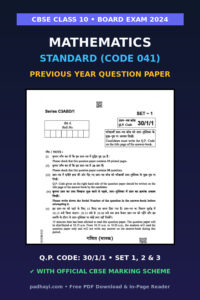
30/7/1 Set-1 Compartment (2026)
30/7/2 Set-2 Compartment (2026)
30/7/3 Set-3 Compartment (2026)
30/8/1 Set-1 Compartment (2026)
30/8/2 Set-2 Compartment (2026)
30/8/3 Set-3 Compartment (2026)
30/1/1 Set-1 (2026)
30/1/2 Set-2 (2026)
30/1/3 Set-3 (2026)
30/2/1 Set-1 (2026)
CBSE Class 10 Maths Standard Previous Year Question Papers (PYQs) with Solutions Archive
Welcome to the comprehensive digital archive of CBSE Class 10 Mathematics Standard (Subject Code: 041) Previous Year Question Papers with Official Step-by-Step Marking Scheme Solutions. Solving authentic board examination papers from prior years is universally recognized by educators, board toppers, and academic evaluators as the single most effective preparation strategy for scoring 95%+ marks in the CBSE Class 10 board examinations.
This repository organizes all official examination sets year-wise across multiple examination series, national regions, and compartment/supplementary cycles. Below in the dedicated Year Tabs, you can explore, read online via our continuous high-speed document reader, and download every single set complete with its attached official CBSE marking scheme.
1. Why Solving Authentic CBSE Class 10 Maths Standard PYQs is Non-Negotiable
Unlike ordinary reference mock papers, authentic CBSE Previous Year Question Papers offer unmatched pedagogical advantages:
- Exact Calibration of Question Typologies: CBSE math examinations adhere to a strictly balanced cognitive taxonomy defined by the National Curriculum Framework (NCF). The paper allocates approximately 50% to Knowledge and Understanding, 30% to Application of Concepts, and 20% to Higher Order Thinking Skills (HOTS) and analytical case studies. Practicing real papers conditions you to this precise cognitive balance.
- Mastery of the Multi-Set Calibration System: In every board examination cycle, CBSE produces approximately 15 to 18 sets across multiple regions (Series 30/1, 30/2, 30/3, 30/4, 30/5, etc.). While core theorems and foundational competencies remain consistent, numerical variants and problem contexts differ. Solving multiple sets from each year exposes you to the complete spectrum of questions the board setters devise.
- Demystifying the Evaluator Rubric via Attached Marking Schemes: Every paper in this archive includes the complete, unabridged official CBSE Marking Scheme. Rather than merely showing final answers, the marking scheme reveals the step-by-step value points, intermediate formula credits, and procedural allocations used by thousands of appointed evaluators during nationwide spot evaluation.
- Eliminating Exam Anxiety & Refining Speed Under Timed Conditions: Attempting 38 questions across 5 sections within 180 minutes requires disciplined pacing. Practicing past papers trains you to navigate through MCQs within 30 minutes, freeing ample time for multi-step 5-mark proofs and intricate 4-mark case studies.
2. CBSE Class 10 Mathematics Standard Unit-Wise Weightage & Syllabus Blueprint
The theory paper for CBSE Class 10 Mathematics Standard carries an aggregate of 80 marks (with the remaining 20 marks allocated to school-based internal assessment). The board blueprint is distributed across seven fundamental mathematical units as follows:
| Unit No. | Unit Name | Chapters Covered | Marks Weightage |
|---|---|---|---|
| I | Number Systems | Real Numbers (Fundamental Theorem of Arithmetic, Irrationality Proofs) | 06 Marks |
| II | Algebra | Polynomials, Pair of Linear Equations, Quadratic Equations, Arithmetic Progressions | 20 Marks |
| III | Coordinate Geometry | Lines (Distance Formula, Section Formula, Mid-point Formula) | 06 Marks |
| IV | Geometry | Triangles (Basic Proportionality Theorem) and Circles (Tangent Theorems) | 15 Marks |
| V | Trigonometry | Introduction to Trigonometry, Trigonometric Identities, Heights and Distances | 12 Marks |
| VI | Mensuration | Areas Related to Circles, Surface Areas and Volumes of Combined Solids | 10 Marks |
| VII | Statistics & Probability | Mean, Median, Mode of Grouped Data; Classical Probability | 11 Marks |
| Total Theory Examination | 80 Marks | ||
3. Five-Section Paper Architecture Explained
Across all recent examination sessions (including 2026, 2025, 2024, 2023, and 2022), the question paper is partitioned into five standardized sections containing a total of 38 mandatory questions:
- Section A (Questions 1 to 20 — 20 Marks): Comprises 20 multiple-choice questions carrying 1 mark each. Questions 1 to 18 are single-choice objective questions testing rapid recall, mental arithmetic, and conceptual clarity. Questions 19 and 20 are Assertion-Reasoning questions requiring careful validation of both statements and their deductive relationship.
- Section B (Questions 21 to 25 — 10 Marks): Contains 5 Very Short Answer (VSA) type questions carrying 2 marks each. Typically features fundamental geometric deductions, HCF/LCM applications, arithmetic progression terms, and trigonometric value evaluations. Internal choices are provided in 2 questions.
- Section C (Questions 26 to 31 — 18 Marks): Features 6 Short Answer (SA) type questions carrying 3 marks each. This section tests substantive proofs (such as proving irrationality of √3 or √5), tangent length theorems, section formula coordinates, and quadratic equation formulations. Internal choices are provided in 2 questions.
- Section D (Questions 32 to 35 — 20 Marks): The pivotal Long Answer (LA) section comprising 4 questions carrying 5 marks each. Questions here demand rigorous, formal presentations: proving the Basic Proportionality Theorem (Thales Theorem), solving speed-distance or work-time quadratic word problems, two-point heights and distances derivations, and combined solid volume/surface area computations. Internal choices are provided in 2 questions.
- Section E (Questions 36 to 38 — 12 Marks): Features 3 Case-Based / Source-Based integrated competency units carrying 4 marks each. Each unit features a practical real-world scenario (architectural design, sports analytics, geographical surveying) followed by sub-parts carrying 1 mark, 1 mark, and 2 marks (with an internal alternative in the 2-mark sub-part).
4. Recommended Protocol for Navigating the Year Tabs Below
To extract maximum preparation value from this comprehensive archive, we recommend the following step-by-step revision routine:
- Select a Target Year from the Tabs Below: Click on the tab for your target examination session (e.g., 2026, 2025, 2024, 2023, 2022, or 2020). The view updates instantly to display all official sets published in that year.
- Open a Specific Question Paper Set: Choose a specific paper code (e.g., Series 30/1/1 Set-1). You can review the paper directly in our full-screen continuous document reader or download the verified PDF to your local device.
- Simulate Authentic 3-Hour Exam Conditions: Print or view the question paper portion (the first 14 to 16 pages) without looking ahead to the solutions. Set a strict countdown timer for 3 hours, write answers on blank ruled sheets, and complete all 38 questions independently.
- Audit Your Work with the Attached Marking Scheme: Navigate to the attached official marking scheme (pages 17 onwards). Grade your handwritten answers step-by-step against the official value points, deducting marks for omitted formula declarations, missing units, or unjustified geometric steps.
- Track and Resolve Recurring Errors: Maintain an error log noting topics where marks were lost. Practice parallel questions from companion sets (e.g., Sets 2 and 3 of the same series) to solidify mastery.
5. Frequently Asked Questions (FAQs)
Q1. Are these official CBSE question papers or third-party sample papers?
Every paper in this archive is the authentic, unmodified official CBSE board examination question paper distributed to students in examination centres across India and overseas. Furthermore, each PDF includes the official CBSE marking scheme released post-examination for evaluation centers.
Q2. Why does each year contain up to 18 or 21 different sets?
CBSE develops multiple question paper series (such as Series 30/1, 30/2, 30/3, 30/4, 30/5, etc.) tailored to different geographical zones across India (Delhi, All India, Foreign regions, and Compartment examinations). Each series contains 3 parallel sets (Set 1, Set 2, Set 3) to safeguard exam integrity. Having all sets available ensures comprehensive coverage of all question variants.
Q3. What is the difference between Maths Standard (041) and Maths Basic (241)?
CBSE introduced two difficulty levels in Class 10 Mathematics. Mathematics Standard (Code 041) is designed for students intending to pursue Mathematics, Physics, Chemistry, or engineering in Classes 11 and 12, featuring deeper analytical questions and Higher Order Thinking Skills. Mathematics Basic (Code 241) is a simplified tier for students pursuing Commerce or Humanities without higher mathematics.
Q4. Can I preview and download all papers for free?
Yes. All papers across all years and sets are permanently free for preview and direct high-speed download via our Cloudflare R2 CDN infrastructure. Select any set from the year tabs below to start practicing immediately.
Classes & Batches

Class 10 Maths Full Syllabus NCERT Masterclass: Chapter-Wise Concepts, Proofs & Shortcut Tricks | Dear Sir

Class 10 English Board Express: First Flight Prose, Poetry Analysis & Core Grammar Rules | Dear Sir

Class 10 SST Complete NCERT Board Course: Animated History, Civics, Geography & Economics | Digraj Sir

Class 10 Science Full Syllabus Batch 2026-27: Complete NCERT Lectures, Concept Notes & PYQs | PW Foundation
Study Resources & Notes
Class 10 Maths Formula & Methods Revision: PDFs, Examples and Practice
NCERT Class 10 Maths Book PDF
CBSE Class 10 Maths Basic PYQs with Solution
CBSE Class 10 Maths Basic Sample Paper with Solution & Marking Scheme
Quick Practice & Sets


Community Buzz

How to Prepare for Class 10 Maths in 30 Days Without Stress
Class 10 Economics: What Per Capita Income Hides
Class 10 English Literature: Build an Evidence-Based Answer
Class 10 Refractive Index: Connect Speed and Bending of Light
Comments (0)
No comments yet. Be the first to comment!
Please log in to comment
Log In