
If the sum of first m terms of an AP is $2m^{2}+3m$, then its second term is :
[1]
A school is organizing a charity run to raise funds for a local hospital. The run is planned as a series of rounds around a track, with each round being 300 metres. To make the event more challenging and engaging, the organizers decide to increase the distance of each subsequent round by 50 metres. For example, the second round will be 350 metres, the third round will be 400 metres and so on. The total number of rounds planned is 10.
Based on the information given above, answer the following questions:
| (i) |
Write the fourth, fifth and sixth term of the Arithmetic Progression so formed. |
||||||
| (ii) | Determine the distance of the $8^{th}$ round. | ||||||
| (iii) |
|
[4]
Case Study - 2
In a garden, saplings of rose flowers were planted at equal intervals to form a spiral pattern. The spiral is made up of successive semicircles, with centres alternatively at A and B, starting with centre at A, of radii 50 cm, 100 cm, 150 cm, ... as shown in the figure given below. Spiral 1 has 10 flowers, Spiral 2 has 20 flowers, Spiral 3 has 30 flowers and so on.
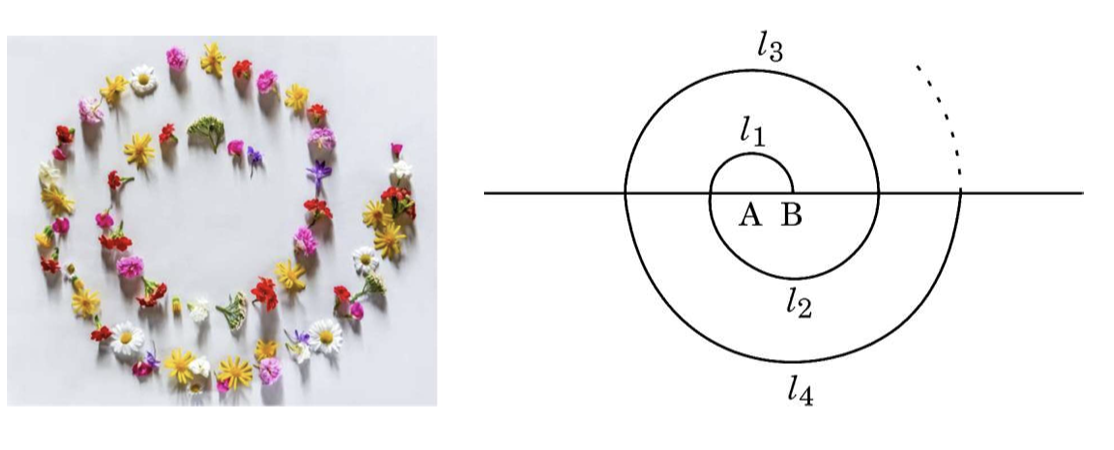
Based on the above information, answer the following questions:
- (i) What is the radius of the 13th spiral?
- (ii) If the radius of the nth spiral is 500 cm, find the value of n.
- (iii) (a) Find the total number of saplings till the $11^{th}$ spiral.
OR
(b) Till which spiral, will there be a total of 450 saplings?
[4 marks]
In an A.P., if the first term $a=7$, nth term $a_{n}=84$ and the sum of first n terms $s_{n}=\frac{2093}{2}$, then n is equal to:
[1 mark]
The sum of first and eighth terms of an A.P. is 32 and their product is 60. Find the first term and common difference of the A.P. Hence, also find the sum of its first 20 terms.
[5 marks]
In an A.P. of 40 terms, the sum of first 9 terms is 153 and the sum of last 6 terms is 687. Determine the first term and common difference of A.P. Also, find the sum of all the terms of the A.P.
[5 marks]
In an A.P., if $a=8$ and $a_{10}=-19$, then value of $d$ is :
[1 mark]
How many terms of the A.P. $27, 24, 21, \dots$ must be taken so that their sum is $105$? Which term of the A.P. is zero?
[5 marks]
The seventh term of an A.P. whose first term is 28 and common difference -4, is
[1 mark]
Aahana being a plant lover decides to convert her balcony into beautiful garden full of plants. She bought few plants with pots for her balcony. She placed the pots in such a way that number of pots in the first row is 2, second row is 5, third row is 8 and so on.
- - - - INSERT IMAGE HERE - - - -Based on the above information, answer the following questions:
- (i) Find the number of pots placed in the \( 10^{\text{th}} \) row.
- (ii) Find the difference in the number of pots placed in \( 5^{\text{th}} \) row and \( 2^{\text{nd}} \) row.
- (iii) If Aahana wants to place 100 pots in total, then find the total number of rows formed in the arrangement.
OR
(iii) If Aahana has sufficient space for 12 rows, then how many total number of pots are placed by her with the same arrangement?
[4 marks]
If \( p-1 \), \( p+1 \) and \( 2p+3 \) are in A.P., then the value of p is
[1 mark]
(a) The ratio of the \( 11^{th} \) term to \( 17^{th} \) term of an A.P. is 3: 4. Find the ratio of \( 5^{th} \) term to \( 21^{st} \) term of the same A.P. Also, find the ratio of the sum of first 5 terms to that of first 21 terms.
OR
(b) 250 logs are stacked in the following manner: 22 logs in the bottom row, 21 in the next row, 20 in the row next to it and so on (as shown by an example). In how many rows, are the 250 logs placed and how many logs are there in the top row?
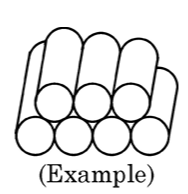
[5 marks]
(a) In an AP, if $a=50$, $d=-4$ and $S_{n}=0$, then find the value of $n$.
OR
(b) Find the sum of the first twelve 2-digit multiples of 7, using an AP.
[2 marks]
Case Study 1
Do you know old clothes which are thrown as waste not only fill the landfill site but also produce very harmful greenhouse gas. So, it is very important that we reuse old clothes in whatever way we can.
The picture given below on the right, shows a footmat (rug) made out of old t-shirts yarn. Observing the picture, you will notice that a number of stitches in circular rows are making a pattern: 6, 12, 18, 24, ...
- - - - INSERT IMAGE HERE - - - -Based on the above information, answer the following questions :
- (a) Check whether the given pattern forms an AP. If yes, find the common difference and the next term of the AP.
- (b) Write the $n^{th}$ term of the AP. Hence, find the number of stitches in the $10^{th}$ circular row.
[4 marks]
(a) Find the sum of first 30 terms of AP: 30, -24, -18, ...
OR
(b) In an AP if \(S_{n}=n(4n+1)\), then find the AP.
[2 marks]
Case Study - 1
In Mathematics, relations can be expressed in various ways. The matchstick patterns are based on linear relations. Different strategies can be used to calculate the number of matchsticks used in different figures. One such pattern is shown below. Observe the pattern and answer the following questions using Arithmetic Progression:
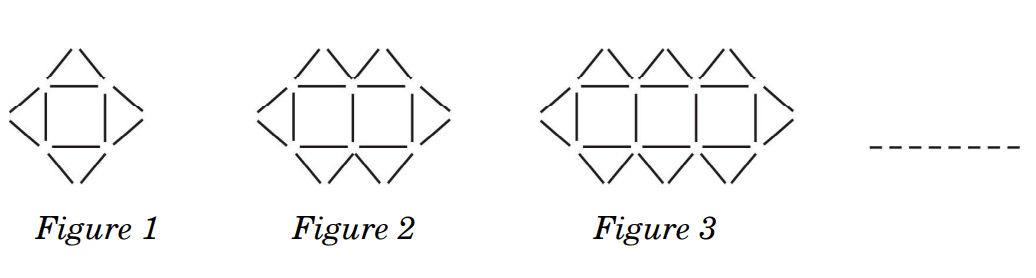
(a) Write the AP for the number of triangles used in the figures. Also, write the nth term of this AP.
(b) Which figure has 61 matchsticks?
[4 marks]
The middle term of the A.P.: $10, 7, 4, \dots, -62$ is :
(A) Ridhi drew a polygon with $n$ sides. The smallest exterior angle is $10^\circ$ and all exterior angles are in arithmetic progression with common difference $5^\circ$. Find the number of sides $n$ of the polygon.
OR
(B) Find the sum of all integers between 1 and 400 that are multiples of both 4 and 5.
[3 marks]
The value of $x$ for which $2x$, $(x + 10)$ and $(3x + 2)$ are the three consecutive terms of an A.P. is :
If $1 + 2 + 3 + 4 + \dots + 50 = 25k$, then $k =$ :
If the sum of the first $n$ terms of an A.P. is given by $S_n = 5n^2 - n$, find the $n^{\text{th}}$ term and hence find its $20^{\text{th}}$ term.
[3 marks]