
The tangents drawn at the extremities of the diameter of a circle are always:
[1]
In the given figure, PA is a tangent from an external point P to a circle with centre O. If $\angle POB=115^{\circ}$ then $\angle APO$ is equal to:
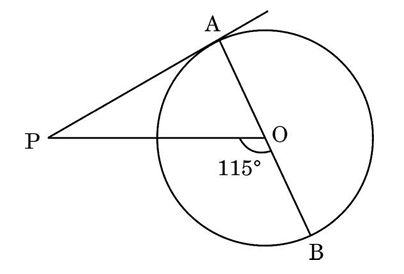
[1]
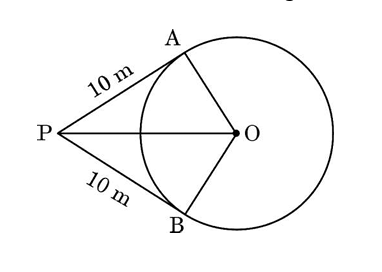
A person is standing at P outside a circular ground at a distance of 26 m from the centre of the ground. He found that his distances from the points A and B on the ground are 10 m (PA and PB are tangents to the circle). Find the radius of the circular ground.
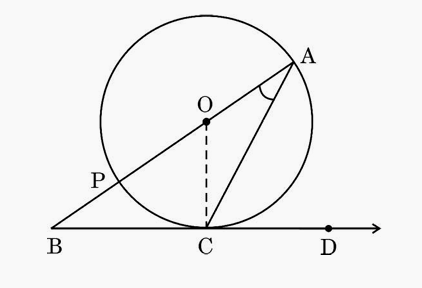
(a) In the given figure, O is the centre of the circle and BCD is tangent to it at C. Prove that $\angle BAC+\angle ACD=90^{\circ}$.
OR
(b) Prove that opposite sides of a quadrilateral circumscribing a circle subtend supplementary angles at the centre of the circle.
[3]
In the given figure, PA is a tangent to a circle with centre O. If $OP=10$ cm, then the length of AP is:
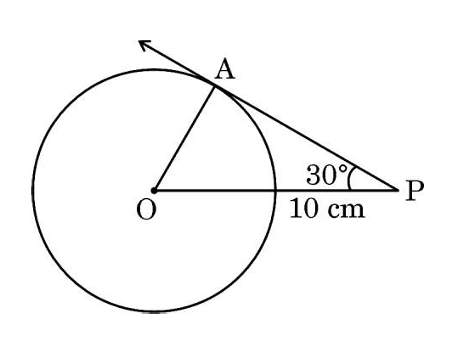
[1 marks]
Two concentric circles are of radii 6 cm and 10 cm. Find the length of the chord of the larger circle which touches the smaller circle.
[2 marks]
Prove that a rectangle circumscribing a circle is a square.
[3 marks]
Directions: In Q. No. 19 and 20 a statement of Assertion (A) is followed by a statement of Reason (R). Choose the correct option.
(a) Both, Assertion (A) and Reason (R) are true and Reason (R) is correct explanation of Assertion (A).
(b) Both, Assertion (A) and Reason (R) are true but Reason (R) is not correct explanation for Assertion (A).
(c) Assertion (A) is true but Reason (R) is false.
(d) Assertion (A) is false but Reason (R) is true.
Assertion (A): The tangents drawn at the end points of a diameter of a circle, are parallel.
Reason (R): Diameter of a circle is the longest chord.
[1 mark]
In the given figure, AB is a diameter of the circle with centre O. AQ, BP and PQ are tangents to the circle. Prove that $\angle POQ=90^{\circ}$.
IMAGE
[3 marks]
A circle with centre O and radius 8 cm is inscribed in a quadrilateral ABCD in which P, Q, R, S are the points of contact as shown. If AD is perpendicular to DC, $BC=30$ cm and $BS=24$ cm, then find the length DC.
IMAGE
[3 marks]
A backyard is in the shape of a triangle ABC with right angle at B. $AB=7~m$ and $BC=15$ m. A circular pit was dug inside it such that it touches the walls AC, BC and AB at P, Q and R respectively such that $AP=xm.$
IMAGE
Based on the above information, answer the following questions:
(i) Find the length of AR in terms of x.
(ii) Write the type of quadrilateral BQOR.
(iii) (a) Find the length PC in terms of x and hence find the value of x.
OR
(b) Find x and hence find the radius r of circle.
[4 marks]
Directions: In Q. No. 19 and 20, a statement of Assertion (A) is followed by a statement of Reason (R). Select the correct option from the following options:
- (a) Both, Assertion (A) and Reason (R) are true. Reason (R) explains Assertion (A) completely.
- (b) Both, Assertion (A) and Reason (R) are true. Reason (R) does not explain Assertion (A).
- (c) Assertion (A) is true but Reason (R) is false.
- (d) Assertion (A) is false but Reason (R) is true.
Assertion (A): If the $PA$ and $PB$ are tangents drawn to a circle with centre $O$ from an external point $P$, then the quadrilateral $OAPB$ is a cyclic quadrilateral.
IMAGE
Reason (R): In a cyclic quadrilateral, opposite angles are equal.
[1 mark]
(A) In two concentric circles, the radii are $OA=r$ cm and $OQ=6$ cm, as shown in the figure. Chord $CD$ of larger circle is a tangent to smaller circle at $Q$. $PA$ is tangent to larger circle. If $PA=16$ cm and $OP=20$ cm, find the length $CD$.
IMAGE
OR
(B) In given figure, two tangents $PT$ and $QT$ are drawn to a circle with centre $O$ from an external point $T$. Prove that $\angle PTQ=2\angle OPQ$.
IMAGE
[3 marks]
The picture given below shows a circular mirror hanging on the wall with a cord. The diagram represents the mirror as a circle with centre $O$. $AP$ and $AQ$ are tangents to the circle at $P$ and $Q$ respectively such that $AP=30$ cm and $\angle PAQ=60^{\circ}$
IMAGE
Based on the above information; answer the following questions :
(i) Find the length $PQ$.
(ii) Find $\angle POQ$
(iii) (a) Find the length $OA$.
OR
(b) Find the radius of the mirror.
[4 marks]
The distance between two parallel tangents of a circle of diameter 7 cm is:
[1 mark]
In the given figure, BC and BD are tangents to the circle with centre O and radius 9 cm.
If \( OB=15 \text{ cm} \), then the length \( (BC+BD) \) is :
IMAGE
[1 mark]
Directions for Q.19 & Q.20: In question numbers 19 and 20, a statement of Assertion (A) is followed by a statement of Reason (R). Choose the correct option:
(a) Both Assertion (A) and Reason (R) are true and Reason (R) is the correct explanation of Assertion (A).
(b) Both Assertion (A) and Reason (R) are true but Reason (R) is not the correct explanation of Assertion (A).
(c) Assertion (A) is true, but Reason (R) is false.
(d) Assertion (A) is false, but Reason (R) is true.
Assertion (A): A tangent to a circle is perpendicular to the radius through the point of contact.
Reason (R): The lengths of tangents drawn from the external point to a circle are equal.
[1 mark]
Prove that the tangents drawn from an external point to a circle are equal in length.
[3 marks]
In the given figure, PQ is tangent to the circle centred at O. If \( \angle AOB=95^{\circ} \) then the measure of \( \angle ABQ \) will be
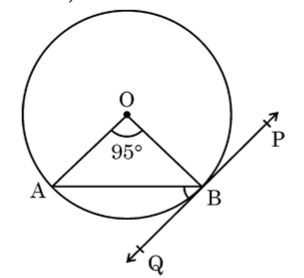
[1 mark]
(a) Two tangents TP and TQ are drawn to a circle with centre O from an external point T. Prove that \( \angle PTQ=2\angle OPQ \).

OR
(b) In the given figure, a circle is inscribed in a quadrilateral ABCD in which \( \angle B=90^{\circ} \). If \( AD=17 \text{ cm} \), \( AB=20 \text{ cm} \) and \( DS=3 \text{ cm} \), then find the radius of the circle.
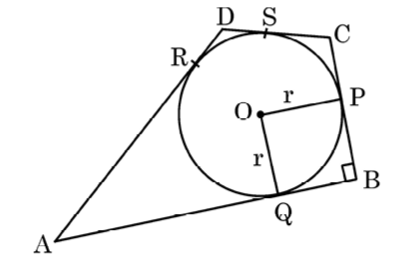
[3 marks]
Case Study
The discus throw is an event in which an athlete attempts to throw a discus. The athlete spins anti-clockwise around one and a half times through a circle, then releases the throw. When released, the discus travels along tangent to the circular spin orbit.
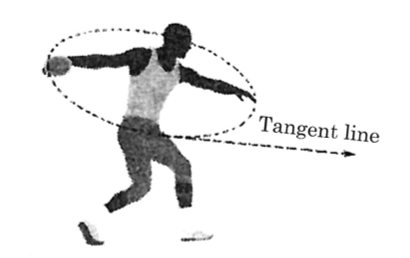
In the given figure, AB is one such tangent to a circle of radius 75 cm. Point O is centre of the circle and \( \angle ABO=30^{\circ} \). PQ is parallel to OA.
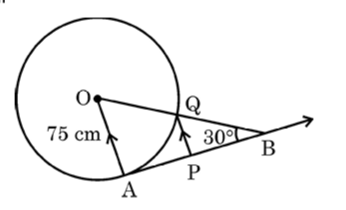
Based on above information:
- (a) find the length of AB.
- (b) find the length of OB.
- (c) find the length of AP.
OR
(c) Find the length of PQ
[4 marks]
In Figure 1, if tangents PA and PB drawn from a point P to a circle with centre O, are inclined to each other at an angle of $70^{\circ}$, then find the measure of $\angle POA$.
- - - - INSERT IMAGE HERE - - - -
[2 marks]
In Figure 3, the tangent $l$ is parallel to the tangent $m$ drawn at points A and B respectively to a circle centred at O. PQ is a tangent to the circle at R. Prove that $\angle POQ=90^{\circ}$
- - - - INSERT IMAGE HERE - - - -
[4 marks]
Two concentric circles are of radii 4 cm and 3 cm. Find the length of the chord of the larger circle which touches the smaller circle.
[2 marks]
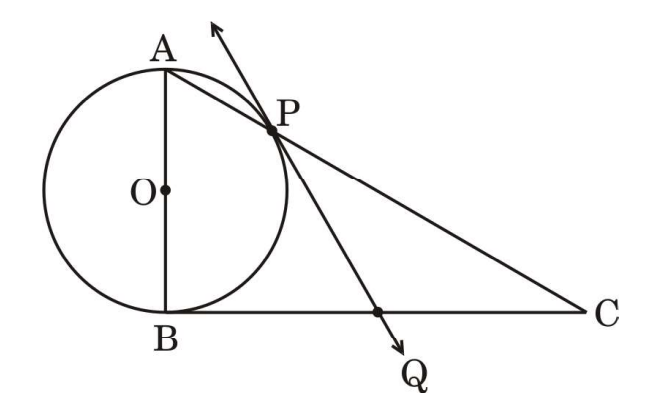
In Figure 1, a triangle ABC with \(\angle B=90^{\circ}\) is shown. Taking AB as diameter, a circle has been drawn intersecting AC at point P. Prove that the tangent drawn at point P bisects BC.
[4 marks]
Prove that the parallelogram circumscribing a circle is a rhombus.
[3 marks]
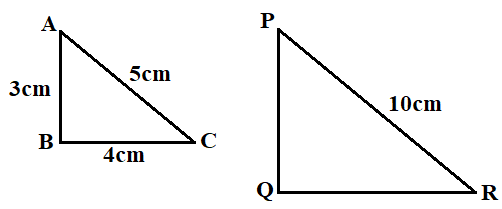
In the figure given below, radius $r$ of the incircle touching the sides of right-angled triangle $ABC$ (right-angled at $B$ with $AB = 6\text{ cm}$ and $BC = 8\text{ cm}$) is :
From an external point $Q$, the length of the tangent to a circle is $24\text{ cm}$ and the distance of $Q$ from the centre is $25\text{ cm}$. The radius of the circle is :
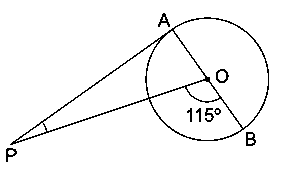
In the given figure, $PA$ and $PB$ are tangents from an external point $P$ to a circle with centre $O$. If $\angle APB = 80^\circ$, then $\angle AOB$ is equal to :
A quadrilateral $ABCD$ is drawn to circumscribe a circle, as shown in the figure below. Prove that $AB + CD = AD + BC$.
[3 marks]