
(a) The perimeter of a right triangle is 60 cm and its hypotenuse is 25 cm. Find the lengths of other two sides of the triangle.
OR
(b) A train travels a distance of 480 km at a uniform speed. If the speed had been $8\text{ km/h}$ less, then it would have taken 3 hours more to cover the same distance. Find the speed of the train.
[5]
The discriminant of the quadratic equation $x^{2}-3x-2=0$ is:
[1 marks]
The equation $x+\frac{1}{x}=3 (x\ne0)$ is expressed as a quadratic equation in the form of $ax^{2}+bx+c=0$. The value of $a-b+c$ is:
[1 marks]
(a) The difference of the squares of two positive numbers is 180. The square of the smaller number is 8 times the greater number. Find the two numbers.
OR
(b) Find the value(s) of k for which the equation $2x^{2}+kx+3=0$ has real and equal roots. Hence, find the roots of the equations so obtained.
[5 marks]
If the roots of equation $ax^{2}+bx+c=0$, $a \ne 0$ are real and equal, then which of the following relation is true ?
[1 mark]
A rectangular floor area can be completely tiled with 200 square tiles. If the side length of each tile is increased by 1 unit, it would take only 128 tiles to cover the floor.
(i) Assuming the original length of each side of a tile be x units, make a quadratic equation from the above information.
(ii) Write the corresponding quadratic equation in standard form.
(iii) (a) Find the value of x, the length of side of a tile by factorisation.
OR
(b) Solve the quadratic equation for x, using quadratic formula.
IMAGE
[4 marks]
If the roots of quadratic equation $4x^{2}-5x+k=0$ are real and equal, then value of $k$ is:
[1 mark]
The discriminant of the quadratic equation \( 2x^{2}-5x-3=0 \) is
[1 mark]
(a) The diagonal of a rectangular field is 60 m more than the shorter side.
If the longer side is 80 m more than the shorter side, find the length of the sides of the field.
OR
(b) The sum of the ages of a father and his son is 45 years. Five years ago, the product of their ages (in years) was 124. Determine their present age.
[5 marks]
The least positive value of k, for which the quadratic equation \( 2x^{2}+kx-4=0 \) has rational roots, is
[1 mark]
Case Study
While designing the school year book, a teacher asked the student that the length and width of a particular photo is increased by x units each to double the area of the photo. The original photo is 18 cm long and 12 cm wide.
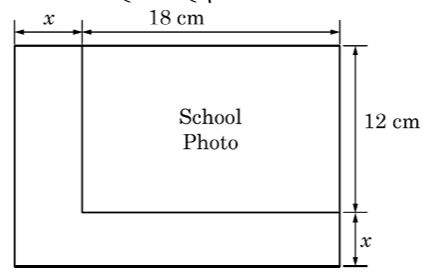
Based on the above information, answer the following questions:
- (I) Write an algebraic equation depicting the above information.
- (II) Write the corresponding quadratic equation in standard form.(III) What should be the new dimensions of the enlarged photo?
OR - (III) Can any rational value of x make the new area equal to \( 220 \text{ cm}^{2} \)?
[4 marks]
(a) Find the nature of the roots of the quadratic equation $x^{2}-5x+9=0$.
OR
(b) Write a quadratic equation with roots $-3$ and $5$.
[2 marks]
Solve the quadratic equation $2x^{2}-5x-1=0$ for $x$.
[2 marks]
(a) Find the value of m for which the quadratic equation \((m-1)x^{2}+2(m-1)x+1=0\) has two real and equal roots.
OR
(b) Solve the following quadratic equation for x: \(\sqrt{3}x^{2}+10x+7\sqrt{3}=0\)
[2 marks]
The product of Rehan's age (in years) 5 years ago and his age 7 years from now, is one more than twice his present age. Find his present age.
[2 marks]
If $(1 - p)$ is a root of the quadratic equation $x^2 + px + 1 - p = 0$, then its roots are :
Assertion (A): If the zeroes of the quadratic polynomial $(2k - 1)x^2 + 4x + (k^2 + 1)$ are reciprocal of each other, then $k = 1$.
Reason (R): If the roots of $ax^2 + bx + c = 0$ are reciprocal of each other, then $c = a$.
In a rectangular park measuring $50\text{ m} \times 40\text{ m}$, a rectangular pond is constructed in the centre leaving a grass strip of uniform width around it. If the area of the grassy strip is $1184\text{ m}^2$, find the dimensions of the pond.
[5 marks]
Which of the following is not a quadratic equation?
Find the discriminant and determine the nature of the roots of the quadratic equation $x^2 + 4x - 3\sqrt{2} = 0$.
[2 marks]