
A card is selected at random from a deck of 52 playing cards. The probability of it being a red face card is :
[1]
Assertion (A): The probability of selecting a number at random from the numbers 1 to 20 is 1.
Reason (R): For any event E, if $P(E)=1$, then E is called a sure event.
[1]
Two dice are thrown at the same time. Determine the probability that the difference of the numbers on the two dice is 2.
[3]
In a random experiment of throwing a die, which of the following is a sure event?
[1 marks]
A lot consists of 200 pens of which 180 are good and the rest are defective. A customer will buy a pen if it is not defective. The shopkeeper draws a pen at random and gives it to the customer. What is the probability that the customer will not buy it?
Another lot of 100 pens containing 80 good pens is mixed with the previous lot of 200 pens. The shopkeeper now draws one pen at random from the entire lot and gives it to the customer. What is the probability that the customer will buy the pen?
[3 marks]
If the probability of a player winning a game is 0.79, then the probability of his losing the same game is :
[1 mark]
From the data 1, 4, 7, 9, 16, 21, 25, if all the even numbers are removed, then the probability of getting at random a prime number from the remaining is :
[1 mark]
Two dice are rolled together. The probability of getting sum of numbers on the two dice as 2, 3 or 5, is:
[1 mark]
In a pack of 52 playing cards one card is lost. From the remaining cards, a card is drawn at random. Find the probability that the drawn card is queen of heart, if the lost card is a black card.
[2 marks]
If probability of winning a game is $p$, then probability of losing the game is :
[1 mark]
A card is drawn from a well shuffled deck of $52$ playing cards. The probability that drawn card is a red queen, is:
[1 mark]
Two dice are rolled together. The probability of getting a doublet is :
[1 mark]
A bag contains $4$ red, $5$ white and some yellow balls. If probability of drawing a red ball at random is $\frac{1}{5}$, then find the probability of drawing a yellow ball at random.
[2 marks]
A card is drawn at random from a well-shuffled deck of 52 cards. The probability of getting a red card is:
[1 mark]
A die is thrown once. Find the probability of getting a number less than 7.
[1 mark]
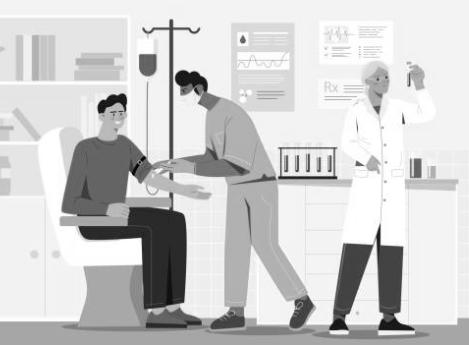
Blood group describes the type of blood a person has. It is a classification of blood based on the presence or absence of inherited antigenic substances on the surface of red blood cells. Blood types predict whether a serious reaction will occur in a blood transfusion.
In a sample of 50 people, 21 had type O blood, 22 had type A, 5 had type B and rest had type AB blood group.
- - - - INSERT IMAGE HERE - - - -Based on the above, answer the following questions:
- (i) What is the probability that a person chosen at random had type O blood?
- (ii) What is the probability that a person chosen at random had type AB blood group?
- (iii) What is the probability that a person chosen at random had neither type A nor type B blood group?
OR
(iii) What is the probability that person chosen at random had either type A or type B or type O blood group?
[4 marks]
Probability of happening of an event is denoted by p and probability of non-happening of the event is denoted by q. Relation between p and q is
[1 mark]
A girl calculates that the probability of her winning the first prize in a lottery is 0.08. If 6000 tickets are sold, how many tickets has she bought?
[1 mark]
In a group of 20 people, 5 can't swim. If one person is selected at random, then the probability that he/she can swim, is
[1 mark]
A bag contains 4 red, 3 blue and 2 yellow balls. One ball is drawn at random from the bag. Find the probability that drawn ball is
(i) red
(ii) yellow.
[2 marks]
T-shirts marked with numbers 4 to 99 are placed in a box. Gunika draws one at random. The probability that the number on the shirt is either a perfect square or a perfect cube is :
Two dice are rolled simultaneously. The probability of getting a number less than 4 on each die is :
2 cards of diamonds and 4 cards of spades are missing from a standard pack of 52 playing cards. A card is drawn at random from the remaining pack. The probability of getting a heart card is :
Two dice are thrown simultaneously. Find the probability that neither a doublet nor a sum of 10 turns up.
[2 marks]
An event is most unlikely to happen. Its probability is closest to :
Assertion (A): Two coins are tossed simultaneously. The possible outcomes are two heads, two tails, or one of each. Therefore, the probability of each outcome is $\frac{1}{3}$.
Reason (R): The probability of an event $E$ is given by $P(E) = \frac{\text{Number of favourable outcomes}}{\text{Total number of possible outcomes}}$, provided all outcomes are equally likely.
A card is drawn at random from a well-shuffled pack of 52 playing cards. Find the probability of getting :
(i) a black face card
(ii) a red jack
(iii) a spade or an ace.
[3 marks]
CASE STUDY 3
In a blood donation camp organized at a general hospital, 100 voluntary donors were tested for their blood groups. The percentage distribution of donors across the four major blood types $A, B, O$ and $AB$ is given in the chart and table below :
| Blood Group | A | B | O | AB |
|---|---|---|---|---|
| Number of Donors | 30 | 32 | x | 4 |
Based on the above information, answer the following questions :
(i) Find the value of $x$ (donors with blood group O). [1 mark]
(ii) If a donor is selected at random, find the probability that the donor has blood group AB. [1 mark]
(iii) (a) Find the probability that a randomly chosen donor does not have blood group A. [2 marks]
OR
(iii) (b) Find the probability that a randomly chosen donor is a universal donor (Blood Group O) or universal recipient (Blood Group AB). [2 marks]