
Unable to load document pages inline.
Download PDF Instead
Define both unknowns with units before forming equations. Substitution works well when a coefficient is 1; elimination is often quicker when coefficients already match.
Download this chapter’s printable notes, worksheet and answers (PDF)
Formulas and methods
- Write the equations as a₁x + b₁y + c₁ = 0 and a₂x + b₂y + c₂ = 0.
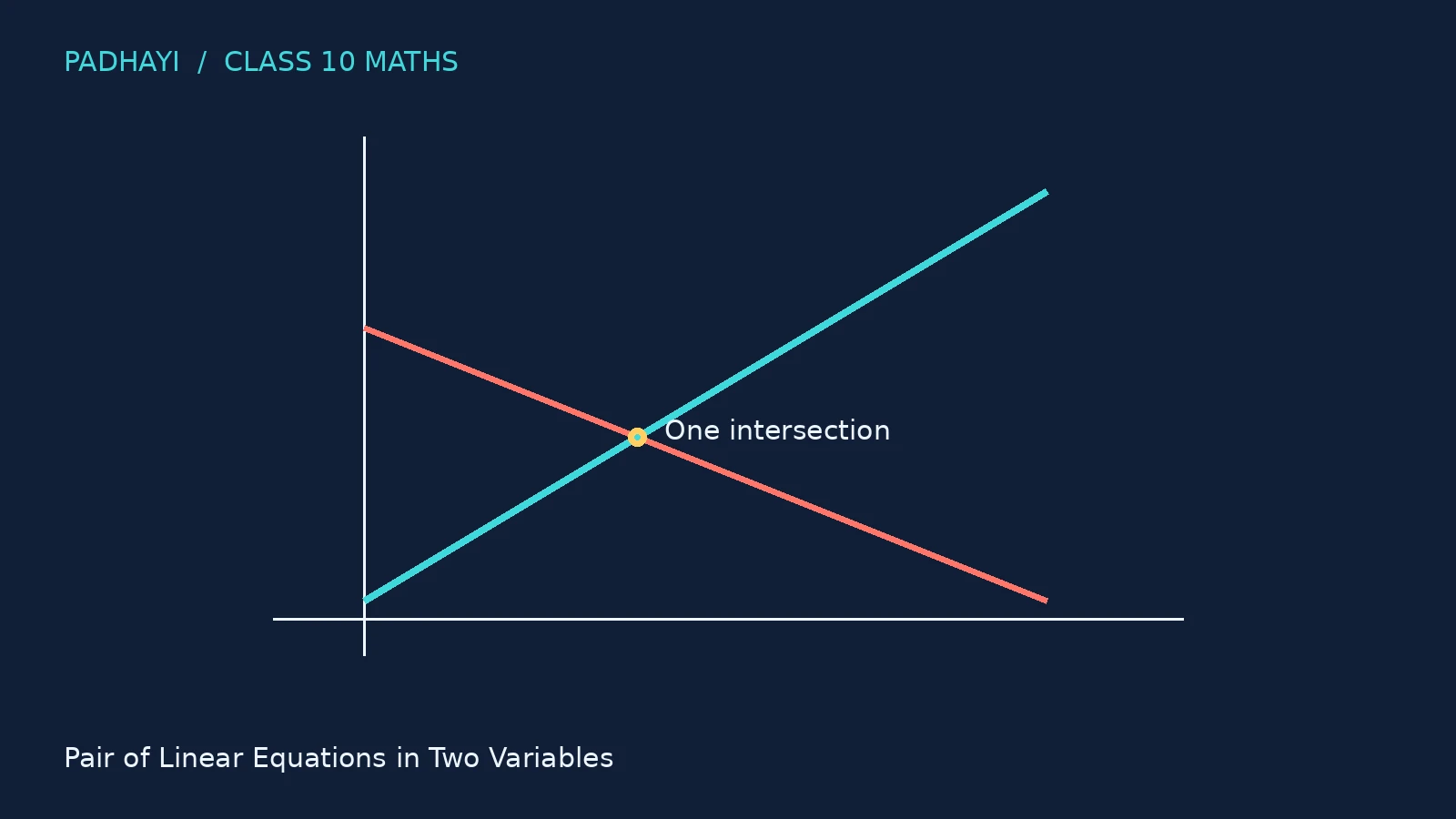
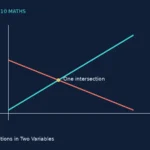
- If a₁b₂ − a₂b₁ ≠ 0, there is one solution: the lines intersect.
- For genuine lines with proportional a,b coefficients, proportional constants give coincident lines and infinitely many solutions; non-proportional constants give parallel lines and no solution. Ratio tests must not divide by zero.
Worked examples
Example 1: Solve 2x + y = 11 and x − y = 1.
Add the equations: 3x = 12, so x = 4. Substitute into x − y = 1: y = 3. Check: 2(4) + 3 = 11.
Example 2: Two notebooks and three pens cost Rs 84. One notebook and one pen cost Rs 32. Find each price.
Let notebook price be n and pen price be p. Then 2n + 3p = 84 and n + p = 32. Subtract twice the second equation from the first: p = 20. Thus n = 12. Check: 24 + 60 = 84.
Common mistake to avoid
Multiply every term, including the constant, when eliminating. A contradiction such as 0 = 5 means no solution; 0 = 0 alone does not determine unique values.
Practice worksheet
Try these before opening the answers. Show your working and include units. Difficulty labels are for this worksheet, not official CBSE categories.
- Foundation: Solve x + y = 9 and x − y = 3.
- Core: Solve 3x + 2y = 16 and x + y = 6.
- Core: Classify x + 2y = 5 and 2x + 4y = 11.
- Challenge: For which k do 2x + 3y = 7 and 4x + 6y = k have infinitely many solutions?
Show answers and reasoning
- Add: 2x = 12. Thus x = 6, y = 3.
- Subtract twice the second equation: x = 4. Then y = 2.
- Doubling the first gives 2x + 4y = 10, inconsistent with 11. Parallel lines; no solution.
- The second must be twice the first, including its constant: k = 14.
Continue your revision
- All 14 chapters in the Maths Formula & Methods collection
- Pair of Linear Equations in Two Variables NCERT solutions
- Chapterwise Maths Standard previous-year questions
Official textbooks and syllabus
This is original Padhai revision material, not an official CBSE or NCERT publication. Use it alongside your textbook.
Classes & Batches

Class 10 English Board Express: First Flight Prose, Poetry Analysis & Core Grammar Rules | Dear Sir

Class 10 Maths Full Syllabus NCERT Masterclass: Chapter-Wise Concepts, Proofs & Shortcut Tricks | Dear Sir

Class 10 SST Complete NCERT Board Course: Animated History, Civics, Geography & Economics | Digraj Sir

Class 10 Science Full Syllabus Batch 2026-27: Complete NCERT Lectures, Concept Notes & PYQs | PW Foundation
Study Resources & Notes



Quick Practice & Sets

CBSE Class 10 Science 30-Minute Rapid Chapter Mocks

CBSE Class 10 Science Chapter-wise Assertion & Reason Bank

CBSE Class 10 Maths Standard Timed Chapter Mocks

CBSE Class 10 Maths Standard NCERT Exemplar HOTS
Community Buzz

Class 10 Economics: What Per Capita Income Hides
Class 10 English Literature: Build an Evidence-Based Answer
Class 10 Refractive Index: Connect Speed and Bending of Light
Class 10 Decentralisation: Explain Why Local Government Matters

Comments (0)
No comments yet. Be the first to comment!
Please log in to comment
Log In