
Unable to load document pages inline.
Download PDF Instead
Sketch the solid and mark the joined surfaces. Volumes add for joined solids; surface areas require counting only the exposed surfaces.
Download this chapter’s printable notes, worksheet and answers (PDF)
Formulas and methods
- Cuboid: V = lbh; total surface area = 2(lb + bh + hl). Cube: V = a³; total surface area = 6a².
- Cylinder: V = πr²h; curved area = 2πrh; total area = 2πr(h+r).
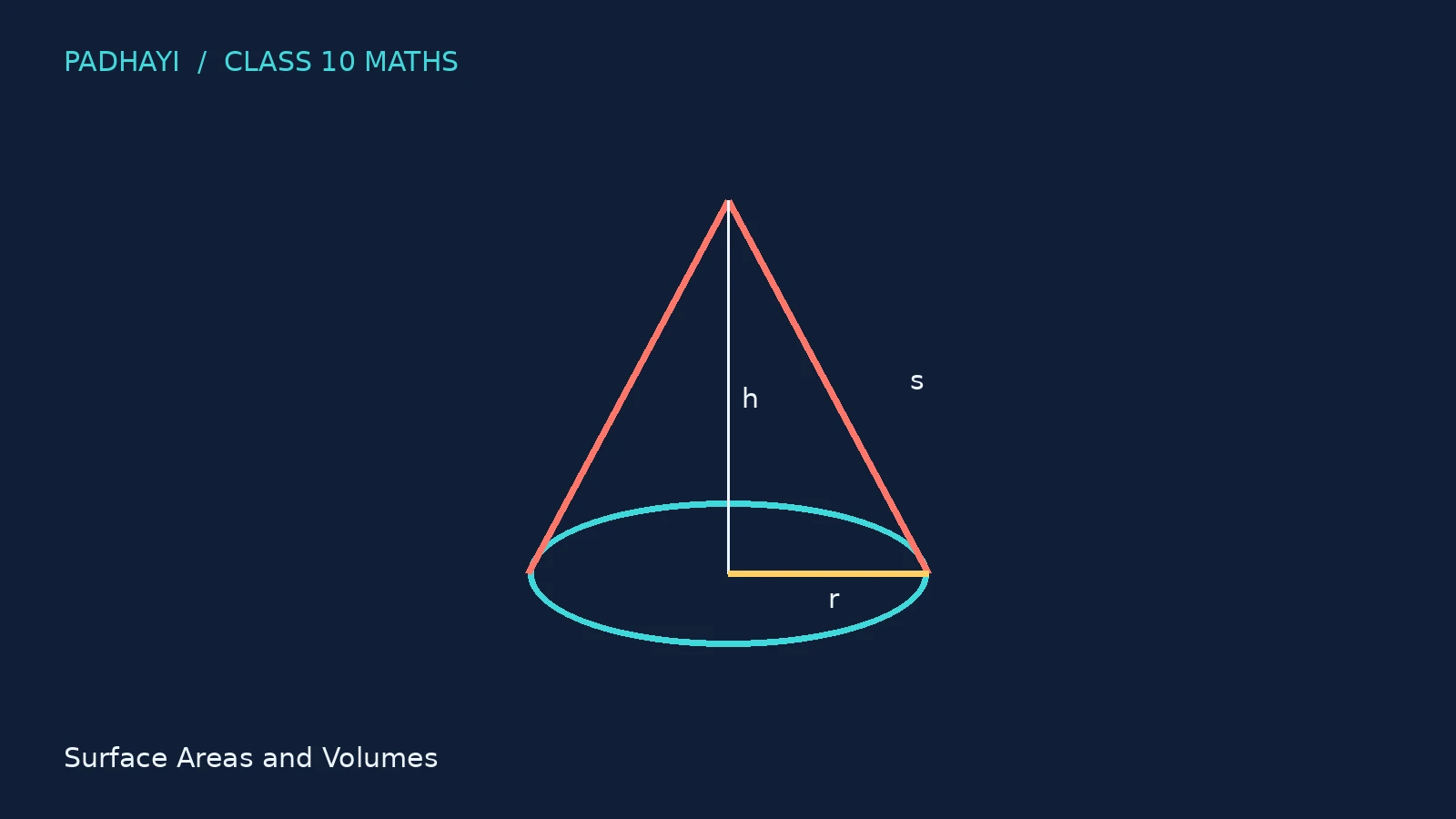
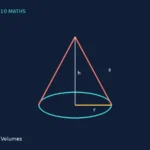
- Cone: V = πr²h/3; slant height s = √(r²+h²); curved area = πrs; total area = πr(s+r).
- Sphere: V = 4πr³/3; area = 4πr². Hemisphere: V = 2πr³/3; curved area = 2πr²; total area = 3πr².
Worked examples
Example 1: A cone has radius 3 cm and height 4 cm. Find its curved area and volume.
Slant height s = √(9+16) = 5 cm. Curved area = π×3×5 = 15π cm². Volume = π×9×4/3 = 12π cm³.
Example 2: A hemisphere of radius 3 cm sits on a cylinder of the same radius and height 7 cm. Find the exposed area, including the bottom.
Count cylinder curved area, hemisphere curved area, and cylinder bottom. Area = 2π×3×7 + 2π×9 + π×9 = 69π cm². The shared circular face is internal and is not counted.
Common mistake to avoid
Cone surface area uses slant height, but volume uses perpendicular height. Convert all lengths to one unit before calculating.
Practice worksheet
Try these before opening the answers. Show your working and include units. Difficulty labels are for this worksheet, not official CBSE categories.
- Foundation: Find the volume of a cuboid 4 cm by 5 cm by 6 cm.
- Core: Find the total surface area of a hemisphere of radius 7 cm using π = 22/7.
- Core: A cylinder has radius 2 cm and height 9 cm. Find its volume.
- Challenge: A cone of radius 3 cm and height 4 cm is joined to a hemisphere of radius 3 cm. Find the combined volume.
Show answers and reasoning
- 4×5×6 = 120 cm³.
- 3πr² = 3×(22/7)×49 = 462 cm².
- π×4×9 = 36π cm³.
- Cone volume = 12π; hemisphere volume = (2/3)π×27 = 18π. Total = 30π cm³.
Continue your revision
- All 14 chapters in the Maths Formula & Methods collection
- Surface Areas and Volumes NCERT solutions
- Chapterwise Maths Standard previous-year questions
Official textbooks and syllabus
This is original Padhai revision material, not an official CBSE or NCERT publication. Use it alongside your textbook.
Classes & Batches

Class 10 English Board Express: First Flight Prose, Poetry Analysis & Core Grammar Rules | Dear Sir

Class 10 Maths Full Syllabus NCERT Masterclass: Chapter-Wise Concepts, Proofs & Shortcut Tricks | Dear Sir

Class 10 SST Complete NCERT Board Course: Animated History, Civics, Geography & Economics | Digraj Sir

Class 10 Science Full Syllabus Batch 2026-27: Complete NCERT Lectures, Concept Notes & PYQs | PW Foundation
Study Resources & Notes


Quick Practice & Sets

CBSE Class 10 Science 30-Minute Rapid Chapter Mocks

CBSE Class 10 Science Chapter-wise Assertion & Reason Bank

CBSE Class 10 Maths Standard Timed Chapter Mocks

CBSE Class 10 Maths Standard NCERT Exemplar HOTS
Community Buzz

Class 10 Economics: What Per Capita Income Hides
Class 10 English Literature: Build an Evidence-Based Answer
Class 10 Refractive Index: Connect Speed and Bending of Light
Class 10 Decentralisation: Explain Why Local Government Matters

Comments (0)
No comments yet. Be the first to comment!
Please log in to comment
Log In