
Unable to load document pages inline.
Download PDF Instead
First move every term to one side. Try factorisation when the factors are clear; otherwise the quadratic formula works for any real coefficients with a nonzero leading coefficient.
Download this chapter’s printable notes, worksheet and answers (PDF)
Formulas and methods
- Standard form: ax² + bx + c = 0, a ≠ 0. Discriminant D = b² − 4ac.
- For D ≥ 0, x = (−b ± √D)/(2a). The whole numerator is divided by 2a.
- D > 0: two distinct real roots. D = 0: two equal real roots. D < 0: no real roots.
Worked examples
Example 1: Solve 2x² − 7x + 3 = 0.
Split the middle term: 2x² − 6x − x + 3 = (2x − 1)(x − 3). Hence x = 1/2 or 3. Both make the original expression zero.
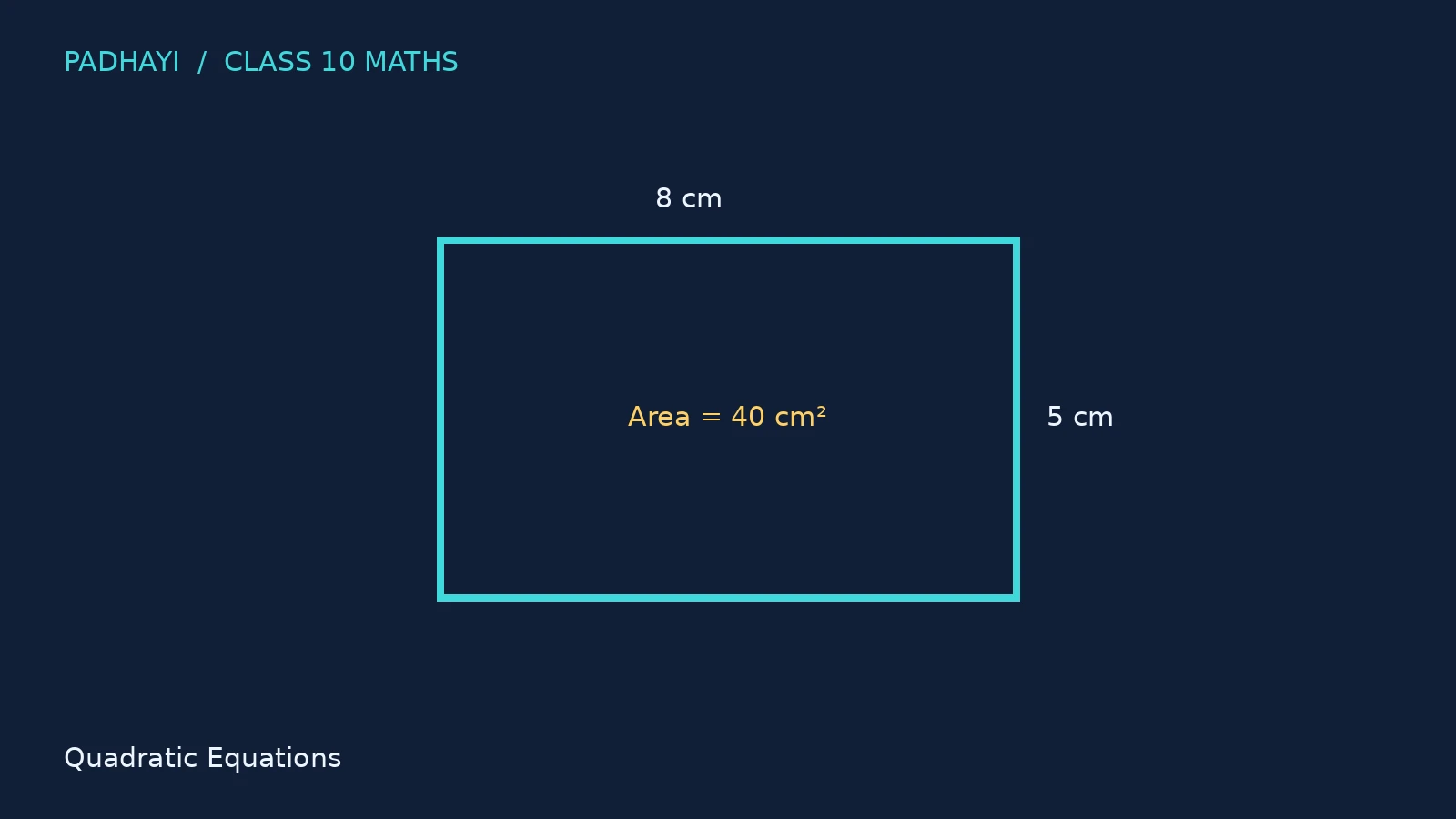
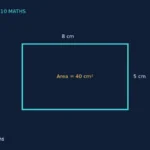
Example 2: A rectangle has width x cm, length (x + 3) cm and area 40 cm². Find its dimensions.
x(x + 3) = 40 gives x² + 3x − 40 = 0 = (x + 8)(x − 5). Roots are −8 and 5. A width must be positive, so width = 5 cm and length = 8 cm.
Common mistake to avoid
Use b with its sign. Keep both algebraic roots until the context justifies rejecting one. Negative dimensions are not valid.
Practice worksheet
Try these before opening the answers. Show your working and include units. Difficulty labels are for this worksheet, not official CBSE categories.
- Foundation: Solve x² − 5x + 6 = 0.
- Core: How many real roots does 3x² + 2x + 1 = 0 have?
- Core: Solve x² + 4x + 1 = 0.
- Challenge: Find k if x² − 6x + k = 0 has equal real roots.
Show answers and reasoning
- (x − 2)(x − 3) = 0, so x = 2 or 3.
- D = 4 − 12 = −8. No real roots.
- D = 12. x = (−4 ± √12)/2 = −2 ± √3.
- D = 36 − 4k = 0, so k = 9. The repeated root is 3.
Continue your revision
- All 14 chapters in the Maths Formula & Methods collection
- Quadratic Equations NCERT solutions
- Chapterwise Maths Standard previous-year questions
- Choosing factorisation or the quadratic formula
Official textbooks and syllabus
This is original Padhai revision material, not an official CBSE or NCERT publication. Use it alongside your textbook.
Classes & Batches

Class 10 English Board Express: First Flight Prose, Poetry Analysis & Core Grammar Rules | Dear Sir

Class 10 Maths Full Syllabus NCERT Masterclass: Chapter-Wise Concepts, Proofs & Shortcut Tricks | Dear Sir

Class 10 SST Complete NCERT Board Course: Animated History, Civics, Geography & Economics | Digraj Sir

Class 10 Science Full Syllabus Batch 2026-27: Complete NCERT Lectures, Concept Notes & PYQs | PW Foundation
Study Resources & Notes


Quick Practice & Sets

CBSE Class 10 Science 30-Minute Rapid Chapter Mocks

CBSE Class 10 Science Chapter-wise Assertion & Reason Bank

CBSE Class 10 Maths Standard Timed Chapter Mocks

CBSE Class 10 Maths Standard NCERT Exemplar HOTS
Community Buzz

Class 10 Economics: What Per Capita Income Hides
Class 10 English Literature: Build an Evidence-Based Answer
Class 10 Refractive Index: Connect Speed and Bending of Light
Class 10 Decentralisation: Explain Why Local Government Matters
Comments (0)
No comments yet. Be the first to comment!
Please log in to comment
Log In