
Unable to load document pages inline.
Download PDF Instead
Start by writing each positive integer as a product of primes. The smallest exponent shared by two numbers gives the HCF; the largest exponent present gives the LCM.
Download this chapter’s printable notes, worksheet and answers (PDF)
Formulas and methods
- Every integer greater than 1 has a prime factorisation unique apart from the order of its prime factors. The number 1 is neither prime nor composite.
- For two positive integers a and b: HCF(a,b) × LCM(a,b) = ab. This product rule is not a general rule for three integers.
- To prove irrationality, assume the number is p/q in lowest terms, square if needed, and show that p and q share a prime factor.
Worked examples
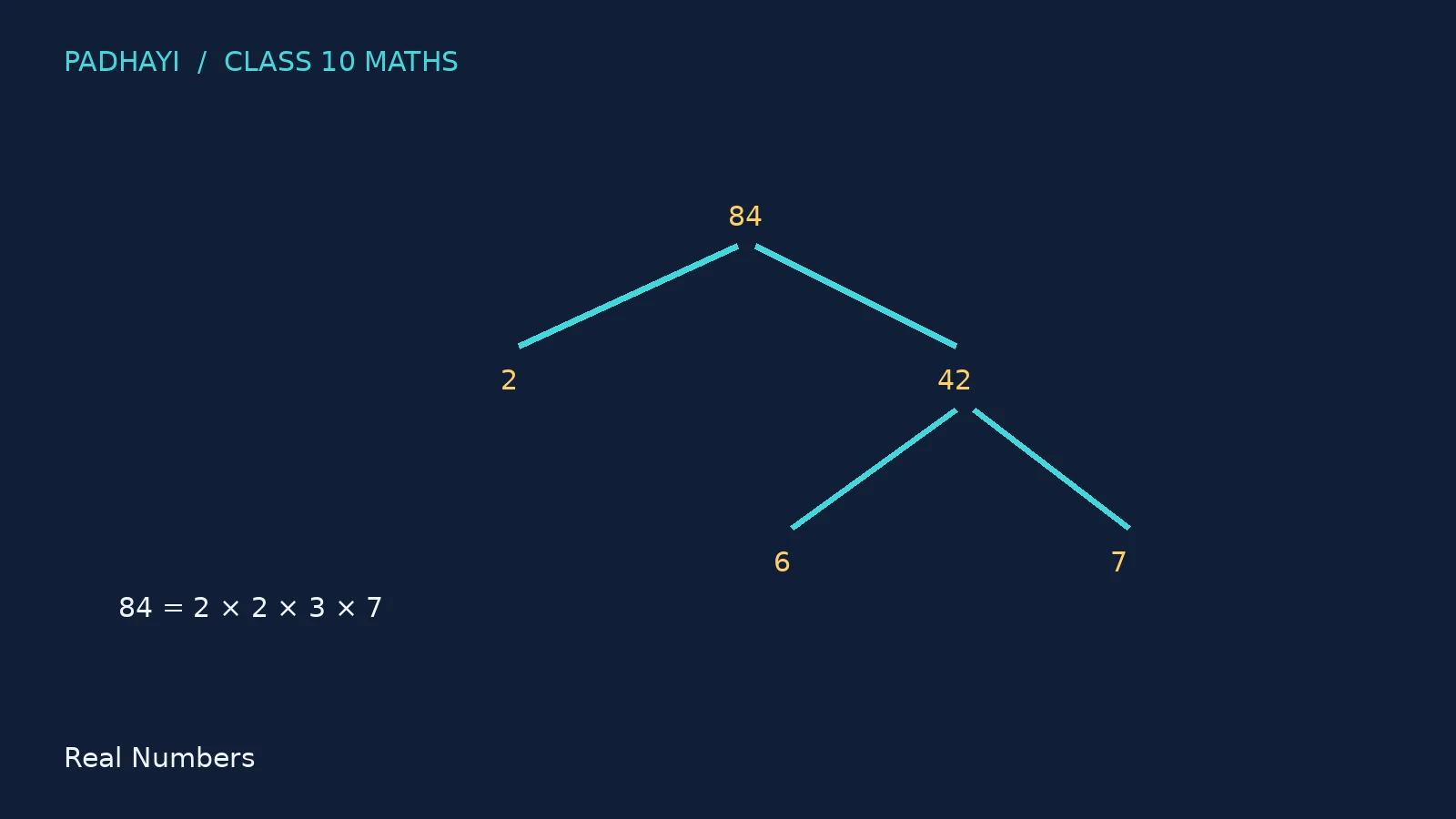
Example 1: Find the HCF and LCM of 84 and 126.
84 = 2² × 3 × 7; 126 = 2 × 3² × 7. Therefore HCF = 2 × 3 × 7 = 42 and LCM = 2² × 3² × 7 = 252. Check: 42 × 252 = 84 × 126 = 10584.
Example 2: Why is √3 irrational?
Suppose √3 = p/q, with coprime integers p,q and q ≠ 0. Then p² = 3q², so 3 divides p. Write p = 3k. This gives q² = 3k², so 3 also divides q. That contradicts coprimality; √3 is irrational.
Common mistake to avoid
Do not call every non-integer irrational: 7/4 is rational. In an irrationality proof, state that the fraction is in lowest terms.
Practice worksheet
Try these before opening the answers. Show your working and include units. Difficulty labels are for this worksheet, not official CBSE categories.
- Foundation: Find the HCF and LCM of 36 and 60.
- Core: Two positive integers have HCF 8 and product 1536. Find their LCM.
- Core: Find the greatest number that divides 96 and 144 exactly.
- Challenge: Prove that 3 + 2√5 is irrational, given that √5 is irrational.
Show answers and reasoning
- 36 = 2² × 3² and 60 = 2² × 3 × 5. HCF = 12; LCM = 180.
- LCM = 1536/8 = 192.
- HCF(96,144) = 48.
- If 3 + 2√5 = r were rational, then √5 = (r − 3)/2 would be rational, a contradiction.
Continue your revision
- All 14 chapters in the Maths Formula & Methods collection
- Real Numbers NCERT solutions
- Chapterwise Maths Standard previous-year questions
Official textbooks and syllabus
This is original Padhai revision material, not an official CBSE or NCERT publication. Use it alongside your textbook.
Classes & Batches

Class 10 English Board Express: First Flight Prose, Poetry Analysis & Core Grammar Rules | Dear Sir

Class 10 Maths Full Syllabus NCERT Masterclass: Chapter-Wise Concepts, Proofs & Shortcut Tricks | Dear Sir

Class 10 SST Complete NCERT Board Course: Animated History, Civics, Geography & Economics | Digraj Sir

Class 10 Science Full Syllabus Batch 2026-27: Complete NCERT Lectures, Concept Notes & PYQs | PW Foundation
Study Resources & Notes


Quick Practice & Sets

CBSE Class 10 Science 30-Minute Rapid Chapter Mocks

CBSE Class 10 Science Chapter-wise Assertion & Reason Bank

CBSE Class 10 Maths Standard Timed Chapter Mocks

CBSE Class 10 Maths Standard NCERT Exemplar HOTS
Community Buzz

Class 10 Economics: What Per Capita Income Hides
Class 10 English Literature: Build an Evidence-Based Answer
Class 10 Refractive Index: Connect Speed and Bending of Light
Class 10 Decentralisation: Explain Why Local Government Matters
Comments (0)
No comments yet. Be the first to comment!
Please log in to comment
Log In